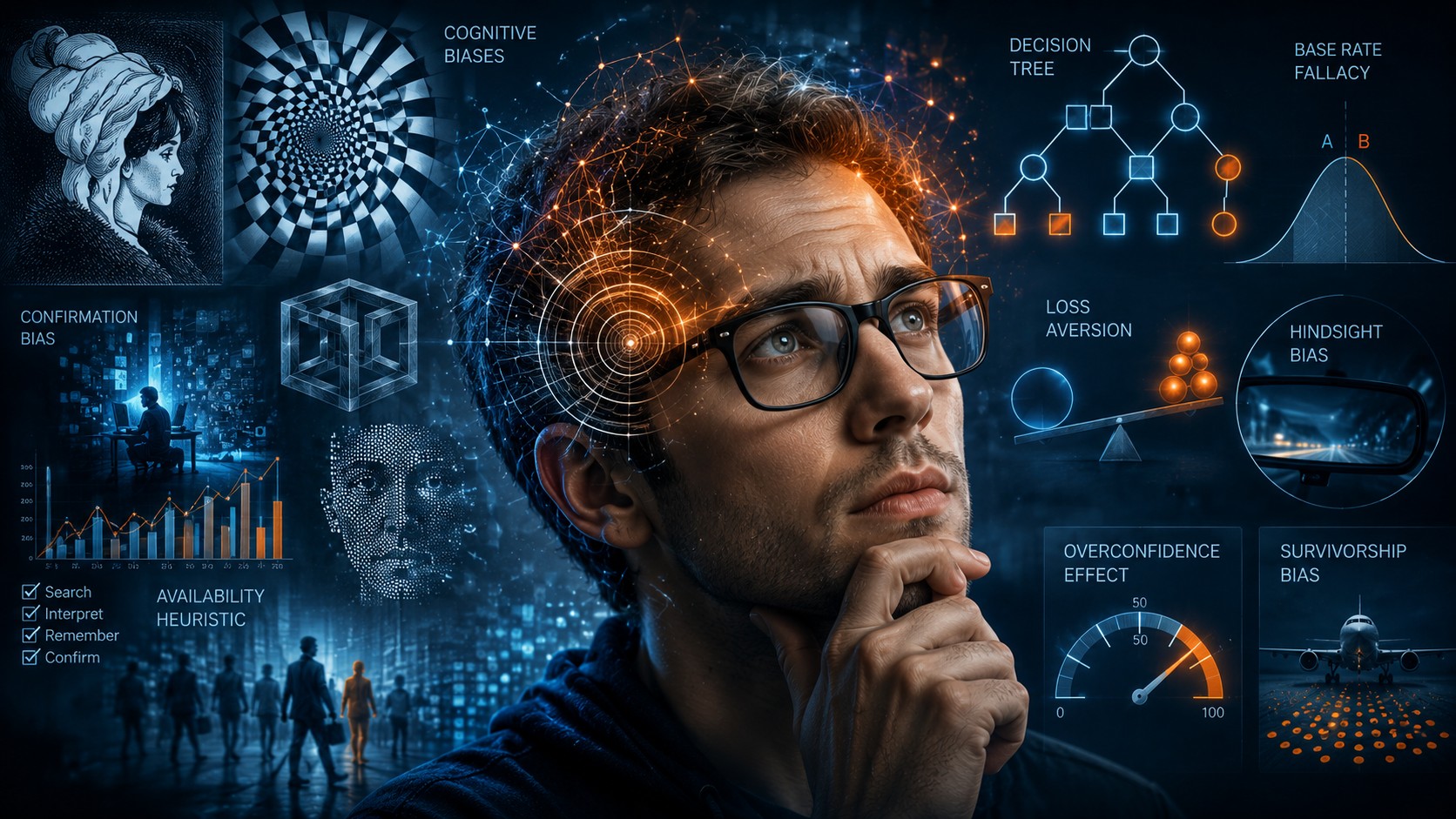
Cognitive Biases That Influence Your Decisions
Why your brain often tricks you — and what neuroscience teaches us about making better choices.
What Cognitive Biases Are and Why They Exist
Every day, you make thousands of decisions. Some are trivial, like choosing what to eat for breakfast. Others can shape your finances, relationships, career, and health for years.
Most people believe these decisions are rational. Modern neuroscience tells a different story.
Your brain is an extraordinary prediction machine, but it is also full of shortcuts — mental heuristics that evolved to save time and energy. These shortcuts are incredibly useful, yet they can systematically lead us astray. Psychologists call these errors cognitive biases.
Understanding these biases doesn't make you immune to them. Even Nobel Prize winners, judges, doctors, and professional investors fall victim to them every day. The good news? Once you recognize these hidden traps, you can dramatically improve your decision-making.
What Is a Cognitive Bias?
A cognitive bias is a predictable pattern of thinking that deviates from objective reasoning. Instead of carefully analyzing every piece of information, your brain often relies on quick rules of thumb. In many situations, this is adaptive — it allows rapid decisions with limited mental effort. But these shortcuts can also distort reality.
For example:
- You may overestimate your abilities.
- You may ignore evidence that contradicts your beliefs.
- You may remember failures differently than successes.
- You may follow a crowd despite knowing better.
Far from being signs of low intelligence, these biases are deeply rooted in normal human cognition.
Why Did Evolution Leave Us With Biases?
Our ancestors rarely needed perfect reasoning. They needed fast reasoning.
Imagine hearing rustling in the bushes:
- Assuming it was a predator — even when it wasn't — could save your life.
- Spending minutes calculating probabilities could get you eaten.
Evolution therefore favored brains that were efficient rather than perfectly logical. In today's world, however, these ancient mechanisms influence decisions about investing, politics, nutrition, education, technology, and relationships. The environments have changed. Our brains haven't.
Your Brain Is a Prediction Engine
Rather than passively recording reality, the brain constantly predicts what will happen next. Incoming sensory information is compared with prior expectations, memories, and beliefs.
This predictive architecture makes perception incredibly efficient but also vulnerable to systematic errors. We often don't see the world as it is. We see the world as our brain expects it to be.
The Fast Brain vs. The Slow Brain
Psychologists often distinguish between two modes of thinking:
System 1
- Automatic
- Fast
- Emotional
- Intuitive
- Requires little effort
System 2
- Deliberate
- Analytical
- Slow
- Logical
- Energy intensive
Most cognitive biases arise because System 1 generates an immediate answer that System 2 fails to adequately question. Learning to deliberately activate slower thinking is one of the simplest ways to reduce costly mistakes.
Bias #1: Confirmation Bias
Humans naturally seek information that confirms what they already believe. We unconsciously:
- Read articles supporting our opinions.
- Follow like-minded social media accounts.
- Remember evidence that agrees with us.
- Dismiss contradictory facts.
Confirmation bias can affect investing, politics, medicine, relationships, and scientific research. Ironically, the smarter someone is, the better they often become at defending incorrect beliefs.
How to fight it
- Actively search for opposing evidence.
- Ask: "What would convince me that I'm wrong?"
- Debate people who disagree respectfully.
- Write down predictions before outcomes occur.
Bias #2: Availability Bias
Events that are easy to remember feel more common than they actually are.
After watching several airplane crash videos, flying may suddenly feel extremely dangerous — even though driving remains statistically riskier. Similarly, sensational news stories distort our perception of crime, disease, or rare events.
Your memory is not a perfect database. It prioritizes emotionally vivid experiences.
Bias #3: Anchoring
The first number or piece of information you encounter strongly influences later judgments. For example:
- A $2,000 television discounted to $1,200 feels like a bargain.
- Salary negotiations often revolve around whoever states the first figure.
- Restaurants strategically place expensive menu items first to influence perception.
Retailers use anchoring constantly. Knowing this doesn't completely eliminate its effects.
The Role of Attention
Many biases become stronger when we are:
- Sleep deprived
- Distracted
- Emotionally stressed
- Multitasking
- Under time pressure
This is one reason why improving attention and cognitive control can indirectly improve decision quality.
If you're interested in strengthening concentration, check out 👉The Complete Guide to Focus and learn how sustained attention supports better reasoning. Likewise, understanding the brain's architecture in 👉The Complete Guide to the Human Brain provides valuable context for many of the mechanisms discussed here.
Key Takeaways — Part 1
- Cognitive biases are normal features of human cognition.
- They arise from mental shortcuts that evolved for speed rather than accuracy.
- Understanding these biases helps improve judgment without eliminating intuition.
- Better sleep, attention, and deliberate reflection reduce many common thinking errors.
Beyond the Obvious: Biases You Encounter Every Day
Some cognitive biases are easy to recognize once you know their names. Others quietly shape your decisions without you ever noticing. In this section, we'll explore some of the most influential biases affecting your confidence, memory, finances, relationships, and even your perception of reality.
Bias #4: The Dunning–Kruger Effect
One of the most famous findings in psychology is that people with limited knowledge in a domain often overestimate their competence, while genuine experts tend to be more aware of their own limitations.
This happens because evaluating your own skill requires many of the same abilities needed to perform the task itself.
In practice:
- Beginners may feel extremely confident after learning the basics.
- Experts often say, "It's more complicated than it seems."
- People who know the least are sometimes the most certain.
This bias explains why confidence should never be mistaken for competence.
How to reduce its impact
- Seek objective feedback.
- Regularly test your knowledge.
- Welcome correction instead of avoiding it.
- Continue learning even after early success.
Bias #5: Overconfidence Bias
Closely related to the Dunning–Kruger effect, overconfidence bias affects people at every level of expertise.
Humans consistently overestimate:
- Their driving ability.
- Their investment skills.
- Their memory.
- Their predictions about future events.
- Their resistance to manipulation.
Ironically, being aware of this bias does not automatically protect you from it.
Many professional investors and entrepreneurs keep written decision journals precisely because memory tends to rewrite history in their favor.
Bias #6: Hindsight Bias
After an event occurs, people often believe they "knew it all along." Examples include:
- "I knew that stock was going to crash."
- "It was obvious who would win the election."
- "Anyone could have predicted that outcome."
But before the event happened, uncertainty was usually much higher. Hindsight bias creates the illusion that the world is more predictable than it really is, encouraging excessive confidence in future decisions.
Keeping written predictions before outcomes occur is one of the best ways to counteract this effect.
Bias #7: Loss Aversion
Research suggests that losing $100 typically feels more painful than gaining $100 feels pleasurable. This asymmetry influences countless decisions:
- Investors hold losing positions too long.
- People avoid necessary changes.
- Consumers reject beneficial opportunities because they focus on possible losses.
Our brains evolved to prioritize avoiding danger over seeking gains. While adaptive in prehistoric environments, this tendency can prevent rational long-term decision-making.
Bias #8: The Sunk Cost Fallacy
Imagine you've watched 90 minutes of a terrible movie. Should you keep watching simply because you've already invested your time? Many people do.
Similarly:
- Businesses continue failing projects.
- Students remain in unsuitable academic programs.
- Investors refuse to sell declining assets.
- Relationships continue despite obvious incompatibility.
Past investments cannot be recovered. Only future costs and benefits should influence your current decision.
Bias #9: Framing Effect
The way information is presented can dramatically change decisions, even when the underlying facts remain identical. For example:
- "90% survival rate"
- "10% mortality rate"
Both statements describe exactly the same situation, yet they often produce different emotional reactions. Advertisers, politicians, negotiators, and marketers routinely exploit framing effects. Whenever possible, try to restate problems using neutral language before deciding.
Bias #10: Social Proof
Humans naturally look to others for guidance, especially under uncertainty. This explains why:
- Popular restaurants attract even more customers.
- Viral posts gain additional engagement.
- Long review lists influence purchases.
- Crowds can spread both wisdom and misinformation.
Following the majority is often efficient — but not always correct. Critical thinking sometimes means resisting the crowd.
Bias #11: Authority Bias
People tend to assign excessive credibility to statements made by perceived authority figures. A claim may appear more convincing simply because it comes from:
- A doctor.
- A celebrity.
- A CEO.
- A professor.
- A social media influencer.
Expert opinion deserves respect, but evidence should always remain the ultimate standard.
How Stress Amplifies Cognitive Biases
Stress shifts the brain toward faster, more automatic processing. Under pressure, people rely more heavily on heuristics and emotional responses while engaging less analytical reasoning. Sleep deprivation has similar effects.
This is why high-quality sleep, effective stress management, and sustained attention are essential not only for productivity but also for sound judgment.
For a deeper exploration, read:
Train Your Brain to Think Better
Completely eliminating cognitive biases is impossible. However, you can significantly reduce their influence by adopting simple habits:
- Slow down important decisions.
- Seek disconfirming evidence.
- Write predictions before outcomes.
- Discuss ideas with people who disagree.
- Review past mistakes honestly.
- Base conclusions on data rather than intuition alone.
These habits strengthen metacognition — the ability to think about your own thinking.
Cognitive Biases in the Real World
It's easy to think of cognitive biases as fascinating psychological curiosities. In reality, they influence nearly every important decision you make. From choosing a career to voting in elections, from diagnosing diseases to investing retirement savings, these invisible mental shortcuts shape outcomes with remarkable consistency.
The goal is not to become perfectly rational — that's impossible. The goal is to recognize when your brain may be misleading you and create systems that lead to better decisions.
Investing: Where Biases Can Become Expensive
Financial markets are fertile ground for cognitive biases.
Herd Mentality
When everyone seems to be buying a particular stock or cryptocurrency, many investors feel compelled to join the crowd. Unfortunately, by the time an investment becomes universally popular, much of its growth may already have occurred.
Recency Bias
People often assume that recent trends will continue indefinitely. After several years of rising markets, investors become overly optimistic. After crashes, they may become excessively pessimistic.
Confirmation Bias
Investors frequently search only for information supporting their existing positions while ignoring warning signs. Successful long-term investing often requires actively looking for reasons not to buy an asset.
Medical Decisions and Health
Patients and healthcare professionals are not immune to bias. For example:
- Availability bias may cause rare diseases receiving extensive media attention to seem more common than they are.
- Anchoring can lead clinicians to stick with an initial diagnosis despite conflicting evidence.
- Authority bias may discourage patients from asking important questions.
Seeking second opinions and carefully reviewing evidence can improve medical decision-making.
Social Media: A Bias Amplifier
Modern recommendation algorithms are excellent at reinforcing existing beliefs. By repeatedly showing users content similar to what they've already engaged with, platforms can unintentionally strengthen:
- Confirmation bias
- Availability bias
- Group polarization
- False consensus effects
Over time, this can create the impression that "everyone agrees" when exposure has simply become narrower.
Artificial Intelligence and Human Bias
AI systems process enormous amounts of data, but they can also inherit biases present in that data.
At the same time, AI can help humans compensate for certain cognitive limitations by:
- Identifying statistical patterns.
- Reducing emotional reactions.
- Standardizing repetitive decisions.
- Highlighting overlooked information.
The best outcomes often come from collaboration between human judgment and computational analysis rather than relying exclusively on either.
Why Smart People Still Fall for Biases
Intelligence does not eliminate cognitive biases. In fact, highly intelligent individuals are often exceptionally skilled at constructing convincing explanations for beliefs they formed intuitively.
Education helps, but intellectual humility may be even more valuable. One of the wisest habits is simply becoming comfortable saying: "I might be wrong."
Practical Strategies to Make Better Decisions
While no technique is perfect, the following practices can dramatically improve judgment over time.
1. Slow Down High-Stakes Decisions
Avoid making major financial, professional, or personal choices under time pressure whenever possible.
2. Seek Disconfirming Evidence
Before committing to an opinion, deliberately ask: "What evidence would prove me wrong?"
3. Use Written Checklists
Pilots and surgeons rely on checklists because memory and intuition are imperfect. The same principle applies to investing, hiring, studying, and strategic planning.
4. Think in Probabilities
Instead of asking "Will this happen?" ask "How likely is this outcome compared with the alternatives?" Probabilistic thinking reduces black-and-white reasoning.
5. Learn From Your Mistakes
Keep a decision journal recording:
- Your prediction.
- Your reasoning.
- Your confidence level.
- The eventual outcome.
Reviewing past decisions is one of the fastest ways to improve calibration.
Metacognition: Thinking About Thinking
Perhaps the single most valuable cognitive skill is metacognition — the ability to observe and evaluate your own thought processes.
People with strong metacognitive skills tend to:
- Recognize uncertainty.
- Detect errors more quickly.
- Adjust beliefs when presented with new evidence.
- Continue learning throughout life.
Metacognition doesn't eliminate biases, but it makes them easier to detect before they lead to costly mistakes.
Can You Train Yourself to Be Less Biased?
Research suggests that while individual biases are difficult to eliminate entirely, structured habits can reduce their impact. Helpful practices include:
- Regular critical thinking exercises.
- Exposure to diverse viewpoints.
- Statistical literacy.
- Mindfulness and emotional regulation.
- Adequate sleep and stress management.
- Continuous learning and curiosity.
The objective isn't perfection — it's making slightly better decisions consistently over many years. Those small improvements compound.
Brain Geek Tool Spotlight
Want to strengthen the foundations of better thinking? Explore these free tools on Brain Geek:
Improving brain health won't eliminate biases, but it can enhance attention, self-control, and reflective thinking — all of which help counter automatic mental shortcuts.
Related Brain Geek Articles
To deepen your understanding of the brain and decision-making, continue with these cornerstone guides:
👉The Complete Guide to the Human Brain — Discover how the brain's architecture shapes thought and behavior.
👉The Complete Guide to Focus — Learn how attention influences reasoning and productivity.
👉The Complete Guide to Sleep — Understand why sleep deprivation increases errors in judgment and emotional decision-making.
👉The Complete Guide to Memory — Explore how memory distortions interact with cognitive biases.
👉The Four Major Neurotransmitters (coming soon) — Learn how dopamine, serotonin, norepinephrine, and acetylcholine influence motivation and learning.
👉The Science of Deep Work (coming soon) — Discover why uninterrupted concentration leads to better thinking.
Frequently Asked Questions
What is a cognitive bias?
A cognitive bias is a predictable pattern of thinking that deviates from objective reasoning — a mental shortcut the brain uses to make decisions quickly with limited information.
Can you eliminate cognitive biases?
No. Biases are built into normal human cognition. But you can significantly reduce their influence through awareness, slower deliberate thinking, written decision journals and seeking disconfirming evidence.
Are intelligent people less biased?
Not really. High intelligence often makes people better at constructing convincing arguments for beliefs they formed intuitively. Intellectual humility matters more than raw IQ.
Does sleep affect decision-making?
Yes. Sleep deprivation and stress both push the brain toward fast, automatic processing — amplifying nearly every cognitive bias. Healthy sleep is one of the most underrated cognitive interventions.
What's the single most important habit for better decisions?
Keeping a written decision journal. Recording predictions, reasoning and confidence levels before outcomes occur is the fastest way to improve calibration and counter hindsight bias.
Final Thoughts
Your brain is one of nature's most extraordinary creations — but it is not an objective machine. It evolved to survive, not to reason perfectly.
The same shortcuts that helped our ancestors react quickly to danger can now influence investments, relationships, political opinions, purchases, and everyday judgments in subtle but powerful ways.
Recognizing cognitive biases is therefore one of the most valuable skills you can develop. It encourages intellectual humility, improves critical thinking, and helps you make decisions based on evidence rather than instinct alone.
The goal is not to eliminate intuition, but to know when intuition deserves a second look.
And perhaps the most important question you can ask yourself before making any major decision is simply:
"What if my brain is fooling me right now?"