Learning & Memory is the Brain Topic that turns neuroscience into something you can actually use this week. It covers how the brain encodes information, where memories live, why they fade, and the small set of evidence-based techniques — spaced repetition, active recall, interleaving, deliberate practice — that consistently outperform the way most people study. If you only read one Brain Geek hub for a practical payoff, this is the one.
How human memory really works
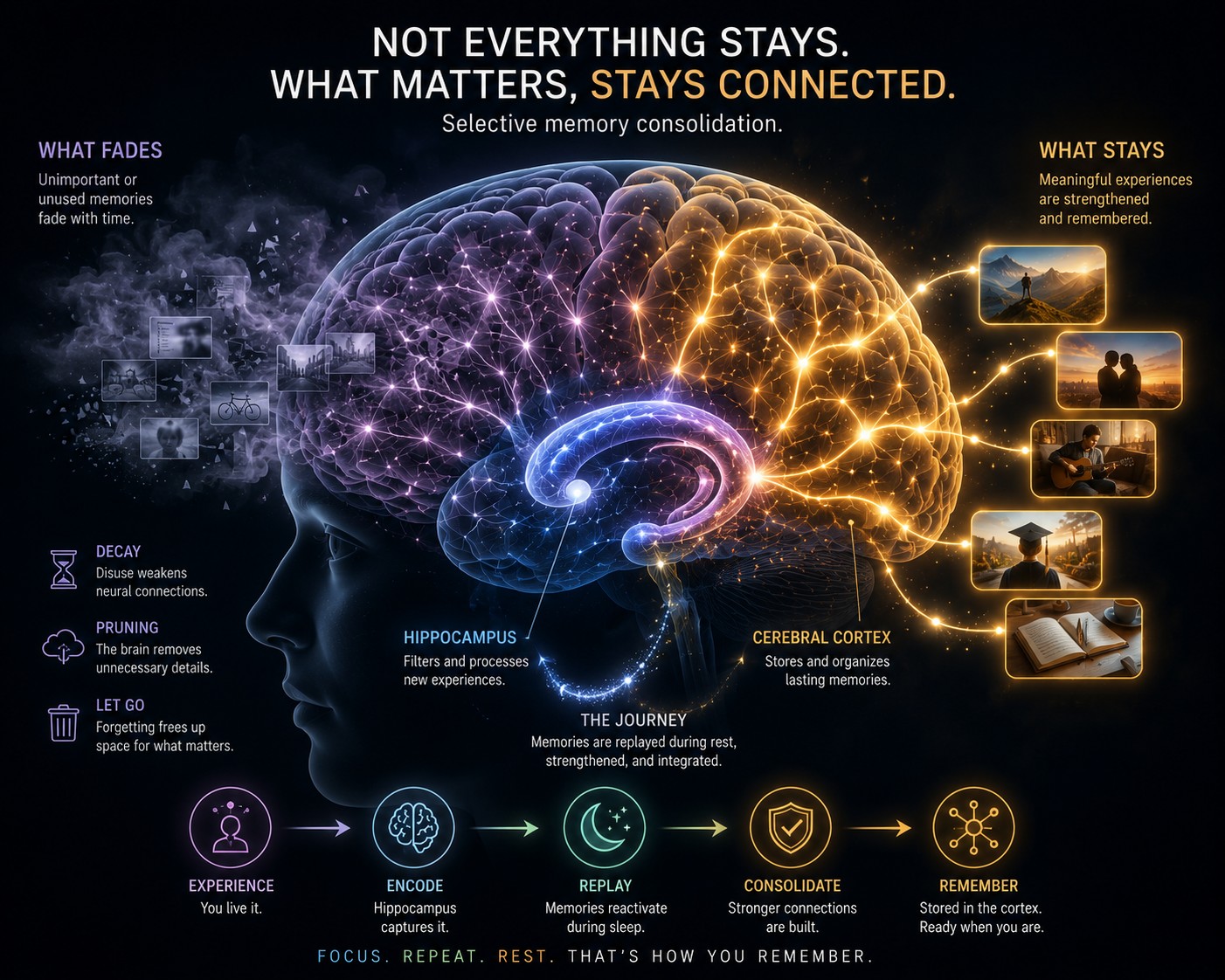
Memory is not one system. Working memory, the temporary scratchpad in your prefrontal cortex, holds a handful of items for seconds. Long-term memory is split between declarative memory (facts and events, stored with help from the hippocampus) and procedural memory (skills, anchored in the basal ganglia and cerebellum). Every new memory is fragile at first, then gradually consolidated — much of that work happens while you sleep, which is why our Sleep & Recovery hub keeps coming up in this section.
Why we forget
Forgetting is not a bug; it is a feature. Hermann Ebbinghaus's famous forgetting curve showed that without retrieval, most newly learned material is gone within days. Our pillar article Why We Forget and How to Remember More walks through the science of decay, interference and motivated forgetting, and what the research recommends instead.
Techniques that actually work
Spaced repetition
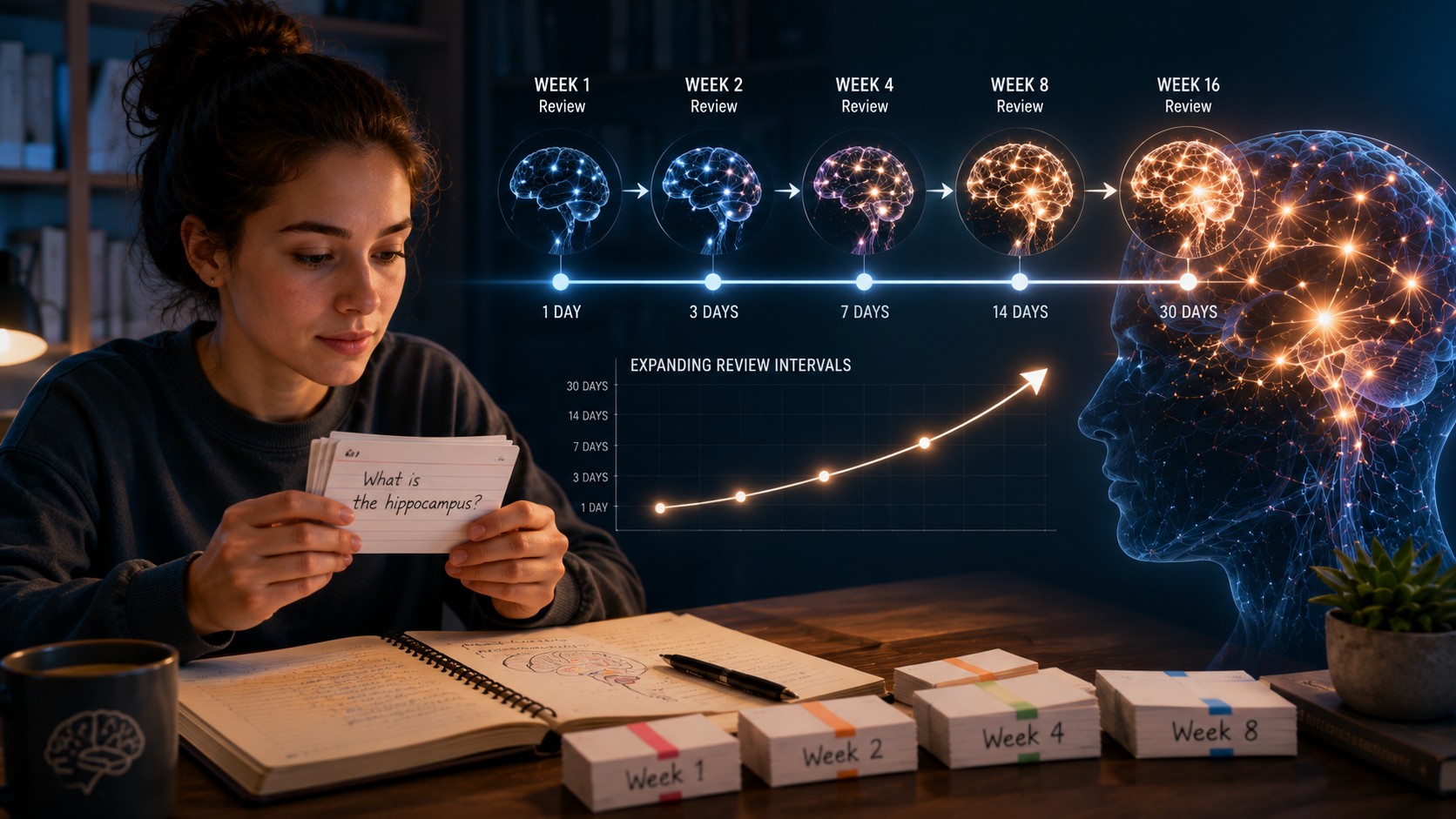
Reviewing material at expanding intervals — one day, three days, a week, a month — beats cramming on almost every measurable outcome. We explain the mechanism and how to apply it in The Complete Guide to Spaced Repetition.
Active recall
Pulling information out of your head is far more effective than re-reading it. Flashcards, self-testing and "blank-page" recall sessions force retrieval and strengthen the synaptic traces involved.
Deliberate practice
For skills rather than facts, the gold standard is deliberate practice — short, focused sessions at the edge of your current ability, with feedback. Our pillar The Science of Deliberate Practice unpacks Anders Ericsson's research and translates it into a usable framework.
The lifestyle multipliers
You cannot out-study a brain that is exhausted, undernourished or chronically stressed. Quality sleep consolidates memory; aerobic exercise increases BDNF and improves hippocampal volume (see Exercise and Cognitive Performance); reducing chronic stress preserves the very structures memory depends on. Brain Geek's Learning & Memory section keeps coming back to this: technique matters, but it multiplies with biology.
Tools and companions
To benchmark your own memory, try the Working Memory Assessment. For a paper-first study workflow, the lined and graph notebooks in the Brain Geek Shop — including the Euler and Newton editions — are built around the idea that handwriting itself encodes information more deeply than typing. And for inspiration, the Great Brains section shows how the most prolific learners in history structured their own minds.