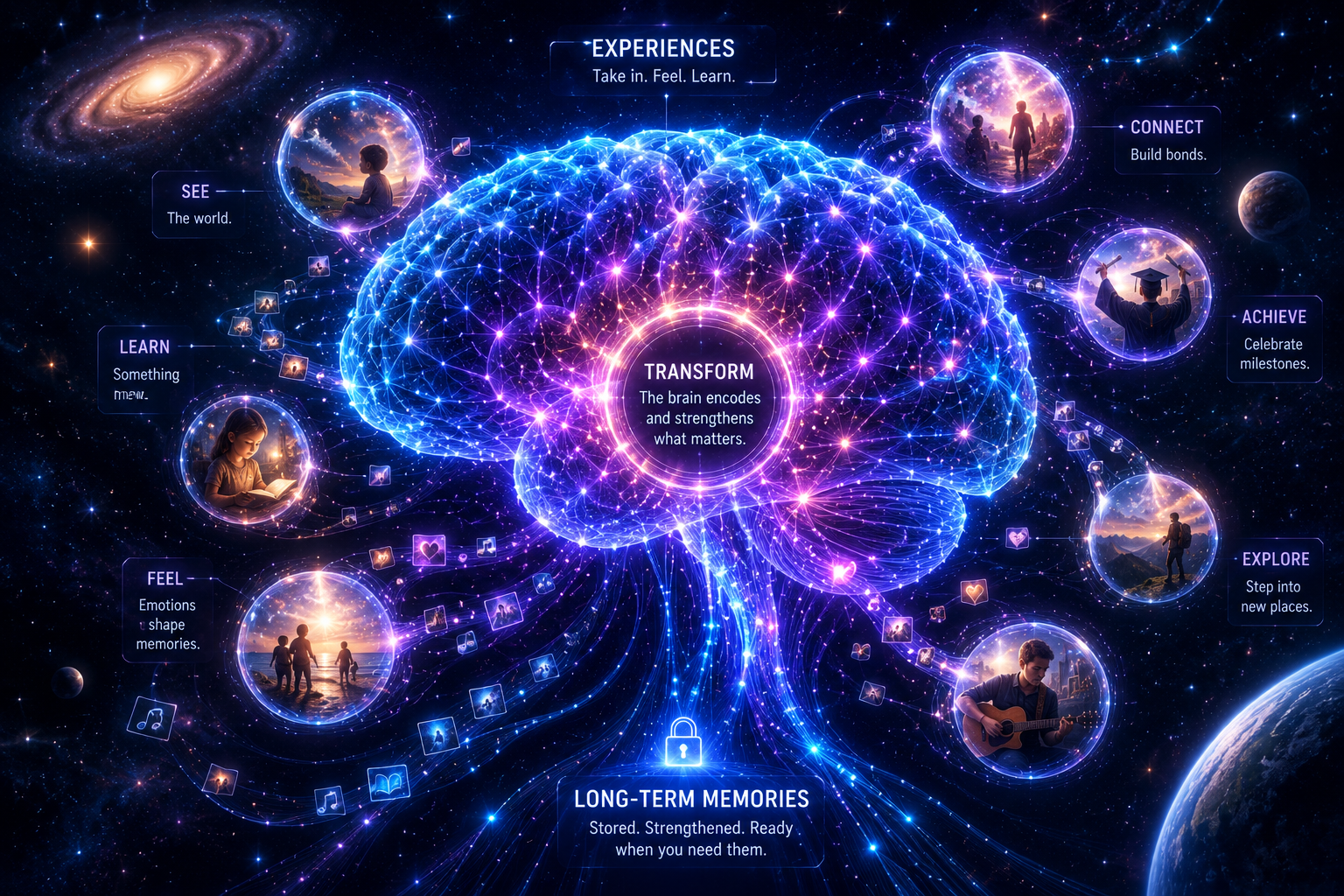
The Complete Guide to Memory
How Your Brain Stores Knowledge, Shapes Identity, and Builds Intelligence.
Introduction
Memory is one of the most extraordinary abilities in the natural world.
Every skill you possess, every fact you know, every face you recognize, and every experience that has shaped your life depends on memory. Without memory, there would be no learning. Without learning, there would be no expertise. Without expertise, there would be no civilization.
Memory is not simply a mental filing cabinet. It is the foundation of intelligence itself.
Every moment of your life is constantly being filtered, encoded, stored, modified, and reconstructed by your brain. In this guide, you will discover:
- How memory actually works
- The different types of memory
- Why some memories last forever while others disappear
- The brain structures involved in memory formation
- How to improve memory using neuroscience-backed techniques
- The biggest myths about memory
Why Memory Matters More Than You Think
Most people think memory is simply about remembering information. In reality, memory influences almost every aspect of human life.
Memory helps you:
- Learn new skills
- Build relationships
- Develop expertise
- Make decisions
- Predict future outcomes
- Navigate your environment
- Maintain a sense of identity
When memory functions properly, we rarely notice it. When it fails, its importance becomes obvious immediately. Forgetting a friend's name is embarrassing. Forgetting an important appointment can be costly. Losing the ability to create new memories can completely transform a person's life.
Memory and Identity
Imagine waking up tomorrow with no memory of your family, your education, your friends, or your life experiences. Would you still be the same person?
This question has fascinated philosophers, neuroscientists, and psychologists for centuries. While our biology contributes to who we are, much of our identity comes from accumulated memories.
Our memories shape:
- Our beliefs
- Our preferences
- Our fears
- Our ambitions
- Our personalities
Memory is the thread connecting every version of ourselves across time.
What Is Memory?
Scientists define memory as the process by which information is encoded, stored, and later retrieved.
This definition reveals the three fundamental stages of memory:
- Encoding — taking in information
- Storage — holding information over time
- Retrieval — bringing information back
Every memory you possess has passed through these stages.
Stage 1: Encoding
Before information can become a memory, it must first be encoded. Encoding is the process of transforming experience into a form that the brain can store.
Attention plays a critical role. If something never captures your attention, it is unlikely to become a lasting memory.
This is why you may remember a surprising conversation from years ago while forgetting what someone said five minutes ago. The brain prioritizes information that is:
- Emotional
- Novel
- Meaningful
- Relevant
- Repeated
Stories are easier to remember than isolated facts because they provide meaning. The brain is constantly asking: "Is this worth remembering?"
Stage 2: Storage
Once information has been encoded, it must be stored. Storage refers to the preservation of information over time. Some memories last seconds. Others survive for decades.
Unlike a computer, the brain does not store memories in a single location. Memories are distributed across vast networks of neurons.
Every time you learn something new, your brain physically changes. Neurons strengthen their connections. New pathways form. Old pathways weaken. This process is known as neuroplasticity.
Discover how the brain rewires itself throughout life.
Stage 3: Retrieval
Retrieval is the process of accessing stored information. Every time you remember a fact, recognize a face, or recall an experience, retrieval occurs.
Retrieval is not passive. In fact, retrieval strengthens memory. This explains why testing yourself is more effective than simply rereading information. Each successful recall strengthens neural pathways. The brain learns by remembering.
The Different Types of Memory
Memory is not a single system. Instead, it is a collection of specialized systems working together. Understanding these systems helps explain why you can forget a person's name while still remembering how to ride a bicycle.
Sensory Memory
Sensory memory is the shortest form of memory. It briefly stores information arriving through the senses. Visual information may remain available for less than a second. Auditory information can last several seconds. Without sensory memory, reality would feel fragmented and unstable.
Working Memory
Working memory is often called the brain's mental workspace. It allows us to temporarily hold and manipulate information. Examples include:
- Solving math problems
- Following instructions
- Reading complex paragraphs
- Holding a phone number before dialing
Many cognitive scientists consider working memory one of the most important predictors of academic success.
Short-Term Memory
Short-term memory stores information for a limited period of time. Researchers once believed humans could hold seven items simultaneously. Modern research suggests the true number is often closer to four.
Long-Term Memory
Long-term memory is the brain's vast archive. It stores facts, skills, habits, experiences, language and knowledge. Its capacity appears remarkably large. Some memories remain accessible for an entire lifetime.
Episodic Memory
Episodic memory stores personal experiences — places, times, events, emotions. Your first day at school, your wedding, a memorable vacation. Scientists sometimes refer to episodic memory as "mental time travel."
Semantic Memory
Semantic memory contains facts and knowledge. Unlike episodic memory, it is not tied to a specific event. You may know that Paris is the capital of France without remembering when you learned it. Semantic memory forms the foundation of education and expertise.
Procedural Memory
Procedural memory stores skills and habits — riding a bicycle, typing, playing a musical instrument, swimming, driving. Once learned, these skills often become automatic. This is why people say: "It's like riding a bike."
The Hippocampus: The Memory Architect
No structure is more closely associated with memory than the hippocampus. Located deep inside the temporal lobes, the hippocampus plays a crucial role in forming new memories.
Think of it as a temporary processing center. Information arrives. The hippocampus organizes it. Then the memory is gradually distributed across the cortex for long-term storage. Without the hippocampus, creating new long-term memories becomes extremely difficult.
The Famous Case of H.M.
One of the most important discoveries in memory research came from a patient known as H.M. After surgery removed parts of his hippocampus, H.M. lost the ability to form new long-term episodic memories. He could remember much of his past. He could still learn certain skills. But he could not reliably create new personal memories.
This case transformed neuroscience. It demonstrated that memory is not a single system but multiple systems working together.
How Memories Are Formed
Every memory begins with attention. The brain receives enormous amounts of information every second. Most of it is discarded. A small portion receives attention.
This information is encoded and processed. The hippocampus begins organizing the experience. Over time, repeated activation strengthens neural pathways. This process is known as consolidation. Eventually, the memory becomes more stable and easier to retrieve.
Why Sleep Builds Memory
One of the most important discoveries of modern neuroscience is that memory formation continues while we sleep. Sleep is not passive. It is an active period of neural processing.
During sleep:
- The brain replays experiences
- Neural pathways are strengthened
- Important memories are consolidated
- Irrelevant information is discarded
This is one reason why students who sleep well often learn more effectively than those who stay awake studying all night. Sleep is not the enemy of learning. Sleep is part of learning.
Why Emotions Create Powerful Memories
Have you noticed that emotional events are easier to remember? This is not an accident. The amygdala, a brain structure involved in emotional processing, interacts closely with memory systems.
Emotion acts as a signal: "This is important. Remember this." This explains why people often vividly remember weddings, births, accidents, major life events and emotional conversations. The stronger the emotion, the stronger the potential memory.
Why We Forget
Forgetting is not a design flaw. It is a feature. A brain that remembered absolutely everything would quickly become overwhelmed.
Forgetting helps us prioritize useful information, reduce cognitive clutter and adapt to changing environments. Scientists identify several major causes of forgetting:
Decay
Some memories simply weaken over time. Neural pathways that are rarely activated gradually become less accessible.
Interference
New memories can interfere with older memories. Older memories can interfere with newer memories. The brain is constantly managing competing information.
Retrieval Failure
Sometimes the memory exists but cannot be accessed. The information is stored, but the retrieval pathway is temporarily unavailable. This is the famous "it's on the tip of my tongue" experience.
Lack of Attention
If you don't focus, your brain may not encode the information well in the first place.
Can You Actually Improve Your Memory?
One of the most common misconceptions about memory is that it is fixed. Many people assume they are either "good" or "bad" at remembering things. Modern neuroscience tells a different story. Memory is highly trainable.
Just as muscles adapt to exercise, memory systems adapt to use. The brain changes in response to practice, sleep, nutrition, attention, learning strategies and physical activity.
The goal is not to memorize everything. The goal is to make important information easier to encode, consolidate, and retrieve.
Active Recall: The Most Powerful Learning Technique
Many students spend countless hours rereading notes. Unfortunately, rereading often creates the illusion of learning. The brain becomes familiar with information but does not necessarily retain it.
Active Recall works differently. Instead of reviewing information, you force yourself to retrieve it from memory. Examples include:
- Flashcards
- Practice questions
- Self-testing
- Teaching someone else
Every successful retrieval strengthens neural pathways. The brain learns by remembering.
Spaced Repetition: Remember for the Long Term
Spaced Repetition is the practice of reviewing information at increasing intervals — Day 1, Day 2, Day 5, Day 14, Day 30, Day 90. Each review brings the memory back, makes it stronger, and extends how long it lasts. Consistency plus spacing equals stronger, longer-lasting memory.
Learn how to use one of the most effective memory techniques ever discovered.
Deliberate Practice
Not all practice is equally effective. Simply repeating an activity is not enough. Deliberate Practice focuses on weaknesses, feedback, challenge and continuous improvement. Elite musicians, athletes, chess players and scientists rely on it. The same principle applies to memory — you improve it by deliberately exercising it.
Discover why experts train differently than everyone else.
Exercise and Memory
Physical activity is one of the most powerful memory-enhancing tools available. Exercise improves blood flow to the brain, neuroplasticity, mood, attention and memory formation. Research consistently shows that physically active individuals often perform better on cognitive tests. Exercise may even help protect against age-related cognitive decline.
Explore the powerful relationship between movement and brain health.
Nutrition and Memory
Your brain represents only about 2% of your body weight. Yet it consumes roughly 20% of your energy. The quality of that fuel matters.
Research suggests that memory benefits from diets rich in:
- Omega-3 fatty acids
- Vegetables
- Fruits
- Nuts
- Fish
- Polyphenols
Meanwhile, excessive consumption of highly processed foods may negatively impact cognitive function.
Learn how food influences learning, memory and long-term cognitive health.
Memory Myths
Many popular beliefs about memory are simply incorrect. Let's examine a few.
Myth #1: Some People Have a "Photographic Memory"
True photographic memory is extremely rare and controversial. Most extraordinary memorizers rely on techniques rather than natural talent.
Myth #2: Memory Decline Is Inevitable
While aging affects cognition, lifestyle choices significantly influence brain health. Many people maintain excellent memory well into old age.
Myth #3: Intelligence Guarantees Good Memory
Intelligence and memory are related but distinct. A highly intelligent person may still struggle with memory if they use ineffective learning strategies.
Myth #4: Multitasking Improves Productivity
Multitasking often reduces attention and memory performance. The brain performs best when focused.
Discover why multitasking may be damaging your focus and memory.
The Future of Memory Enhancement
Memory research is advancing rapidly. Scientists are exploring brain-computer interfaces, memory prosthetics, neurostimulation, AI-assisted learning and personalized cognitive training.
Researchers are also learning more about how neuroplasticity allows the brain to adapt throughout life. The future may bring entirely new ways to strengthen memory. Yet the most powerful memory-enhancing tools available today remain surprisingly simple: sleep, exercise, focus, practice and learning strategies.
Separate scientific fact from popular misconceptions.
Key Takeaways
- Memory is the foundation of learning and identity.
- Memory consists of multiple systems working together.
- The hippocampus plays a critical role in memory formation.
- Sleep is essential for memory consolidation.
- Emotion strengthens memory encoding.
- Forgetting is a normal and useful process.
- Active Recall and Spaced Repetition are among the most effective techniques.
- Exercise and nutrition support long-term cognitive health.
- Memory can be improved throughout life.
Measure Your Brain
Frequently Asked Questions
Can memory be improved at any age?
Yes. Neuroplasticity allows the brain to continue adapting throughout life.
What is the best technique for improving memory?
Research strongly supports Active Recall and Spaced Repetition.
Does sleep really affect memory?
Absolutely. Sleep plays a critical role in memory consolidation.
Why do emotional events feel easier to remember?
Because emotional processing systems interact closely with memory systems.
Can supplements replace good sleep and learning habits?
No. Supplements may support brain health, but they cannot replace fundamental lifestyle factors.
Final Thoughts
Memory is one of humanity's most remarkable abilities. It allows us to learn from the past, navigate the present, and prepare for the future. Every skill you possess, every lesson you've learned, and every meaningful experience you've had exists because memory made it possible.
The good news is that memory is not fixed. With the right strategies, habits, and tools, you can continue strengthening it throughout your life. And that journey begins today.
Continue Your Brain Geek Journey
👉The Complete Guide to the Human Brain
👉Why We Forget and How to Remember More