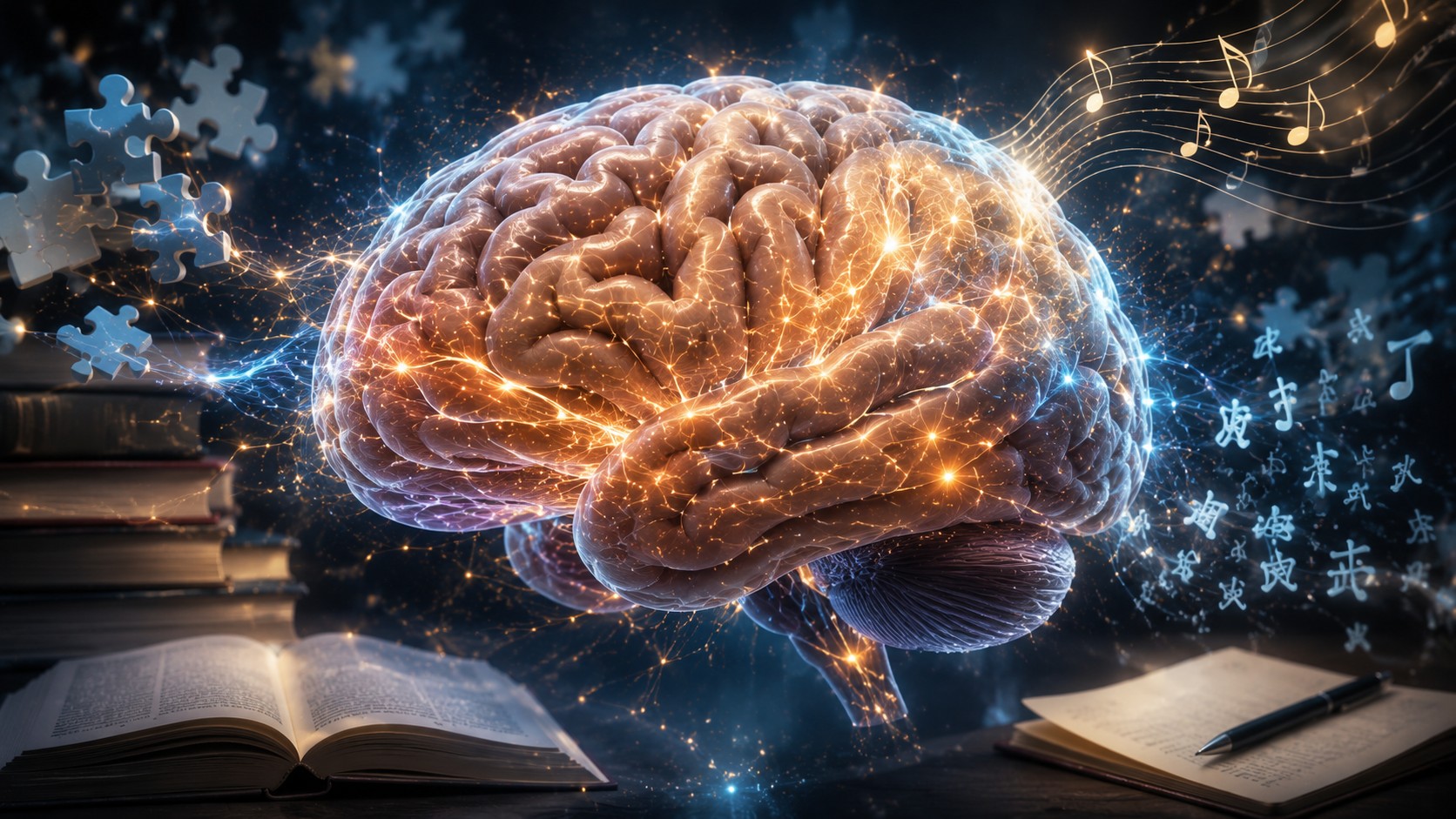
Neuroplasticity Explained: How Your Brain Rewires Itself
The complete guide to the science of brain change — how learning, habits, memory and experience physically reshape your neural connections throughout life.
What if every new skill you practiced, every book you read, and every habit you formed physically changed your brain? That's exactly what happens.
For much of history, scientists believed that the adult brain was essentially fixed after childhood. Once development ended, the prevailing view was that your neural circuitry remained largely unchanged for the rest of your life. Today, decades of research have overturned that assumption. We now know that the brain is remarkably adaptable and capable of reorganizing itself throughout life.
This extraordinary ability is known as neuroplasticity.
Neuroplasticity explains why children learn languages so quickly, why musicians develop exceptional motor skills, why stroke patients can recover lost functions, and why it is possible — at any age — to build better habits and acquire new knowledge.
In this comprehensive guide, you'll discover how neuroplasticity works, why it matters for everyday life, and how you can harness it to become a more effective learner, thinker and problem solver.
What Is Neuroplasticity?
Neuroplasticity, sometimes called brain plasticity, refers to the brain's ability to change its structure and function in response to experience.
Your brain is made up of roughly 86 billion neurons connected through trillions of synapses. These connections are not static. They strengthen, weaken, disappear, or form anew depending on how you think, act and interact with the world.
Every time you:
- Learn a new word,
- Practice the piano,
- Memorize a phone number,
- Solve a difficult puzzle,
- Exercise,
- Or even change your daily routine,
your brain is subtly modifying its internal wiring.
Rather than behaving like a rigid computer, the brain resembles a living ecosystem that constantly adapts to new challenges.
"Neurons That Fire Together Wire Together"
One of the foundational principles of neuroplasticity comes from Canadian psychologist Donald Hebb, who proposed a simple but powerful idea: neurons that repeatedly activate together become more strongly connected.
This concept, often summarized as "neurons that fire together wire together," explains why repetition is so important for learning.
Imagine practicing the same guitar chord every day. Initially, your movements feel awkward and require conscious effort. Over time, the neural pathways involved become more efficient, allowing you to perform the action almost automatically. The same process occurs when learning mathematics, programming, driving or speaking a foreign language.
Conversely, connections that are rarely used tend to weaken over time — a principle sometimes summarized as "use it or lose it."
Your Brain Is Changing Right Now
One of the most fascinating aspects of neuroplasticity is that it never truly stops. Even while reading this article:
- Visual areas process the words on your screen.
- Language networks decode their meaning.
- Memory systems connect new ideas with prior knowledge.
- Attention circuits determine what information is important.
- Synapses involved in understanding these concepts become slightly stronger.
Learning is therefore not simply acquiring information — it is the physical remodeling of your nervous system.
Structural vs. Functional Neuroplasticity
Scientists generally distinguish between two complementary forms of neuroplasticity.
Structural plasticity
Structural plasticity involves physical changes in the architecture of the brain. Examples include:
- The creation of new synaptic connections.
- Growth of dendritic branches.
- Increased insulation (myelination) around nerve fibers.
- Reorganization of neural networks after intensive practice.
Studies have shown that individuals who spend years mastering complex skills — such as musicians, taxi drivers, bilingual speakers or chess players — often display measurable structural adaptations in relevant brain regions.
Functional plasticity
Functional plasticity refers to changes in how different parts of the brain perform tasks. Following injury, neighboring regions may compensate for damaged tissue by taking over certain functions. This capacity is particularly important during rehabilitation after strokes or traumatic brain injuries.
Although recovery is not always complete, the brain's ability to redistribute functions demonstrates just how dynamic it can be.
Why Neuroplasticity Matters in Everyday Life
Understanding neuroplasticity changes the way we think about human potential. It influences:
- Learning and education
- Memory formation
- Focus and attention
- Creativity
- Emotional regulation
- Athletic performance
- Musical expertise
- Language acquisition
- Rehabilitation after neurological injury
- Habit formation and behavior change
Far from being predetermined by genetics alone, many aspects of cognitive performance can be improved through deliberate practice and healthy lifestyle choices. This realization has transformed neuroscience, education, psychology and medicine.
The Brain Is an Energy-Efficient Machine
Your brain is constantly optimizing itself.
Frequently used pathways become stronger and faster because maintaining efficient circuits saves energy. At the same time, rarely used connections may weaken or disappear altogether. This process explains why:
- Practiced skills become automatic.
- Forgotten languages become difficult to recall.
- Long-unused mathematical techniques fade over time.
- Daily habits can feel effortless, whether they are beneficial or harmful.
The brain reinforces what it experiences repeatedly — not necessarily what is objectively good for you. That is why consistency often matters more than intensity when trying to develop new skills.
Critical Periods: Are Children Better Learners?
One of the biggest myths about neuroplasticity is that it disappears after childhood.
It's true that the brain is especially adaptable during certain critical periods of development. During these windows, children can acquire complex skills — such as language pronunciation or sensory processing — with remarkable ease. For example, young children exposed to multiple languages often develop native-like accents effortlessly. Their brains are highly receptive to building new neural circuits for speech and communication.
But this doesn't mean adults stop learning. Instead, adult neuroplasticity operates differently. Learning may require:
- More deliberate practice,
- Greater repetition,
- Focused attention,
- Consistent sleep,
- And strong motivation.
The encouraging message is that your brain remains capable of meaningful change throughout your entire life.
Synaptic Pruning: Why the Brain Removes Connections
Neuroplasticity isn't just about creating new connections — it's also about eliminating unnecessary ones. This process is called synaptic pruning.
Think of your brain as a gardener. Instead of allowing every branch to grow endlessly, it trims weak or unused connections so that valuable pathways become stronger and more efficient. This explains why:
- Skills improve with regular practice.
- Forgotten information becomes harder to access.
- Children gradually specialize in the languages and environments they experience most.
Pruning is an essential part of learning because an efficient brain isn't one with the most connections — it's one with the right connections.
Myelin: The Secret to Expertise
Whenever you repeatedly practice a skill, another important change occurs. Your brain increases the amount of myelin, a fatty insulating layer that wraps around nerve fibers. Myelin acts like insulation around an electrical cable, allowing signals to travel faster and more reliably.
Highly practiced abilities — such as typing, reading music, driving or speaking a second language — often rely on heavily myelinated neural pathways. This is one reason experts appear to perform effortlessly. They aren't necessarily thinking faster than beginners; their brains have simply optimized the relevant circuits through years of repetition.
Neurogenesis: Can Adults Grow New Brain Cells?
For decades, scientists believed that humans were born with a fixed number of neurons. Research has challenged that idea.
While most neuroplasticity involves strengthening or reorganizing existing connections, evidence suggests that adults can generate new neurons in specific brain regions, particularly within the hippocampus, an area deeply involved in learning and memory.
Although the extent of adult neurogenesis remains an active area of research, studies suggest that certain lifestyle habits may support healthy brain renewal, including:
- Regular aerobic exercise,
- High-quality sleep,
- Cognitive stimulation,
- Stress reduction,
- And a nutrient-rich diet.
Even when new neurons are limited, existing networks remain highly adaptable through lifelong plasticity.
Dopamine: The Motivation Molecule Behind Learning
Neuroplasticity doesn't happen in isolation.
One of its most important partners is dopamine, a neurotransmitter involved in motivation, reward and reinforcement. When something feels meaningful, surprising or rewarding, dopamine helps signal that the experience is worth remembering. This increases the likelihood that the associated neural pathways will strengthen.
That's why:
- Gamified learning often works well.
- Positive feedback boosts motivation.
- Curiosity enhances retention.
- Celebrating small wins reinforces habits.
However, constantly chasing instant gratification through social media or endless notifications may train the brain to seek short-term rewards instead of sustained effort. To go deeper, see 👉Dopamine Explained.
How Habits Physically Change Your Brain
Every habit — good or bad — is reflected in neural circuitry.
When you repeat a behavior consistently, the corresponding brain pathways become more efficient. Initially, actions require conscious attention. Over time, they demand less mental effort as they become automated. This process explains why habits like:
- Brushing your teeth,
- Checking your phone,
- Going for a morning run,
- Or practicing meditation,
can eventually feel almost effortless. The brain is continually optimizing repeated behaviors, regardless of whether they benefit your long-term goals.
Exercise: One of the Best Ways to Boost Neuroplasticity
Physical activity benefits far more than muscles and the cardiovascular system.
Regular exercise increases blood flow to the brain, stimulates the release of growth factors, and supports the formation and maintenance of healthy neural connections. Research has linked aerobic exercise with improvements in:
- Executive function,
- Attention,
- Learning,
- Memory,
- Mood,
- And cognitive resilience during aging.
Even moderate activities such as brisk walking can have measurable benefits for brain health when practiced consistently.
Sleep: When the Brain Consolidates Learning
Learning doesn't end when practice stops.
During sleep, especially during deep sleep and REM sleep, the brain strengthens useful connections and reorganizes newly acquired information. Sleep supports:
- Memory consolidation,
- Emotional regulation,
- Problem solving,
- Synaptic maintenance,
- And long-term learning.
Skipping sleep after studying or practicing a new skill can significantly reduce how much information is retained. In many ways, sleep is when neuroplasticity continues working behind the scenes.
How to Harness Neuroplasticity to Rewire Your Brain
The most exciting aspect of neuroplasticity is that it isn't merely an interesting scientific concept — it's something you can actively influence every day.
Every choice you make reinforces certain neural pathways while allowing others to fade. Over weeks, months and years, these tiny changes accumulate into lasting transformations in your abilities, habits and even your personality. The key is to provide your brain with the right conditions for adaptation.
Deliberate Practice Beats Mindless Repetition
Simply repeating an activity isn't enough.
Research consistently shows that deliberate practice — focused, challenging, feedback-driven training — is far more effective than passive repetition. For example:
- Solving progressively harder math problems is better than repeating easy ones.
- Playing difficult passages on the piano develops more skill than endlessly performing familiar songs.
- Actively recalling information strengthens memory more than rereading notes.
The brain adapts most efficiently when it is pushed just beyond its current comfort zone.
Embrace "Desirable Difficulty"
Learning often feels uncomfortable. In fact, if something feels effortless, your brain may not be changing very much.
Psychologists use the term desirable difficulties to describe learning challenges that require effort but ultimately produce stronger and more durable neural connections. Examples include:
- Testing yourself instead of rereading.
- Spacing study sessions across several days.
- Mixing different problem types.
- Explaining concepts in your own words.
- Teaching someone else.
The struggle is often a sign that neuroplasticity is taking place.
Repetition and Consistency Win
Many people overestimate what they can accomplish in a single intense session while underestimating the impact of daily practice. Your brain responds best to repeated activation over time.
Just 20–30 minutes per day of:
- Reading,
- Language learning,
- Musical practice,
- Meditation,
- Or cognitive training,
can produce significant improvements when maintained consistently for months. Small actions, repeated frequently, reshape the brain more effectively than occasional bursts of effort.
Protect Your Brain from Chronic Stress
Stress isn't always harmful.
Short-term stress can sharpen attention and improve performance. However, chronic stress may interfere with neuroplasticity by impairing memory formation and reducing cognitive flexibility. Long-lasting elevated stress hormones can make it more difficult to learn new information and adapt to changing circumstances.
Helpful protective habits include:
- Regular physical exercise,
- Quality sleep,
- Mindfulness or meditation,
- Social connection,
- Time spent outdoors,
- And effective recovery between periods of intense work.
Building resilience is itself a form of neuroplasticity.
Nutrition Supports Brain Remodeling
The brain accounts for only about 2% of body weight yet consumes roughly 20% of the body's energy. Providing it with adequate nutrition supports learning and long-term cognitive health.
A brain-friendly diet generally emphasizes:
- Fatty fish rich in omega-3 fatty acids,
- Colorful fruits and vegetables,
- Nuts and seeds,
- Legumes,
- Whole grains,
- Olive oil,
- And minimally processed foods.
Hydration also matters. Even mild dehydration can negatively affect attention and cognitive performance.
Lifelong Learning Keeps the Brain Flexible
Your brain thrives on novelty.
Learning a language, taking up photography, studying history, practicing chess or exploring programming all challenge existing neural networks and encourage the formation of new ones. Perhaps most importantly, learning across diverse domains creates a richer web of associations, making future learning easier.
Curiosity fuels plasticity.
Can You Rewire Bad Habits?
Yes — but replacing habits is often easier than eliminating them.
Because existing neural pathways remain available, simply trying not to perform a behavior may prove difficult. Instead, many psychologists recommend creating a competing routine. For example:
- Replace mindless scrolling with reading a book.
- Replace sugary snacks with healthier alternatives.
- Replace evening television with a walk or language practice.
Over time, repeated use strengthens the new pathway while the old one gradually weakens through lack of reinforcement. This is neuroplasticity in action.
Technology Can Help — or Hurt
Modern technology offers extraordinary learning opportunities, but it can also fragment attention.
Constant interruptions from notifications, multitasking and endless short-form content may train the brain to expect frequent novelty and reduce sustained focus. On the other hand, educational apps, spaced repetition systems, language platforms and digital note-taking tools can accelerate learning when used intentionally.
The goal isn't to avoid technology — it's to use it deliberately.
Common Myths About Neuroplasticity
Explore Brain Geek Tools
Put the science into practice with our free interactive resources:
Brain Geek Recommended Reading
If you'd like to explore neuroplasticity further, consider these outstanding resources:
- The Brain That Changes Itself — Norman Doidge
A landmark introduction to neuroplasticity featuring inspiring real-world stories of brain adaptation.
- Livewired — David Eagleman
Explores how the brain continually rewires itself in response to experience, learning and the environment.
- Moonwalking with Einstein — Joshua Foer
Demonstrates how memory training reshapes cognitive abilities — a vivid case study of plasticity in action.
- Make It Stick — Peter C. Brown and colleagues
Explains evidence-based learning techniques grounded in cognitive science — exactly the conditions that drive neuroplasticity.
Related Brain Geek Articles
👉The Complete Guide to the Human Brain — The cornerstone overview of brain architecture and chemistry.
👉The Complete Guide to Memory — How plasticity transforms experience into lasting memory.
👉The Complete Guide to Focus — Why focused attention is the gateway to neuroplastic change.
👉The Complete Guide to Sleep — The most underrated regulator of brain remodeling.
👉Cognitive Biases That Influence Your Decisions — How habitual mental shortcuts shape your reasoning.
👉Dopamine Explained — The neurotransmitter that drives motivation and reinforcement learning.
Final Thoughts
Neuroplasticity is one of the most hopeful discoveries in modern neuroscience.
It tells us that our brains are not fixed machines but dynamic systems that evolve with every experience, every challenge and every habit we repeat. While genetics provide the foundation, our daily actions shape the structure and efficiency of the neural networks that define who we become.
Whether your goal is to master a language, recover from setbacks, sharpen your memory or simply keep your mind healthy as you age, the same principle applies: