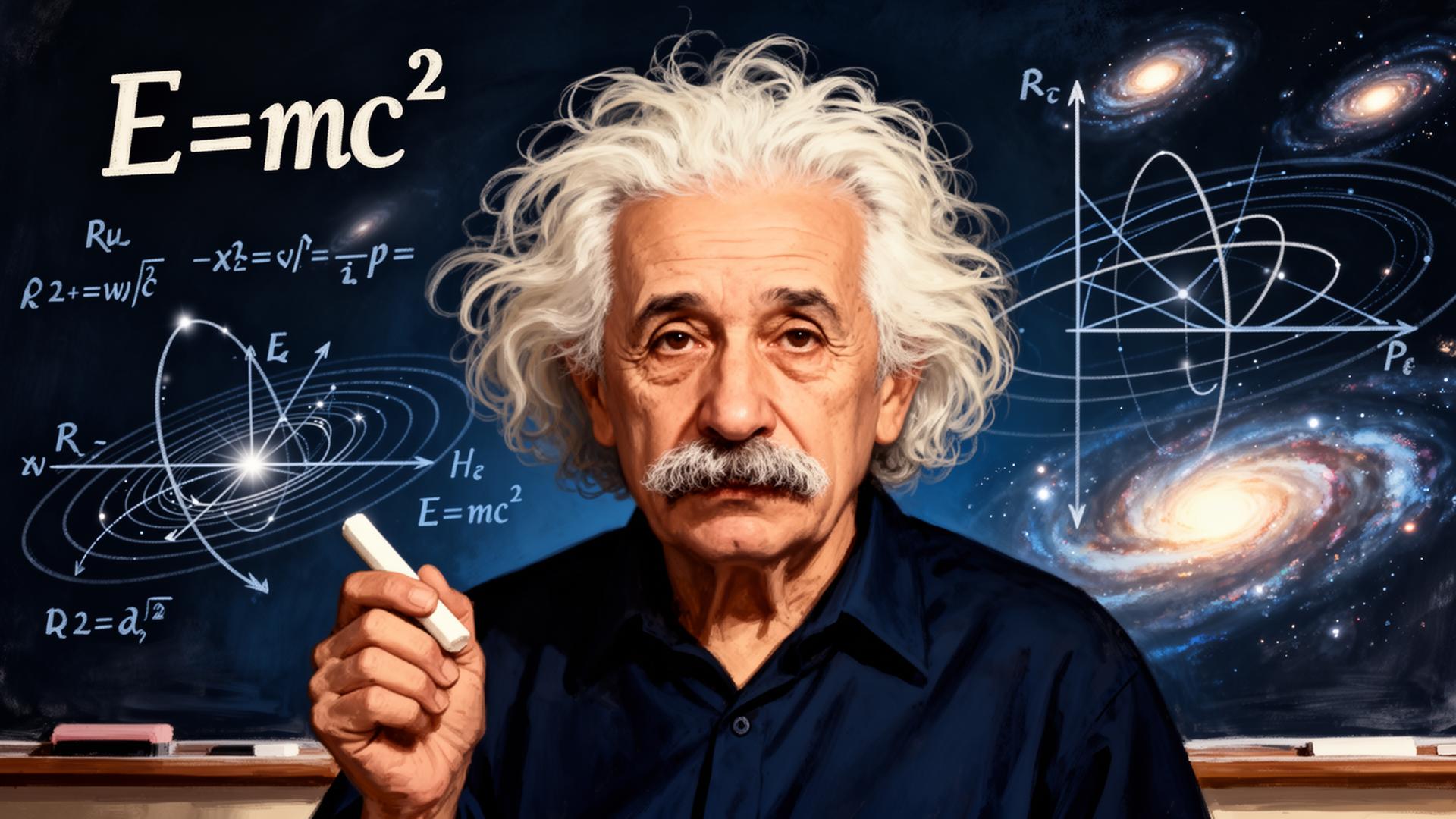
Albert Einstein: The Genius Who Changed Our Understanding of the Universe
From a daydreaming patent clerk to the most recognizable scientist in history — the life, ideas and lasting influence of Albert Einstein.
Few names are as synonymous with genius as Albert Einstein. Wild white hair, a mischievous half-smile, a chalkboard scrawled with equations — even people who have never read a physics textbook recognize the silhouette. But the real Einstein was something more interesting than the icon: a stubborn, playful, fiercely curious mind who refused to accept the universe as it had been handed to him.
In the span of a single decade he overturned three hundred years of physics, redefined gravity, time and matter, and unlocked a chain of discoveries that still shape modern science. This profile is the first in our Great Brains series — a celebration of the thinkers who expanded what it means to be human.
Early Life and Education
Einstein was born on March 14, 1879, in the small German city of Ulm, into a secular Jewish family. His father Hermann ran an electrochemical business; his mother Pauline was a gifted pianist who filled the house with music. The family moved to Munich while Albert was still a baby.
He was not, despite the popular myth, a poor student. He was a quiet, intensely focused one — bored by rote learning and authoritarian teachers, but already devouring geometry, philosophy and Mozart on his own. A small compass given to him at age five made a lifelong impression: an invisible force was at work in the world, and someone, eventually, would have to explain it.
After his family moved to Italy, the teenage Einstein left school and made his way to Switzerland, where he eventually entered the Swiss Federal Polytechnic in Zürich in 1896. He graduated in 1900 as a trained physics and mathematics teacher, but academic doors stubbornly refused to open. To pay rent, he took a job as a third-class technical examiner at the Swiss Patent Office in Bern.
"The important thing is not to stop questioning. Curiosity has its own reason for existing."— Albert Einstein
The Scientific Revolution of 1905
That patent office turned out to be the perfect laboratory. Examining inventions about clocks, signals and the synchronization of distant events trained Einstein to think hard about a question almost no one was asking: what is time, exactly?
In 1905 — his now-famous annus mirabilis, or "miracle year" — the unknown 26-year-old clerk published four scientific papers, any one of which would have made a career:
- The photoelectric effect — showing that light behaves as discrete packets of energy (photons). This paper later won him the Nobel Prize and helped launch quantum mechanics.
- Brownian motion — explaining the jittery dance of tiny particles as proof that atoms and molecules really exist.
- Special relativity — rewriting the rules of space and time for objects moving close to the speed of light.
- Mass–energy equivalence — the short, decisive paper that introduced the equation E = mc².
Within a few years, the patent clerk was a university professor. Within a decade, he had completed something even bigger.
General Relativity: Rewriting Gravity
Special relativity dealt with motion at constant speeds. The real prize was gravity. From 1907 to 1915, Einstein wrestled with what he later called the happiest thought of his life: a person in free fall does not feel their own weight. From that single observation he built the general theory of relativity.
The picture is breathtaking. Space and time are not separate stages on which events unfold. They are woven together into a single four-dimensional fabric — space-time — and massive objects bend it. What we call gravity is simply matter and light following the curves carved by stars and planets.
In 1919, during a solar eclipse, the British astronomer Arthur Eddington measured starlight bending around the Sun by exactly the amount Einstein had predicted. The next morning, Einstein woke up famous. Newspapers around the world ran headlines like "Lights All Askew in the Heavens." A new picture of the universe had arrived.
A century later, general relativity is the foundation of modern cosmology. It predicts black holes, gravitational waves, the expansion of the universe and the Big Bang itself. It also quietly makes your GPS work — without correcting for relativistic effects, navigation systems would drift by miles every day.
E = mc² — In Plain English
No equation in history is more famous. It is also one of the most misunderstood. E = mc² says that energy (E) and mass (m) are two forms of the same thing, related by the speed of light squared (c²).
The speed of light is enormous. Squared, it becomes an almost unimaginable number. So the equation is really telling us this: a tiny amount of matter contains a staggering amount of energy. A single gram of mass, fully converted, would release roughly the energy of 20,000 tons of TNT.
That insight is why the Sun shines — fusing hydrogen into helium converts a sliver of mass into the light and warmth that make life on Earth possible. It is also why nuclear power and nuclear weapons exist. Einstein himself, a lifelong pacifist, was horrified by the destructive uses of his idea, even as he conceded that the science was unavoidable.
Beyond Relativity
Relativity tends to overshadow everything else, but Einstein's broader contributions are extraordinary in their own right:
- Quantum theory. His paper on the photoelectric effect is one of the founding documents of quantum mechanics — even though Einstein himself remained skeptical of the theory's deepest implications ("God does not play dice with the universe").
- Statistical physics. His work on Brownian motion gave experimental proof that atoms exist.
- Bose–Einstein statistics. With Indian physicist Satyendra Bose, he predicted an entirely new state of matter (the Bose–Einstein condensate), finally produced in the lab in 1995.
- Cosmology. His field equations made modern cosmology possible — including the cosmological constant, which he once called his "biggest blunder" but which has since returned to explain the accelerating expansion of the universe.
The Mind of a Genius
What made Einstein Einstein? Not a magical IQ, and certainly not effortless brilliance. He worked obsessively — for years — on problems most physicists thought were already solved. He failed often. He revised constantly. He told colleagues that one of his greatest strengths was that he stayed with problems longer than others.
Three habits stand out:
- Thought experiments. Einstein imagined himself riding a beam of light, falling inside an elevator, watching trains pass at impossible speeds. Many of his greatest insights came from visual mental simulations long before any equation appeared.
- Combinatory play. He famously credited his creativity to playing with ideas the way a child plays with blocks — and to playing the violin daily. Music, walking and sailing were not distractions; they were part of his thinking process.
- Independent thinking. He resisted intellectual authority his entire life. He published his most disruptive papers as an outsider with no university position. Curiosity, not approval, was his compass.
Modern neuroscience would recognize all of this immediately. The same systems that drive motivation and learning — see 👉Dopamine Explained — are the systems that reward novelty, persistence and meaningful goals. Einstein's life is, in many ways, a case study in cognitive habits we can all cultivate.
A Life in Milestones
The major moments that shaped Einstein's life and work:
- 1879Born March 14 in Ulm, Germany.
- 1896Enters the Swiss Federal Polytechnic in Zürich to train as a physics and math teacher.
- 1902Begins work at the Swiss Patent Office in Bern as a technical examiner.
- 1905His 'miracle year' — publishes four papers that revolutionize physics, including special relativity and E = mc².
- 1915Completes the general theory of relativity, redefining gravity as the curvature of space-time.
- 1919Eddington's solar-eclipse observations confirm general relativity. Einstein becomes a global celebrity.
- 1921Awarded the Nobel Prize in Physics — for the photoelectric effect, a cornerstone of quantum theory.
- 1933Flees Nazi Germany and settles in the United States, joining the Institute for Advanced Study in Princeton.
- 1939Signs the letter to President Roosevelt warning of the potential for nuclear weapons.
- 1955Dies April 18 in Princeton, still working on a unified field theory.
Lesser-Known Facts & Anecdotes
- He was offered the presidency of Israel in 1952 and politely declined.
- He could not drive a car. He never bothered to learn.
- He played the violin almost daily, and said that if he had not become a physicist he would have been a musician.
- His brain was preserved after death without his family's consent, and parts of it were studied by neuroscientists for decades.
- He failed the entrance exam to the Swiss Polytechnic on his first attempt — in subjects outside math and physics.
- His FBI file ran to nearly 1,500 pages because of his pacifism and civil rights advocacy.
- He was a passionate sailor who frequently capsized — and could not swim.
Legacy and Influence
A century after his greatest work, Einstein's fingerprints are everywhere. Every confirmed detection of gravitational waves, every black-hole image, every breakthrough in cosmology is also a quiet confirmation of his equations. GPS satellites, lasers, semiconductors and solar panels all rely on physics he helped found.
But his cultural legacy may be even larger. Einstein became the modern symbol of the scientific imagination — proof that a quiet person at a wooden desk, armed mostly with pencil, paper and stubborn curiosity, can change how an entire species understands its own home in the universe.
Why Einstein Still Inspires
For students, scientists and lifelong learners, Einstein offers something rarer than a list of discoveries. He offers a posture toward the world:
- Question what everyone takes for granted.
- Stay with hard problems longer than seems reasonable.
- Play. Treat thinking as a creative act, not a chore.
- Stay humble. He often described his greatest insights as gifts of wonder, not proof of superiority.
- Care about people. He used his platform to defend peace, civil rights and refugees throughout his life.
"I have no special talent. I am only passionately curious."— Albert Einstein
Explore Your Own Mind
Einstein believed everyone could think more deeply about the world. These free Brain Geek tools are a fun place to start exploring your own cognitive abilities:
Recommended Reading
If Einstein has sparked your curiosity, these books are excellent next steps:
- Einstein: His Life and Universe — Walter Isaacson
The most acclaimed modern biography — accessible, deeply researched, and beautifully written.
- Relativity: The Special and the General Theory — Albert Einstein
Einstein's own attempt to explain his theories to general readers. Surprisingly readable and historically essential.
- Subtle Is the Lord — Abraham Pais
The definitive scientific biography, written by a physicist who knew Einstein personally.
- The World As I See It — Albert Einstein
A short collection of Einstein's essays on science, philosophy, society and the meaning of life.
- Six Easy Pieces — Richard Feynman
The clearest popular introduction to the physics Einstein helped build — perfect companion reading.
- A Brief History of Time — Stephen Hawking
Hawking carries Einstein's torch and explains how relativity reshaped cosmology.
- Einstein's Dreams — Alan Lightman
A poetic novel imagining the dreams of a young Einstein — a meditation on time, creativity and curiosity.
Continue Exploring Brain Geek
👉The Complete Guide to the Human Brain — The cornerstone overview of brain architecture and chemistry.
👉Dopamine Explained — The neurochemistry of curiosity, motivation and learning.
👉The Complete Guide to Memory — How great thinkers built and used extraordinary memory.
👉The Complete Guide to Focus — The science of sustained, deep attention.
👉The Complete Guide to Sleep — Why Einstein swore by 10 hours of sleep and frequent naps.
👉Cognitive Biases That Influence Your Decisions — The hidden shortcuts that shape how we think.
👉Discover more Great Brains — Upcoming profiles on Marie Curie, Newton, Tesla, Turing, Ramanujan, Cajal and more.
Key Lessons from Einstein
- Stay relentlessly curious. Wonder is a discipline, not a personality trait.
- Make space for play. Music, walks and daydreams are part of serious thinking.
- Question the obvious. The most important assumptions are usually invisible.
- Be patient with hard problems. Long, slow attention is a superpower.
- Use your platform for good. Knowledge carries responsibility.
Albert Einstein reminds us that great minds are not born in another category of human. They are built — slowly, stubbornly, joyfully — by anyone who keeps asking better questions. Keep exploring with Brain Geek, and the next great idea might just be yours.