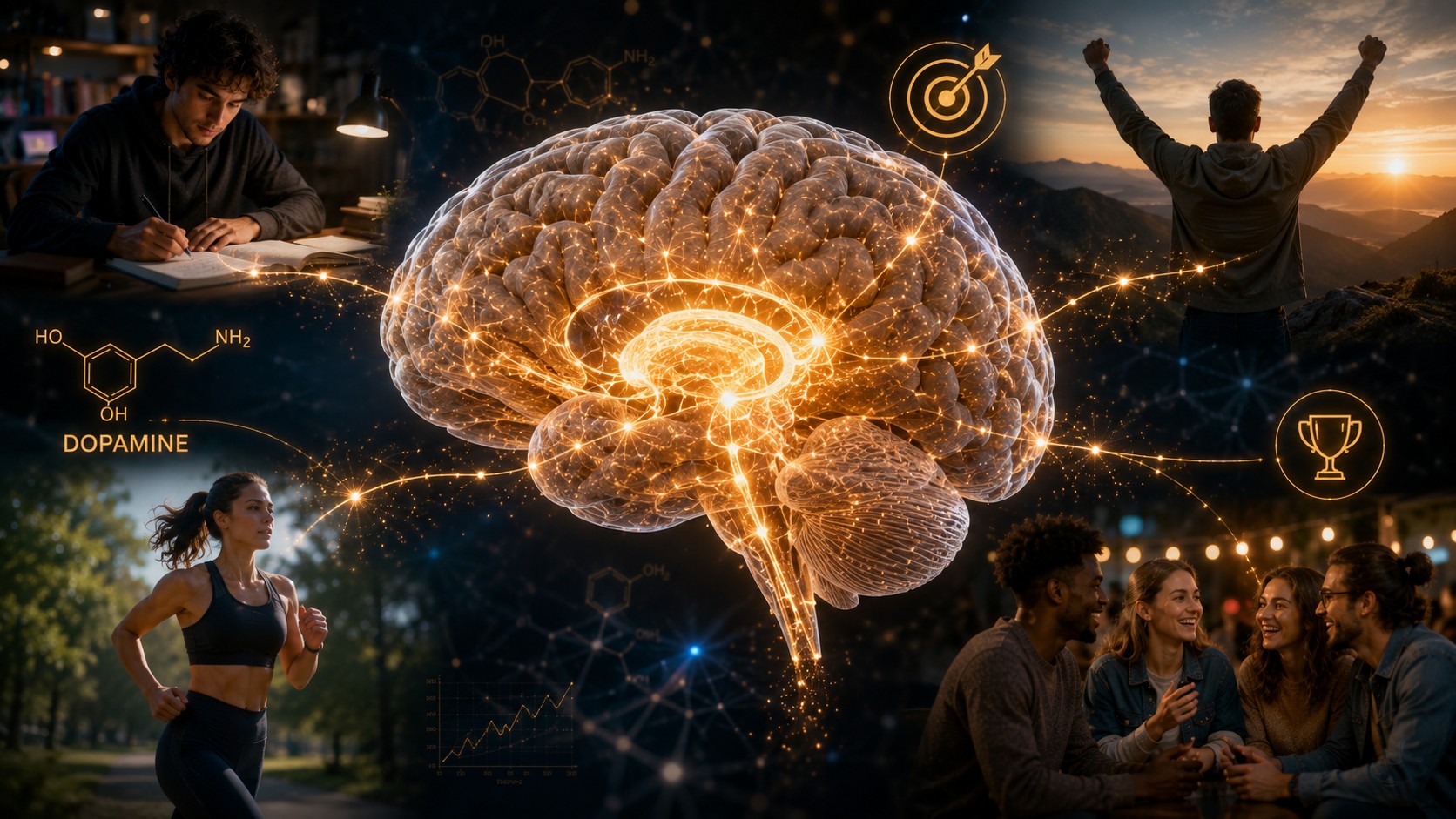
The Complete Guide to Dopamine
How your brain's motivation system really works — the science of dopamine, addiction, ADHD, technology and the habits that protect long-term brain health.
Dopamine is often called the "pleasure molecule," but that nickname barely scratches the surface. In reality, dopamine is one of the brain's most important neurotransmitters, influencing motivation, learning, movement, decision-making, memory, and even addiction.
Every day, dopamine quietly shapes thousands of your decisions. It influences whether you feel motivated to exercise, finish a project, scroll social media for another hour, or pursue long-term goals despite short-term discomfort.
Understanding dopamine isn't just fascinating neuroscience — it has practical implications for productivity, mental health, education, and overall well-being. In this comprehensive guide, we'll separate scientific fact from internet myths and explain how dopamine truly works.
The Science of Dopamine: What It Is and What It Really Does
What Is Dopamine?
Dopamine is a neurotransmitter, a chemical messenger that allows neurons to communicate with one another.
It belongs to a family of molecules called catecholamines, synthesized from the amino acid tyrosine through several enzymatic steps. Once released into synapses, dopamine binds to specialized receptors that modify neuronal activity throughout the brain and body.
Dopamine vs. Pleasure
One of neuroscience's biggest misconceptions is that dopamine directly creates pleasure. Research suggests that while dopamine contributes to reward processing, it is especially involved in:
- Wanting rather than liking
- Predicting rewards
- Reinforcing learning
- Goal-directed behavior
- Motivation to act
- Habit formation
This distinction explains why people can become compulsively attached to activities that no longer bring much enjoyment.
Where Is Dopamine Produced?
Several brain regions manufacture dopamine, but four major pathways dominate its functions.
1. Mesolimbic Pathway
Often called the brain's reward circuit, this pathway connects deep structures involved in motivation and reinforcement. It becomes active during:
- Eating
- Social interaction
- Winning games
- Learning
- Novel experiences
- Anticipating rewards
Its job is not merely to make experiences pleasurable but to encourage repeating behaviors beneficial for survival.
2. Mesocortical Pathway
This pathway projects toward the prefrontal cortex and supports:
- Executive function
- Planning
- Working memory
- Decision-making
- Sustained attention
- Complex reasoning
Insufficient dopamine activity here has been associated with attention difficulties and cognitive deficits.
3. Nigrostriatal Pathway
Running between the substantia nigra and basal ganglia, this circuit is essential for smooth voluntary movement. Degeneration of dopamine-producing neurons in this pathway leads to the characteristic symptoms of Parkinson's disease.
4. Tuberoinfundibular Pathway
This lesser-known pathway regulates hormone secretion, particularly prolactin release from the pituitary gland. Its functions illustrate that dopamine influences much more than cognition and behavior.
Dopamine and Motivation
Perhaps dopamine's most remarkable role is helping organisms pursue future rewards.
Imagine two students:
- Student A enjoys studying.
- Student B does not particularly enjoy it but continues because they value future success.
Both involve dopamine, but the second example demonstrates dopamine's true evolutionary importance: sustaining effort toward delayed outcomes. The neurotransmitter increases when the brain predicts that an action may improve future survival or success.
This predictive mechanism explains why checking notifications, gambling, and video games can become highly compelling.
Reward Prediction Error: Your Brain's Internal Teacher
One of neuroscience's most elegant discoveries is the concept of reward prediction error. Your brain constantly compares expected reward versus actual reward.
- If reality exceeds expectations: dopamine neurons fire strongly and learning is reinforced.
- If rewards match expectations: dopamine response becomes modest.
- If rewards fail to appear: dopamine activity decreases.
This mechanism allows humans to rapidly adapt behavior and optimize decision-making.
Dopamine and Learning
Every time you master a difficult concept or solve a challenging problem, dopamine helps strengthen the neural circuits involved. It contributes to:
- Reinforcement learning
- Memory consolidation
- Curiosity
- Exploration
- Skill acquisition
- Pattern recognition
This is one reason why gamified learning environments can be so effective — they repeatedly trigger prediction, feedback, and incremental rewards.
Related reading on Brain Geek:
Why Novelty Feels So Exciting
Humans evolved to pay attention to change. Novel experiences often trigger dopamine release because they may provide valuable information or opportunities. This explains why:
- Traveling feels stimulating.
- New hobbies are exciting.
- Unexpected discoveries capture attention.
- Many digital platforms constantly introduce novelty.
However, chronic novelty-seeking can also reduce satisfaction with slower, long-term pursuits.
Key Takeaways — Part 1
- Dopamine is far more than the brain's "pleasure chemical."
- Its primary functions include motivation, learning, prediction, and goal-directed behavior.
- Four major dopamine pathways regulate reward, cognition, movement, and hormones.
- Dopamine teaches the brain by comparing expected and actual outcomes.
- Novelty and uncertainty strongly influence dopamine signaling.
- Understanding dopamine helps explain habits, productivity, education, and even addiction.
Dopamine in Everyday Life: Addiction, ADHD, Technology, and the Truth About "Dopamine Detox"
Why Some Behaviors Become So Hard to Resist
If dopamine is involved in motivation and learning, it makes sense that activities producing rapid and unpredictable rewards can become incredibly compelling.
Your brain evolved to pay attention to opportunities that could improve survival. In today's world, many technologies exploit these same reward systems by delivering frequent novelty and intermittent reinforcement.
Examples include:
- Scrolling through social media feeds
- Checking email or messaging apps
- Playing video games
- Online shopping
- Sports betting and gambling
- Short-form video platforms
The common denominator is not simply pleasure — it is uncertainty. When rewards arrive unpredictably, the brain often remains highly engaged, continually anticipating the next payoff.
Dopamine and Social Media
Modern social media platforms are designed around continuous engagement.
Likes, comments, shares, and new content appear at irregular intervals, encouraging repeated checking behavior. Every refresh presents the possibility of discovering something rewarding or surprising.
This does not mean that social media "drains your dopamine" or permanently damages your brain. Rather, excessive use may compete with activities that require patience and delayed gratification, making it harder for some people to sustain attention on demanding tasks.
Healthy use is possible when technology supports rather than replaces meaningful goals.
Video Games: Harmful or Helpful?
Video games often activate dopamine-related learning systems through:
- Progressive challenges
- Immediate feedback
- Skill improvement
- Achievement systems
- Exploration
- Social cooperation
For many people, gaming is a perfectly healthy hobby.
Problems arise when gaming begins to interfere with sleep, relationships, education, work, or physical health. Balance and context matter far more than simplistic claims that games are inherently "good" or "bad" for the brain.
Gambling and Variable Rewards
Among everyday activities, gambling illustrates reward prediction especially well.
Slot machines, lotteries, and betting systems provide intermittent wins that are difficult to predict. This uncertainty can encourage repeated participation because the brain continually updates its expectations.
Importantly, near misses — outcomes that almost result in success — may also influence motivation, even though they are objectively losses.
Dopamine and ADHD
Attention-Deficit/Hyperactivity Disorder (ADHD) is a complex neurodevelopmental condition involving multiple brain systems, including dopamine signaling.
Many researchers believe that altered dopamine regulation contributes to difficulties with:
- Sustaining attention
- Organizing tasks
- Delaying gratification
- Maintaining motivation for repetitive activities
- Inhibiting impulsive responses
People with ADHD often report being able to focus intensely on highly engaging tasks while struggling with routine responsibilities — a phenomenon sometimes referred to as hyperfocus.
Medications commonly prescribed for ADHD can influence dopamine and related neurotransmitter systems, but treatment should always be individualized and supervised by qualified healthcare professionals.
Related Brain Geek article: 👉The Complete Guide to Focus.
Parkinson's Disease and Dopamine
One of the clearest demonstrations of dopamine's importance comes from Parkinson's disease.
In this condition, dopamine-producing neurons in the substantia nigra progressively degenerate, leading to symptoms such as:
- Tremors
- Muscle rigidity
- Slowed movement
- Balance problems
- Reduced facial expression
Because dopamine plays a central role in movement control, replacing or supporting dopamine signaling can significantly improve symptoms for many patients, although it does not cure the underlying disease.
Dopamine and Depression
Depression cannot be explained by dopamine alone.
While motivation and reward processing may be altered in some individuals, depression involves complex interactions among multiple neurotransmitters, brain circuits, genetics, environmental stressors, and psychological factors.
Some people with depression experience anhedonia — a reduced ability to experience interest or pleasure — which may involve disrupted reward processing.
This illustrates why simplistic statements such as "low dopamine causes depression" fail to capture the full picture.
The Myth of the "Dopamine Detox"
Over the past few years, the phrase dopamine detox has become popular online.
The idea usually suggests avoiding stimulating activities — such as social media, junk food, or entertainment — to "reset" dopamine levels.
The scientific reality is more nuanced.
Your brain continuously produces and uses dopamine because it is essential for normal functioning. You cannot meaningfully "flush out" dopamine or stop your neurons from using it.
However, temporarily reducing highly distracting behaviors may help people:
- Break compulsive habits
- Reduce constant interruptions
- Improve concentration
- Become more aware of automatic behaviors
- Reinvest time in meaningful activities
The benefits likely come from changing habits and attention — not from literally resetting dopamine chemistry.
Can You Have Too Much Dopamine?
Both insufficient and excessive dopamine activity can create problems.
Depending on the brain region involved, abnormal dopamine signaling has been associated with disorders affecting movement, motivation, impulse control, and perception.
The brain functions best when neurotransmitter systems remain balanced rather than maximized.
This is one reason why chasing ever-higher stimulation often fails to produce lasting satisfaction.
Lifestyle Habits That Influence Dopamine Naturally
Although no lifestyle habit permanently "boosts" dopamine to superhuman levels, several behaviors support healthy brain function and reward processing:
Regular Physical Activity
Exercise contributes to overall brain health and may positively influence neurotransmitter systems involved in mood and motivation.
Consistent Sleep
Sleep deprivation impairs attention, decision-making, and emotional regulation, making reward-seeking behaviors harder to control.
Related Brain Geek article: 👉The Complete Guide to Sleep.
Meaningful Goal Setting
Breaking ambitious objectives into smaller milestones provides frequent opportunities for progress and reinforcement.
Learning New Skills
Acquiring knowledge or mastering difficult tasks activates learning circuits that depend on prediction and feedback.
Positive Social Relationships
Supportive interactions, cooperation, and shared achievements contribute to healthy emotional functioning and long-term motivation.
Key Takeaways — Part 2
- Dopamine helps explain why unpredictable rewards can be so engaging.
- Social media, gaming, and gambling all interact with motivation and learning systems, but their effects depend heavily on context and usage.
- ADHD and Parkinson's disease both illustrate the importance of healthy dopamine signaling, though in very different ways.
- Depression is far more complex than a simple "dopamine deficiency."
- The popular concept of a "dopamine detox" oversimplifies neuroscience; the real value often lies in reducing distractions and rebuilding intentional habits.
- Sustainable motivation comes from balanced brain health, purposeful goals, and consistent daily behaviors — not from chasing constant stimulation.
Optimizing Dopamine Naturally: Evidence-Based Strategies for Motivation and Brain Health
Can You Increase Dopamine Naturally?
A quick internet search will reveal countless products promising to "hack," "supercharge," or "maximize" dopamine. Most of these claims are exaggerated.
The brain carefully regulates dopamine because too little and too much activity can both impair normal function. Rather than trying to force unnaturally high dopamine levels, the goal should be to support the brain systems that regulate motivation, learning, and reward in a healthy way.
Fortunately, several everyday habits are backed by scientific evidence.
1. Exercise: One of the Best Brain Investments
Regular physical activity is consistently associated with better cognitive function, improved mood, and healthier brain aging.
Aerobic exercise, resistance training, and even brisk walking can positively influence the neural circuits involved in motivation and executive function.
Exercise also promotes:
- Better blood flow to the brain
- Neuroplasticity
- Stress resilience
- Sleep quality
- Long-term cognitive performance
For many people, building a sustainable exercise routine is one of the most effective ways to support healthy dopamine function indirectly.
2. Sleep Is Non-Negotiable
Chronic sleep deprivation affects attention, emotional regulation, decision-making, and motivation.
When you consistently sleep too little:
- Tasks feel harder to initiate.
- Impulse control declines.
- Reward-seeking behaviors become more tempting.
- Concentration suffers.
Improving sleep hygiene often enhances productivity without requiring any supplements or stimulants.
Related Brain Geek guide: 👉The Complete Guide to Sleep.
3. Nutrition Supports Neurotransmitter Production
Dopamine is synthesized from the amino acid tyrosine, which is naturally found in many protein-rich foods.
Good dietary sources include:
- Eggs
- Fish
- Poultry
- Dairy products
- Soy foods
- Legumes
- Nuts and seeds
However, eating large amounts of tyrosine-rich foods does not automatically flood the brain with dopamine. Neurotransmitter production is tightly regulated and depends on many physiological factors.
A balanced diet remains the best strategy.
4. Break Big Goals into Small Wins
One of the smartest ways to harness dopamine is by structuring progress.
Instead of focusing only on distant outcomes, divide ambitious projects into smaller milestones that provide regular feedback and measurable achievement.
For example, instead of "write a book," try:
- Outline one chapter
- Draft 500 words
- Edit one section
- Complete one illustration
- Publish one article
Each completed step reinforces momentum and makes sustained effort easier.
5. Learn New Skills
Learning activates prediction, feedback, adaptation, and memory — all processes influenced by dopamine.
Whether you study mathematics, languages, programming, music, or neuroscience, continual learning challenges the brain to build and refine neural networks.
This is one reason lifelong learning is associated with greater cognitive reserve and healthier aging.
Related Brain Geek articles:
6. Manage Chronic Stress
Acute stress can temporarily sharpen attention and increase motivation. Chronic stress is different.
Persistent stress hormones may interfere with executive function, emotional regulation, sleep quality, and reward processing, making it harder to stay motivated and think clearly.
Helpful stress-management techniques include:
- Regular exercise
- Mindfulness practices
- Time in nature
- Social connection
- Adequate recovery
- Healthy sleep habits
What About Dopamine Supplements?
Many products claim to increase dopamine naturally. Examples include supplements containing:
- L-tyrosine
- Mucuna pruriens
- Vitamin B6
- Certain herbal extracts
While some ingredients have biological roles related to neurotransmitter synthesis, evidence for meaningful cognitive enhancement in healthy individuals is often limited or context-dependent.
Supplements should never replace foundational habits such as sleep, nutrition, exercise, and stress management.
If you are considering supplements or medications — especially if you have a medical condition or take prescription drugs — consult a qualified healthcare professional.
Caffeine and Dopamine
Coffee does not directly flood the brain with dopamine.
Instead, caffeine primarily blocks adenosine receptors, reducing feelings of fatigue and indirectly influencing dopamine-related signaling in certain brain regions.
For many adults, moderate caffeine intake can improve alertness and concentration.
Excessive consumption, however, may contribute to anxiety, disrupted sleep, or reduced productivity. Balance remains key.
Why Chasing Constant Stimulation Backfires
Modern life offers endless opportunities for immediate gratification:
- Notifications
- Endless scrolling
- Streaming platforms
- Fast entertainment
- Continuous multitasking
Ironically, constantly pursuing stimulation may make slower but more meaningful activities feel comparatively unrewarding.
Reading a book, studying, practicing an instrument, or building a business often requires delayed gratification.
Training yourself to tolerate short-term effort in pursuit of long-term goals is one of the most valuable skills for both personal and professional success.
Frequently Asked Questions
Is dopamine the "happiness chemical"?
No. Dopamine is better understood as a neurotransmitter involved in motivation, learning, anticipation, and reward prediction rather than happiness itself.
Can I measure my dopamine level?
Not through simple home tests. Brain dopamine signaling is highly complex and cannot be meaningfully assessed with consumer blood tests.
Does social media permanently damage dopamine?
Current evidence does not support the idea that ordinary social media use permanently damages dopamine systems. Excessive use may, however, encourage habitual checking behaviors and compete with focused activities.
Does listening to music release dopamine?
Many people experience dopamine-related activity while anticipating and enjoying emotionally meaningful music, particularly when songs evoke surprise or strong personal significance.
Can dopamine explain addiction by itself?
No. Addiction involves multiple neurotransmitters, learning mechanisms, genetics, environmental influences, and social factors. Dopamine is important but represents only one part of a much larger picture.
Brain Geek Tools to Improve Your Cognitive Performance
If you enjoyed this guide, explore Brain Geek's interactive tools — designed to help transform neuroscience into practical action.
Recommended Books
If you'd like to continue exploring dopamine and brain optimization, consider these excellent resources:
- The Molecule of More — Daniel Z. Lieberman & Michael E. Long
The most readable popular-science book on dopamine — explains its role in desire, motivation and future-oriented thinking.
- Behave — Robert Sapolsky
A masterclass on the biology of human behavior, including dopamine's role in motivation and decision-making.
- Why Zebras Don't Get Ulcers — Robert Sapolsky
An indispensable guide to chronic stress — one of the biggest disruptors of healthy dopamine signaling.
- Livewired — David Eagleman
How the brain rewires itself in response to experience — context for understanding habit and reward circuits.
- The Brain That Changes Itself — Norman Doidge
An accessible introduction to neuroplasticity — the foundation for understanding how habits reshape dopamine circuits.
- Dopamine Nation — Dr. Anna Lembke
A clinical and personal exploration of pleasure, pain and balance in the age of constant stimulation.
- Atomic Habits — James Clear
Practical behavior design grounded in reward-loop neuroscience — perfect for translating dopamine theory into daily habits.
- Deep Work — Cal Newport
How sustained focus protects the reward system from the corrosive effects of constant distraction.
- Drive — Daniel H. Pink
The science of motivation beyond rewards and punishments — essential context for understanding intrinsic dopamine drives.
- Why We Sleep — Matthew Walker
Sleep is one of the most underrated regulators of dopamine signaling — this book explains why.
- Spark — Dr. John J. Ratey
How exercise transforms the brain, including dopamine, BDNF and cognitive performance.
Brain Health Products
These products complement the evidence-based lifestyle habits discussed throughout this guide.
- Omega-3 fish oil supplement
Supports overall brain health and the membranes that dopamine neurons depend on.
- High-quality sleep mask
Protect deep sleep — one of the single biggest regulators of dopamine signaling.
- Sunrise alarm clock
Wake with simulated morning light to anchor circadian rhythm and motivation.
- Standing desk
Move more during the day to support motivation, focus and long-term brain health.
- Blue-light filtering glasses
Useful in the evening when reducing bright screen exposure before bed.
Disclosure: As an Amazon Associate, Brain Geek may earn from qualifying purchases at no additional cost to you.
Final Thoughts
Dopamine is one of the brain's most fascinating and misunderstood neurotransmitters.
Rather than serving as a simple "pleasure chemical," it helps us predict rewards, pursue meaningful goals, learn from experience, and adapt to an ever-changing world.
The healthiest way to support dopamine function is not through shortcuts or miracle supplements but through consistent daily habits:
- Sleep well.
- Stay physically active.
- Eat a balanced diet.
- Build meaningful relationships.
- Learn continuously.
- Set achievable goals.
- Reduce unnecessary distractions.
- Embrace long-term progress over instant gratification.
By understanding how dopamine truly works, you can make better decisions, cultivate sustainable motivation, and build habits that benefit your brain for years to come.
Continue Exploring Brain Geek
Deepen your understanding of the brain with these related guides:
👉The Complete Guide to the Human Brain
👉Cognitive Biases That Influence Your Decisions
Key Takeaways
- Dopamine is primarily involved in motivation, learning, anticipation, and reward prediction — not pleasure alone.
- Healthy dopamine function is supported by sleep, exercise, nutrition, stress management, and purposeful goal setting.
- No supplement or "dopamine hack" can replace strong daily habits.
- Breaking large goals into smaller milestones leverages the brain's natural reinforcement systems.
- Sustainable success comes from consistently working with your brain's biology rather than trying to override it.