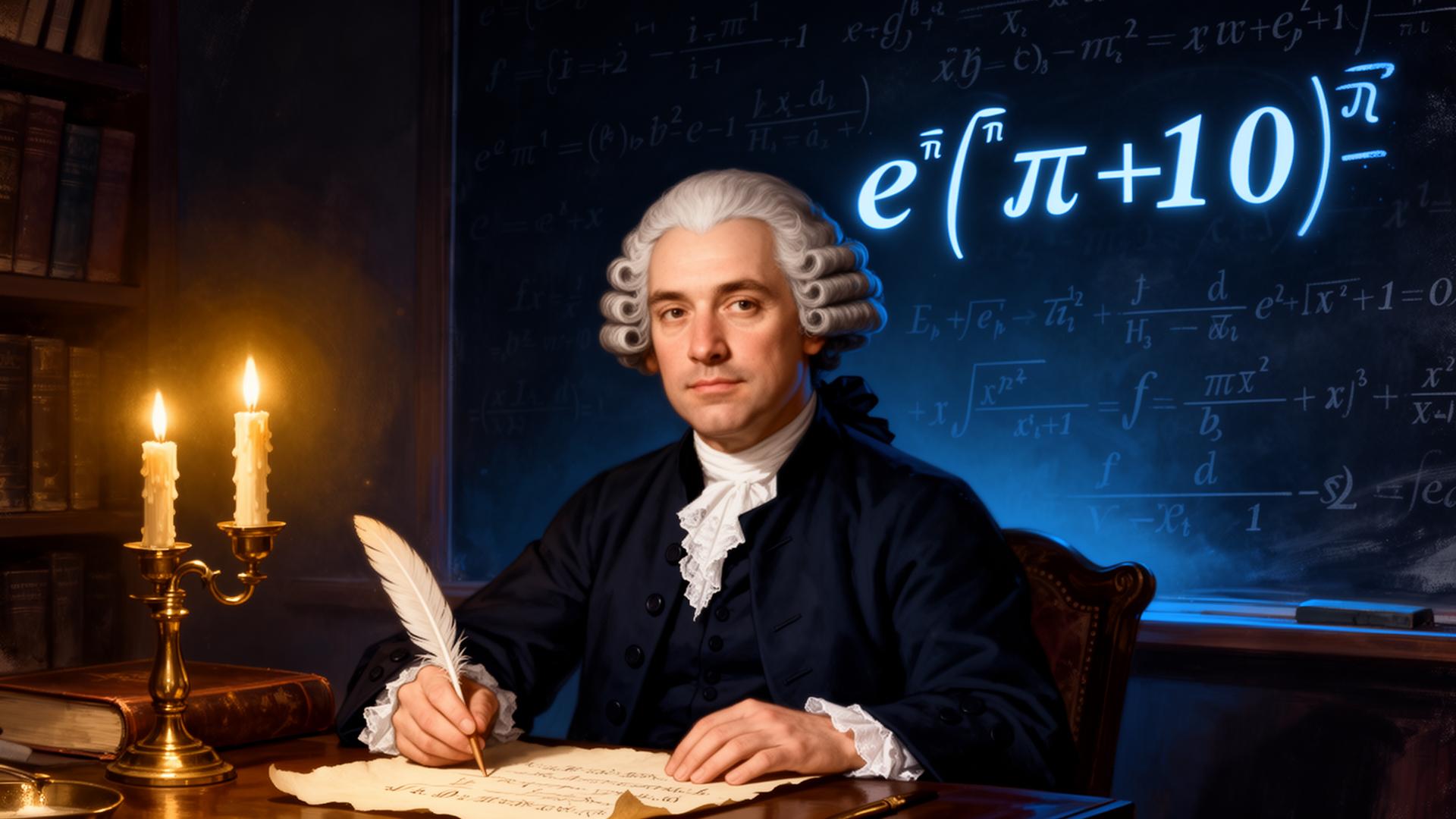
Leonhard Euler: The Most Prolific Mathematician in History
How a quiet Swiss pastor's son rewrote mathematics, invented the language we still use to do it, and produced half of his greatest work after going blind.
If there is a single name that runs through every page of modern mathematics, it belongs to Leonhard Euler. The symbols you used in school, the constants engineers rely on, the equations that power physics, electronics, computer science and even music theory — an astonishing share of them were either invented, popularized, or first written down in their modern form by a quiet Swiss mathematician working by candlelight more than two centuries ago.
Euler (pronounced OY-ler) wrote so much, so well, and across so many fields that the great French mathematician Pierre-Simon Laplace told his students: "Read Euler, read Euler. He is the master of us all." This profile, the second in our Great Brains series, follows the life of a man whose curiosity outran his eyesight, his exile, and even his own century.
Early Life in Switzerland
Leonhard Euler was born on April 15, 1707, in Basel, Switzerland. His father Paul was a Calvinist pastor who had studied mathematics under Jakob Bernoulli; his mother Marguerite came from a family of scholars. The household was modest, devout, intellectually warm — exactly the environment in which a curious child could thrive.
From very early on, Leonhard showed an uncommon talent for numbers. At 13 he was already enrolled at the University of Basel, and at 16 he had a Master's degree in philosophy. His father wanted him to follow the family path into the ministry, but a friend of the family insisted that the boy's gift was too rare to ignore. That friend was Johann Bernoulli, then the most respected mathematician in Europe.
Bernoulli agreed to give the young Euler private weekly lessons. He famously refused to answer questions during them — instead, he handed Euler the hardest texts of the day and told him to figure things out for himself. It was rigorous, lonely work, and it shaped a habit of independent problem-solving that Euler would never lose.
"Although it is not in our power to find a method of perpetual happiness, it is in our power to avoid being unhappy by occupying ourselves with mathematics."— Leonhard Euler
The Mathematical Genius
By his early twenties, Euler had been invited to join the brand-new Imperial Academy of Sciences in Saint Petersburg, where he would spend much of his career. What followed was a flood of original work that touched almost every part of mathematics and physics. A few highlights, in plain language:
Euler's Formula — connecting trigonometry to growth
Euler's formula, e^(ix) = cos(x) + i·sin(x), ties together two parts of mathematics that look completely unrelated: the exponential function (which describes growth) and trigonometry (which describes circles and waves). It is the single equation that makes modern signal processing, electrical engineering and quantum mechanics possible.
Euler's Identity — "the most beautiful equation in mathematics"
Plug π into Euler's formula and something almost miraculous happens. You get e^(iπ) + 1 = 0 — an equation that combines five of the most important constants in all of mathematics (0, 1, π, e and i) using exactly one each of the basic operations. Mathematicians routinely call it the most beautiful equation ever written.
The number e
The constant e ≈ 2.71828 shows up everywhere — in compound interest, population growth, radioactive decay, probability, and the maths of learning curves. Euler did not discover it, but he was the first to study it deeply, give it its symbol, and put it at the heart of analysis.
The Seven Bridges of Königsberg — the birth of graph theory
In 1736 the citizens of Königsberg had a popular puzzle: could you walk through the city and cross each of its seven bridges exactly once? Euler proved that you could not — and in doing so, invented an entirely new branch of mathematics. He represented the problem as dots connected by lines, ignored the geography, and reduced the question to a property of the dots. Today we call this graph theory, and it underlies everything from Google Maps and social networks to chip design and the internet itself.
Calculus, number theory, mechanics, astronomy and physics
Beyond his named results, Euler systematically reorganized calculus into the form taught today, advanced number theory alongside Fermat's legacy, rewrote classical mechanics in terms of forces and energy, computed lunar and planetary orbits used by navigators for a century, and laid the foundations of fluid dynamics, optics and continuum mechanics. Whole university courses are still built from a single chapter of his work.
An Astonishing Productivity
The sheer volume of what Euler produced is hard to believe. Over his lifetime he wrote roughly 850 books and papers. His collected works, the Opera Omnia, run to more than 80 large volumes — and editors are still finishing them more than 230 years after his death. For long stretches of the 18th century, Euler alone was responsible for a significant fraction of every mathematical paper published in Europe.
What makes this even more extraordinary is that he produced about half of it after going almost completely blind. He lost sight in his right eye in his early thirties; in 1771 a cataract surgery destroyed the vision in his remaining eye. Far from slowing down, his output actually increased. He dictated long, intricate proofs to assistants and to his sons, holding entire equations in his head and revising them mentally as he spoke.
Contemporaries said he could mentally calculate to fifty decimal places, recite Virgil's Aeneid from memory, and follow several conversations at once — all while quietly working on a celestial mechanics problem in the background. His mind, it seems, simply did not get tired.
Fun Facts & Notation
A surprising number of the symbols you used in math class come straight from Euler's pen. He didn't invent them all, but his textbooks were so widely read that whatever notation he adopted became the world standard. Among them:
- The symbol f(x) for a function of x.
- The letter e for the base of natural logarithms.
- The letter i for the imaginary unit, √–1.
- The Greek letter Σ (sigma) for summation.
- The modern use of π for the ratio of a circle's circumference to its diameter.
- The notation sin, cos, tan for trigonometric functions.
Every line of modern math, physics or engineering code you have ever seen is written in a notation that Euler either invented or made universal. He is also a quiet hero of computer science — his work on graphs is the mathematical bedrock of routing, search engines, neural networks, social graphs and the internet itself.
A few more anecdotes worth knowing: Euler had thirteen children and famously claimed to do some of his best mathematics with a baby on his lap. He once settled a court argument with the philosopher Denis Diderot using a tongue-in-cheek "algebraic proof" of God's existence. And when he died, the French philosopher Condorcet wrote that Euler had simply "ceased to calculate and to live" — both, by then, the same activity.
A Life in Milestones
The major moments that shaped Euler's life and work:
- 1707Born April 15 in Basel, Switzerland, to a Calvinist pastor and a learned mother.
- 1720Enters the University of Basel at age 13; soon studies privately with Johann Bernoulli.
- 1727Moves to Saint Petersburg to join the new Imperial Russian Academy of Sciences.
- 1735Solves the Basel problem, proving that 1 + 1/4 + 1/9 + ... = π²/6.
- 1736Publishes the solution to the Seven Bridges of Königsberg — the founding paper of graph theory and topology.
- 1741Accepts an invitation from Frederick the Great and moves to the Berlin Academy.
- 1748Publishes Introductio in analysin infinitorum, the foundational textbook of modern analysis.
- 1766Returns to Saint Petersburg at the invitation of Catherine the Great.
- 1771Loses sight in his remaining eye — and goes on to produce roughly half of his life's work while completely blind.
- 1783Dies September 18 in Saint Petersburg, mid-calculation on the orbit of the newly discovered planet Uranus.
Legacy and Influence
Two and a half centuries after his death, Euler is still everywhere. Open any university textbook in mathematics, physics, electrical engineering or computer science and you will meet him within a few pages — sometimes within a few lines. There are Euler equations in fluid dynamics, Euler angles in robotics and aerospace, Euler characteristics in topology, Euler paths in graph theory, the Euler–Lagrange equation in physics, and on and on.
He is also a reminder that great science is not the work of detached prodigies. Euler was a devoted family man, a man of deep faith, a careful teacher, and a craftsman who polished his ideas until they were genuinely beautiful. He wrote for students as carefully as he wrote for the academies — many of his books are still readable, and even enjoyable, today.
Why Euler Still Inspires
For students, programmers, engineers and lifelong learners, Euler offers a posture worth borrowing:
- Show up every day. Most of Euler's "miracles" were the byproduct of decades of patient daily work.
- Find good notation. Clear language and clear symbols are not decoration — they are how thinking gets easier.
- Don't let limits become excuses. Blindness, exile and isolation slowed him; they did not stop him.
- Stay generous. Euler taught, mentored, wrote textbooks and corresponded with hundreds of fellow scientists. Curiosity, for him, was a community.
"Read Euler, read Euler. He is the master of us all."— Pierre-Simon Laplace
Explore Your Own Mind
Euler believed that mathematics was a path to a calmer, sharper mind. These free Brain Geek tools are a fun place to test your own cognitive abilities:
Continue Exploring Brain Geek
👉Albert Einstein: The Genius Who Changed Our Understanding of the Universe — The first profile in our Great Brains series.
👉Discover more Great Brains — Upcoming profiles on Newton, Ramanujan, Turing, Curie, Tesla and many more.
👉The Complete Guide to the Human Brain — The cornerstone overview of brain architecture and chemistry.
👉The Complete Guide to Memory — How great thinkers built and used extraordinary memory.
👉The Complete Guide to Focus — The science of sustained, deep attention.
👉Dopamine Explained — The neurochemistry of curiosity, motivation and learning.
👉Cognitive Biases That Influence Your Decisions — The hidden shortcuts that shape how we think.
Key Lessons from Euler
- Curiosity is a lifelong habit, not a phase.
- Consistent, daily work outproduces any flash of genius.
- Clear language and clean notation make hard things possible.
- Adversity rarely cancels brilliance — sometimes it sharpens it.
- Knowledge grows fastest when it is shared generously.
Leonhard Euler reminds us that one quiet, persistent mind, working with patience and joy, can shape entire centuries of thought. Keep exploring with Brain Geek — and remember that every great theorem started as someone's curious question.