Why Your Attention Span Is Shrinking (And How to Get It Back)
The neuroscience behind the modern attention crisis — and an evidence-based blueprint to rebuild deep focus.
The Science Behind the Modern Attention Crisis
Why Does It Feel So Hard to Focus Today?
Have you ever opened your phone just to check the weather and, twenty minutes later, realized you were still scrolling through social media? Or sat down to read a book only to find yourself checking notifications every few minutes?
If so, you're not imagining things.
Many people report that they struggle to concentrate for long periods, finish books less often, and find deep work increasingly difficult. While the human brain has not fundamentally changed over the past few decades, the environment in which it operates certainly has.
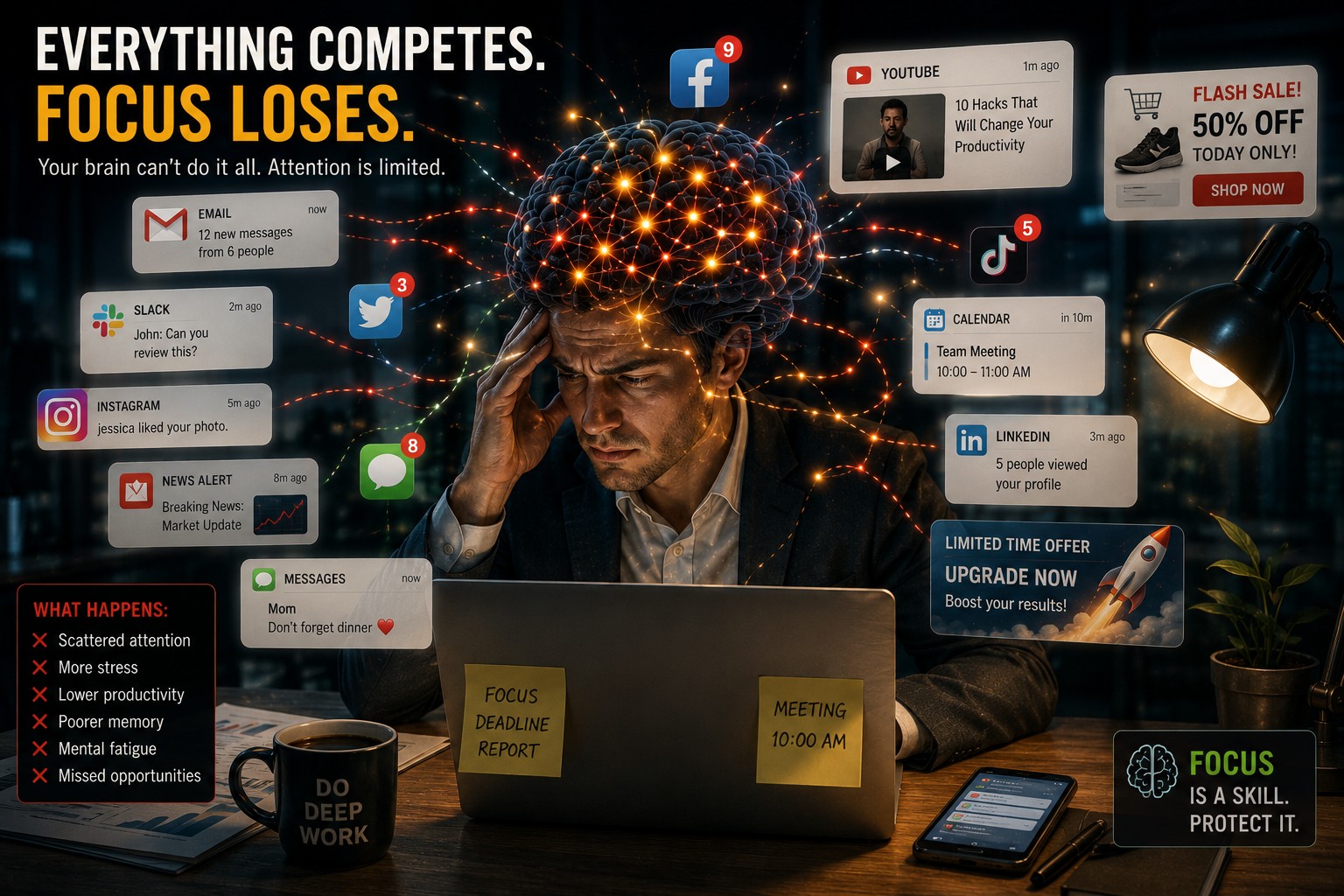
We now live in an economy where thousands of companies compete relentlessly for one scarce resource: your attention.
Understanding why this happens is the first step toward reclaiming your focus.
Attention: One of Your Brain's Most Valuable Resources
Contrary to popular belief, attention is not an unlimited resource. Your brain can only consciously process a limited amount of information at any given moment.
The prefrontal cortex, responsible for executive control and decision-making, acts like an air traffic controller. It constantly decides what deserves your focus and what should be ignored.
This system evolved in environments with relatively few distractions. For most of human history, paying attention meant noticing predators, tracking prey, reading social cues, or solving immediate survival problems.
Today's digital world presents something entirely different: an endless stream of notifications, videos, messages, advertisements, headlines, and recommendations specifically engineered to capture your gaze.
The result is cognitive overload.
The Attention Economy
Many of the world's largest technology companies do not primarily sell products—they sell attention. The longer you stay on a platform, the more advertisements you see, the more data is collected, and the more profitable your engagement becomes.
This creates strong incentives to design products that encourage:
- infinite scrolling,
- autoplay videos,
- algorithmically personalized feeds,
- push notifications,
- intermittent rewards,
- and constant novelty.
These features are not accidents. They are carefully optimized using behavioral science and machine learning to maximize user engagement. Every swipe promises something potentially rewarding: a funny video, an exciting message, breaking news, or social validation.
Your brain learns to keep checking.
Dopamine Loves Novelty
One of the biggest misconceptions is that dopamine is simply the "pleasure chemical." In reality, dopamine is deeply involved in motivation, anticipation, curiosity, and learning. Unexpected rewards generate powerful dopamine signals that encourage exploration and repeated behavior.
Social media platforms, short-form videos, and endless content feeds exploit exactly this mechanism. You never know what the next swipe will reveal:
- an entertaining clip,
- a shocking headline,
- a message from a friend,
- or something completely unexpected.
This variable reward schedule resembles the psychology behind slot machines and can strongly reinforce habitual checking. Over time, the brain becomes increasingly conditioned to seek novelty rather than sustained concentration. To dive deeper, read The Complete Guide to Dopamine.
Constant Interruptions Train the Brain to Be Distracted
Attention is highly trainable. Just as repeated exercise strengthens muscles, repeated behaviors strengthen neural pathways. Unfortunately, constantly interrupting yourself also becomes a learned habit.
Every time you:
- check a notification,
- switch browser tabs,
- answer a message,
- glance at email,
- or pick up your phone during focused work,
you reinforce rapid context switching instead of sustained attention. Eventually, your brain begins to expect interruptions and may even generate them internally through urges to "just quickly check something." This makes prolonged concentration increasingly difficult even in quiet environments.
Information Overload Exhausts Working Memory
Working memory functions like a temporary mental workspace where information is actively manipulated. Unfortunately, it has limited capacity.
Modern digital life bombards us with emails, text messages, social media posts, podcasts, advertisements, online meetings, videos, breaking news, and endless browser tabs. Each incoming item competes for processing resources.
When too much information accumulates simultaneously, mental fatigue increases, decision-making deteriorates, and productivity falls. Many people interpret this feeling as laziness when it is actually cognitive overload.
Multitasking Is Making the Problem Worse
One reason attention spans appear shorter is that many people spend their day switching rapidly between tasks. Research consistently shows that the brain performs demanding cognitive activities sequentially rather than simultaneously.
Each switch carries a mental cost known as a switching cost, requiring time and energy to reorient attention. Ironically, frequent multitasking creates the illusion of productivity while often reducing both speed and accuracy.
If you'd like to dive deeper into this topic, be sure to read our companion article: → The Hidden Cost of Multitasking.
How Digital Habits Are Rewiring Your Brain
Your Brain Adapts to How You Use It
One of the most remarkable features of the human brain is neuroplasticity — its ability to reorganize and strengthen neural connections based on repeated experience. This means your brain is constantly adapting to your habits.
Spend years learning a musical instrument, and the networks involved in motor control and auditory processing become stronger. Practice a new language every day, and language-related circuits become more efficient.
The same principle applies to attention. If you regularly practice sustained concentration, your brain becomes better at focusing. If you constantly switch tasks, check notifications, and consume rapid-fire content, your brain becomes increasingly optimized for distraction.
In other words, your daily habits shape the way your attention works. For the deeper science, read Neuroplasticity Explained.
The Rise of Short-Form Content
Platforms built around 15-second videos, endless scrolling, and personalized recommendations have fundamentally changed how many people consume information. Instead of engaging deeply with one idea, users are encouraged to jump rapidly from one stimulus to another.
Every swipe delivers something different: a comedy clip, a scientific fact, breaking news, an emotional story, or a cooking tutorial. The brain receives continuous novelty without requiring sustained mental effort.
Over time, slower activities — reading books, studying, writing, or solving complex problems — may begin to feel unusually demanding by comparison. This does not mean short-form content permanently damages the brain, but excessive exposure can reduce our tolerance for sustained cognitive effort.
Notifications Keep Your Brain on Alert
Every notification creates a small interruption. Even when you choose not to open it, part of your attention is redirected toward evaluating whether it deserves a response.
This phenomenon is sometimes called attentional residue: after switching away from one task, part of your mind remains occupied by the previous interruption, reducing performance on the current activity.
Multiple interruptions throughout the day create fragmented thinking and make it harder to enter states of deep concentration. Some studies even suggest that simply having your smartphone visible on your desk can reduce available cognitive capacity because part of your brain continues monitoring it.
The Myth of Constant Productivity
Modern culture often celebrates busyness. Answering emails instantly, responding immediately to messages, and staying permanently connected can create the impression of being highly productive.
However, neuroscience tells a different story. Creative thinking, problem-solving, and learning often require uninterrupted periods during which the brain can build complex mental models. Frequent interruptions prevent these deeper cognitive processes from unfolding.
Being constantly busy is not the same as making meaningful progress.
Social Media and Continuous Comparison
Social platforms are designed not only to capture attention but also to encourage repeated emotional engagement. Likes, comments, shares, and follower counts provide intermittent social rewards that encourage users to return frequently.
At the same time, constant exposure to carefully curated highlights from other people's lives can trigger comparison, anxiety, or fear of missing out (FOMO). Emotional distractions consume attentional resources just as effectively as external interruptions. A distracted emotional state often makes focused intellectual work significantly harder.
Sleep Deprivation Makes Attention Even Worse
Many people blame technology alone for declining concentration while overlooking one of the biggest contributors: poor sleep. During sleep, the brain consolidates memories, clears metabolic waste, and restores cognitive performance.
Insufficient or fragmented sleep impairs:
- sustained attention,
- working memory,
- decision-making,
- reaction time,
- emotional regulation,
- and learning.
The effects can resemble those seen after alcohol consumption or extended wakefulness. Late-night screen use may worsen the situation by delaying bedtime and exposing users to stimulating content just before sleep. For the full protocol, see The Complete Guide to Sleep.
Chronic Stress Hijacks Focus
Attention is closely linked to stress physiology. When the brain perceives threats or overwhelming demands, it prioritizes short-term survival over long-term planning.
Elevated stress hormones make it harder to sustain deliberate focus and easier to become distracted by potential threats or novel stimuli. Ironically, many people respond to stress by consuming even more digital media, creating a cycle of distraction that provides temporary relief while making concentration more difficult over time.
Learning stress-management techniques can therefore improve attention indirectly.
Children and Adolescents Face Unique Challenges
Developing brains are especially sensitive to environmental influences. Children today grow up surrounded by smartphones, tablets, streaming services, and social media from an early age.
While technology offers enormous educational opportunities, excessive multitasking and constant digital stimulation may interfere with opportunities to develop sustained attention skills through reading, imaginative play, and uninterrupted learning. Parents and educators increasingly recognize the importance of balancing screen use with activities that promote deep engagement and cognitive development.
Can Your Attention Span Actually Be Rebuilt?
The encouraging news is yes. Because the brain remains plastic throughout life, attentional abilities can improve with deliberate practice.
Many people notice significant gains after reducing unnecessary notifications, scheduling focused work sessions, improving sleep habits, and intentionally limiting digital distractions. Just as distraction can become habitual, so can concentration. Your brain adapts to whichever pattern you repeat consistently.
How to Rebuild Your Attention Span and Train Your Brain for Deep Focus
The Good News: Your Brain Can Recover
If you've spent years jumping between apps, checking notifications every few minutes, or consuming endless streams of short-form content, you might worry that your attention span is permanently damaged.
Fortunately, neuroscience offers a reassuring answer. Thanks to neuroplasticity, the brain remains capable of change throughout life. Just as repeated distractions can strengthen habits of constant task-switching, repeated periods of focused work can rebuild your ability to concentrate.
The key is consistency rather than perfection.
10 Evidence-Based Strategies to Rebuild Attention
1. Eliminate Unnecessary Notifications
Every notification is a potential interruption, and even brief interruptions can break concentration. Start by auditing your devices:
- Disable non-essential push notifications.
- Remove badges that constantly demand attention.
- Turn off sounds and vibrations for social media apps.
- Keep only critical alerts such as calls from close family or work emergencies.
By reducing external triggers, you allow your brain to remain engaged with the task at hand.
2. Practice Single-Tasking
Despite its popularity, multitasking is usually just rapid task-switching. Instead, commit to working on one cognitively demanding activity at a time: write one report, read one chapter, solve one problem, or study one subject.
Single-tasking reduces mental switching costs and allows deeper understanding. If you haven't yet, read our companion article The Hidden Cost of Multitasking to understand why doing less often means accomplishing more.
3. Schedule Deep Work Sessions
Focus rarely happens by accident. Many highly productive people intentionally block uninterrupted periods dedicated to demanding cognitive work. A useful starting point is:
- 25 minutes of focused work followed by a short break (Pomodoro method), or
- 60–90 minutes of uninterrupted deep work for more experienced practitioners.
During these sessions silence your phone, close unnecessary browser tabs, log out of distracting websites, and avoid checking messages. Treat these periods as appointments with your future self. For a full protocol, read The Complete Guide to Focus.
4. Read Long-Form Content Again
Books demand sustained attention in a way that short videos and social media feeds rarely do. If reading has become difficult:
- begin with just 10 pages per day,
- gradually increase session length,
- read without checking your phone,
- and choose topics that genuinely interest you.
Over time, your tolerance for deep concentration often improves significantly. This is one of the simplest and most effective ways to retrain your brain. To improve retention while you read, see Why We Forget and How to Remember More and The Complete Guide to Memory.
5. Protect Your Sleep
Attention depends heavily on sleep quality. Aim for consistent bedtimes, sufficient nightly sleep, reduced screen exposure before bed, and a cool, quiet sleeping environment.
Well-rested brains show better executive control, stronger working memory, and greater resistance to distraction. For more science-backed advice, explore The Complete Guide to Sleep.
6. Exercise Regularly
Physical activity benefits far more than muscles. Regular exercise supports cerebral blood flow, neuroplasticity, mood regulation, stress reduction, and executive function.
Even brisk walking can improve cognitive performance and help restore attentional control. Many people notice better concentration after incorporating movement into their daily routines.
7. Practice Mindfulness
Mindfulness meditation trains the ability to notice when attention wanders and gently redirect it. Even 10 minutes per day may improve sustained attention, emotional regulation, self-awareness, and resistance to distraction.
Importantly, mindfulness is not about emptying the mind — it is about strengthening attentional control through repeated practice.
8. Reduce Digital Friction
Small environmental changes can produce large behavioral effects. Try:
- keeping your phone in another room while working,
- using website blockers during study sessions,
- deleting rarely used social media apps,
- switching your screen to grayscale,
- or setting specific times for checking email.
The goal is not to eliminate technology but to make intentional choices easier than impulsive ones.
9. Train Working Memory
Working memory and attention are closely connected. Challenge your brain through activities such as mental arithmetic, learning a language, playing strategy games, memorization exercises, or using our Working Memory Assessment to monitor your cognitive performance.
10. Accept That Boredom Is Healthy
Modern life offers constant stimulation, leaving little room for boredom. Yet moments without external input encourage reflection, creativity, planning, and problem-solving.
Instead of immediately reaching for your phone while waiting in line or riding public transport, allow your mind to wander occasionally. These quiet moments give your attentional system valuable opportunities to reset.
A 7-Day Attention Reset Challenge
If you'd like to begin immediately, try this simple experiment:
- Day 1 — Turn off all non-essential notifications.
- Day 2 — Complete one uninterrupted 30-minute focus session.
- Day 3 — Read 20 pages of a physical book without checking your phone.
- Day 4 — Take a one-hour walk without social media.
- Day 5 — Spend 10 minutes practicing mindfulness meditation.
- Day 6 — Keep your phone outside the bedroom overnight.
- Day 7 — Complete 90 minutes of deep work with all distractions removed.
Many people notice measurable improvements in focus after just one week.
Final Thoughts
Your attention span is not disappearing because your brain is broken. It is adapting to the environment you repeatedly expose it to.
The encouraging news is that this process works both ways. By reducing unnecessary distractions, protecting your sleep, practicing sustained concentration, and making thoughtful use of technology, you can rebuild your capacity for deep focus.
In a world where attention has become one of the most valuable resources, learning to control yours may be one of the greatest competitive advantages you can develop — not only for productivity, but for learning, creativity, and a richer, more intentional life.
You May Also Like
- The Complete Guide to Focus
- The Hidden Cost of Multitasking
- The Complete Guide to Dopamine
- The Complete Guide to Sleep
- Neuroplasticity Explained
- Why We Forget and How to Remember More
- The Complete Guide to Memory
- Why Humans Make Irrational Decisions
- Cognitive Biases That Influence Your Decisions