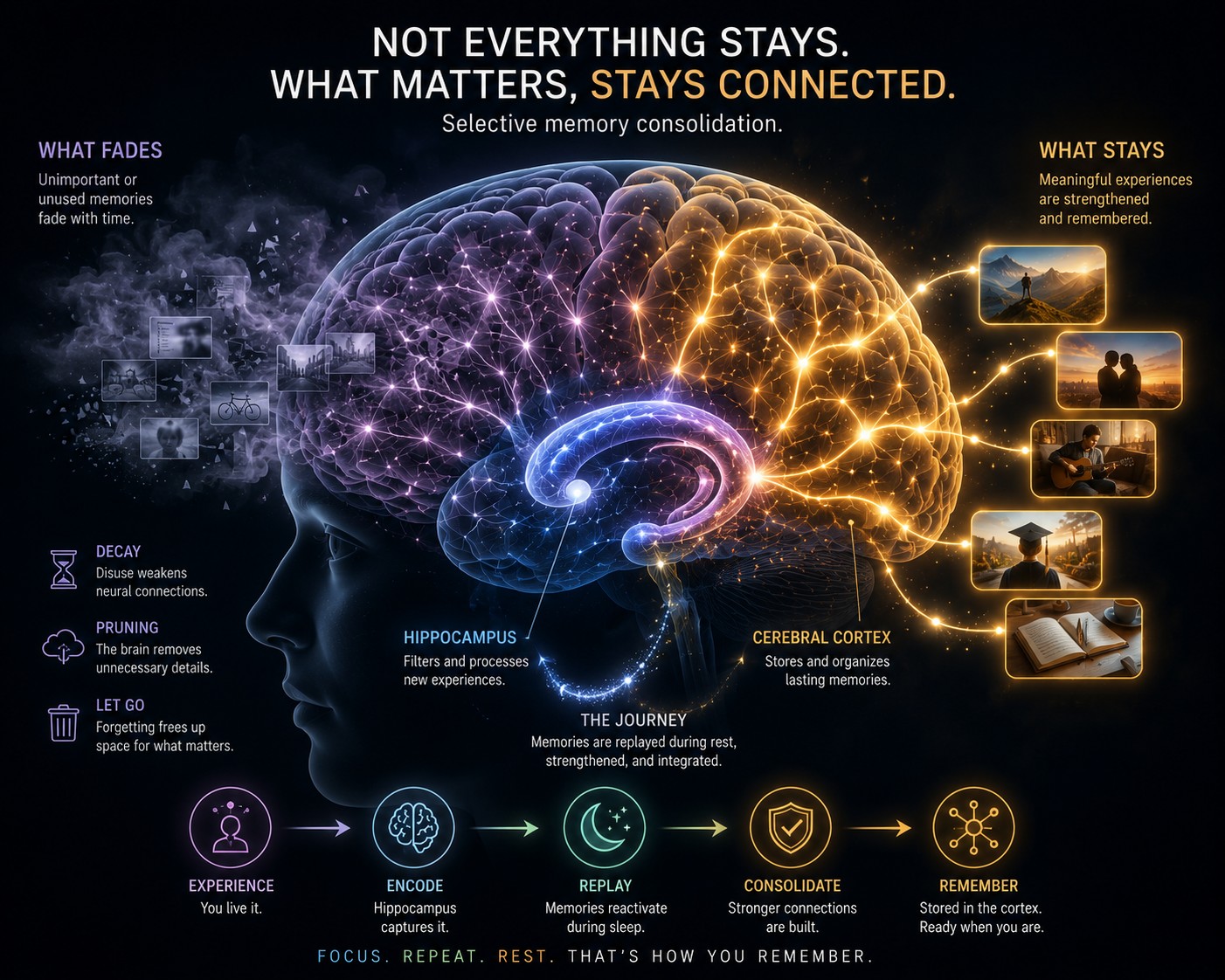
Why We Forget and How to Remember More
The Science Behind Forgetting and the Secrets to Long-Lasting Memory.
Why Do We Forget?
Have you ever studied something intensively, only to realize a few days later that most of it has vanished from your mind? Or walked into a room and completely forgotten why you went there? These experiences are so common that many people assume they simply have a "bad memory."
Fortunately, neuroscience tells a different story.
Forgetting is not a malfunction of the brain — it's an essential feature. Our brains evolved to filter enormous amounts of information, preserving what seems useful while discarding details that appear irrelevant. Without this filtering system, our minds would quickly become overwhelmed.
The exciting part is that memory is highly adaptable. By understanding how forgetting works, we can use scientifically validated strategies to dramatically improve what we retain.
Forgetting Is Actually Useful
It may sound surprising, but forgetting serves an important biological purpose.
Every day, your senses collect millions of pieces of information: faces, sounds, conversations, advertisements, numbers, colors, and countless tiny details. If your brain stored all of them equally, finding important memories would become nearly impossible.
Instead, your nervous system constantly prioritizes.
Healthy forgetting allows you to:
- Reduce cognitive overload.
- Adapt to changing environments.
- Focus on relevant information.
- Generalize concepts instead of memorizing every detail.
- Learn new information without saturating memory capacity.
In many ways, forgetting is just as important as remembering.
How Memories Are Created
Memory formation can be divided into three major stages.
1. Encoding
Before something can be remembered, it must first be encoded. This requires attention.
If you're distracted while reading, multitasking during a lecture, or constantly checking your phone, the information may never be properly encoded in the first place.
Many memory failures are actually attention failures.
2. Consolidation
Once encoded, memories undergo consolidation, a biological process involving the hippocampus and widespread cortical networks.
Sleep plays a particularly important role during this phase by strengthening newly formed neural connections.
3. Retrieval
Finally, memories must be retrieved.
Sometimes the information is still stored but temporarily inaccessible — a phenomenon known as retrieval failure. This explains why a forgotten name often suddenly comes back hours later.
The Forgetting Curve
More than a century ago, psychologist Hermann Ebbinghaus demonstrated that forgetting follows a predictable pattern.
After learning new information, retention drops rapidly if there is no review. The biggest losses often occur within the first hours or days.
This phenomenon became known as the forgetting curve.
Fortunately, each successful review strengthens the memory trace and slows future forgetting. Reviewing information just before it would otherwise be forgotten produces remarkably durable long-term retention.
This simple discovery became the foundation for modern learning methods such as spaced repetition.
The Main Reasons We Forget
Scientists have identified several major mechanisms that explain why memories disappear.
Weak Encoding
If information never receives sufficient attention, it cannot be stored effectively.
Common causes include:
- Multitasking while learning.
- Passive reading without engagement.
- Frequent smartphone interruptions.
- Studying while mentally fatigued.
Improving attention at the moment of learning is often more valuable than spending additional hours reviewing later.
Decay Over Time
Neural connections that are not regularly reactivated tend to weaken.
This does not necessarily mean memories vanish completely, but they become harder to retrieve as time passes.
Regular review strengthens these pathways and keeps information accessible.
Interference
Sometimes old memories interfere with new ones — or vice versa.
For example, learning multiple foreign languages simultaneously may cause vocabulary from one language to intrude on another.
Similarly, learning several similar concepts in quick succession can create confusion if they are not sufficiently differentiated.
Retrieval Failure
Many memories remain stored but cannot be accessed at a particular moment.
Stress, anxiety, fatigue, and lack of contextual cues can temporarily block recall even when the information is still present in the brain.
This is why people often remember something only after they stop actively trying to recall it.
Emotion and Memory
Emotion strongly influences what we remember.
Events associated with surprise, joy, fear, or personal significance activate brain systems involving the amygdala, increasing the likelihood that memories will be consolidated.
However, extreme stress can have the opposite effect.
High levels of chronic stress hormones may impair hippocampal function and reduce both learning efficiency and recall accuracy.
Maintaining good emotional regulation is therefore an important component of effective memory.
If you'd like to better understand how memories are physically stored in the brain, read The Complete Guide to Memory, which explains episodic memory, semantic memory, procedural learning, and the neural circuits involved in long-term storage.
You may also enjoy:
- The Science of Deliberate Practice — learn how expert performers transform repetition into mastery.
- The Complete Guide to Spaced Repetition — discover one of the most effective evidence-based learning techniques ever studied.
- Neuroplasticity Explained — understand how the brain physically rewires itself through experience.
- The Complete Guide to Sleep — explore why quality sleep is essential for memory consolidation and long-term learning.
How to Strengthen Memory and Retain Information for Life
Now that we understand why forgetting occurs, the obvious question is: Can we do anything about it?
The answer is a resounding yes.
Decades of research in cognitive psychology and neuroscience have identified several highly effective techniques that dramatically improve long-term retention. Interestingly, many of these methods are simple to apply but often feel less intuitive than passive review.
1. Use Active Recall Instead of Passive Review
Many students reread textbooks or highlight passages, believing that familiarity equals learning.
Unfortunately, simply seeing information again creates an illusion of competence without significantly strengthening memory.
A much more effective strategy is active recall.
Instead of rereading your notes, close the book and ask yourself:
- What can I remember?
- How would I explain this concept to someone else?
- Can I write down the key ideas without looking?
Each attempt to retrieve information strengthens the neural pathways associated with that memory, making future recall easier.
2. Space Your Learning Sessions
One of the biggest mistakes learners make is cramming everything into a single study session.
While massed practice may produce short-term gains, much of the information is quickly forgotten.
Spaced repetition distributes review sessions over increasing intervals, allowing memories to be reinforced just as they begin to weaken.
A simple review schedule might look like:
- Day 1: Learn new material.
- Day 2: First review.
- Day 5: Second review.
- Day 10: Third review.
- Day 21: Fourth review.
- Day 45: Fifth review.
Each successful retrieval further consolidates the memory and slows forgetting.
3. Test Yourself Frequently
Testing is not just a way to measure learning — it is one of the most effective ways to create learning.
Researchers call this the testing effect.
Practice quizzes, flashcards, and self-generated questions force the brain to reconstruct knowledge instead of merely recognizing it.
Even unsuccessful retrieval attempts can improve future learning by highlighting knowledge gaps.
The goal isn't to avoid mistakes but to learn from them.
4. Connect New Knowledge to Existing Knowledge
The brain remembers information more easily when it fits into existing mental frameworks.
Whenever possible, ask yourself:
- What does this remind me of?
- How does this relate to something I already know?
- Can I connect this idea to a personal experience?
Creating associations builds multiple retrieval pathways, increasing the chances that the memory will remain accessible.
For example, remembering that the hippocampus is involved in forming memories becomes easier when you connect it to stories about patients with hippocampal damage or to previous neuroscience concepts.
5. Learn by Teaching
One of the best ways to discover whether you truly understand something is to teach it.
Explaining an idea forces you to organize knowledge, simplify complex concepts, and identify gaps in understanding.
The popular "Feynman Technique" follows this principle:
- Study a concept.
- Explain it in simple language.
- Identify areas where your explanation breaks down.
- Review those weak points.
- Repeat until the explanation is clear.
Teaching transforms passive familiarity into genuine mastery.
6. Prioritize Sleep
Memory consolidation continues long after studying ends.
During sleep, especially during slow-wave sleep and REM sleep, the brain reactivates recently acquired information and strengthens important neural connections.
Consistently sleeping seven to nine hours improves learning, recall, creativity, and problem-solving.
By contrast, sleep deprivation significantly reduces the ability to encode new memories and retrieve existing ones.
Late-night cramming may therefore be counterproductive. Learn more in The Complete Guide to Sleep.
7. Exercise Your Brain by Exercising Your Body
Physical activity benefits much more than muscles.
Regular aerobic exercise increases blood flow to the brain and stimulates the production of growth factors that support neuroplasticity and hippocampal health.
Studies consistently associate exercise with better learning performance and reduced age-related cognitive decline.
Even brisk walking several times per week may positively influence memory.
8. Feed Your Brain Properly
Although no food instantly improves memory, long-term dietary patterns influence cognitive health.
Research generally supports diets rich in:
- Fatty fish containing omega-3 fatty acids.
- Nuts and seeds.
- Leafy green vegetables.
- Berries.
- Legumes.
- Whole grains.
- Olive oil.
Staying hydrated and avoiding excessive ultra-processed foods may also contribute to better cognitive performance.
Common Memory Myths
Related Brain Geek Articles
- The Complete Guide to Memory
- The Complete Guide to Spaced Repetition
- The Science of Deliberate Practice
- Neuroplasticity Explained
- The Complete Guide to Focus
- The Complete Guide to Sleep
Advanced Memory Techniques and Daily Habits for Lifelong Learning
By now, you've learned that forgetting is a natural part of how the brain works and that evidence-based strategies like active recall and spaced repetition can dramatically improve retention.
But some people seem capable of remembering astonishing amounts of information. Memory champions can memorize hundreds of numbers, decks of cards, or long lists of words in minutes.
Do they have extraordinary brains?
Surprisingly, the answer is usually no.
Most rely on powerful mnemonic techniques that anyone can learn.
The Memory Palace Technique
One of the oldest and most effective memory strategies is the memory palace, also known as the method of loci.
The idea is simple:
- Choose a familiar place, such as your home.
- Mentally walk through it in a fixed order.
- Place vivid mental images representing the information you want to remember in specific locations.
- Later, revisit the location in your imagination to retrieve the information.
Because the human brain is exceptionally good at remembering places and visual scenes, this technique can produce remarkable results.
Chunking: Turning Many Items into Fewer Items
Working memory has limited capacity.
Instead of trying to remember ten unrelated digits individually, we naturally group them into meaningful chunks.
For example:
149217761945- becomes
1492 — 1776 — 1945
The same principle applies to vocabulary, formulas, shopping lists, and complex procedures.
Breaking information into logical groups reduces cognitive load and makes retrieval easier.
Use Visual Imagery
The brain often remembers pictures better than abstract words.
When learning something new, try transforming it into a vivid mental image.
The stranger, funnier, or more emotionally engaging the image, the more memorable it tends to become.
For example, to remember that the hippocampus is essential for memory formation, you might imagine a giant hippopotamus organizing books inside a library.
Although absurd, these unusual associations create stronger retrieval cues than dry repetition.
Tell Stories Instead of Memorizing Lists
Humans evolved as storytellers.
Our brains naturally remember narratives with characters, emotions, goals, and sequences of events.
Whenever possible, convert disconnected facts into a coherent story.
Medical students, language learners, historians, and public speakers frequently use narrative structures to improve recall.
A meaningful story creates multiple connections between individual pieces of information.
Interleaving: Mix Topics Instead of Blocking Them
Many learners spend hours studying only one subject before moving to another.
Research suggests that interleaving — alternating related topics — can produce better long-term learning.
For example, instead of studying only algebra for three hours, you might rotate between:
- Algebra
- Geometry
- Statistics
- Problem solving
This approach forces the brain to discriminate between concepts and strengthens flexible retrieval.
It often feels harder in the moment but leads to better retention over time.
Use Desirable Difficulties
Learning should not always feel easy.
In fact, introducing manageable challenges often strengthens memory.
Examples include:
- Solving problems before checking the answer.
- Recalling notes from memory before rereading them.
- Delaying reviews slightly instead of reviewing immediately.
- Generating explanations in your own words.
These "desirable difficulties" increase effort during learning but produce more durable memories.
Reduce Cognitive Overload
The modern world constantly competes for your attention.
Notifications, emails, social media, and multitasking fragment concentration and impair encoding. Learn more in The Complete Guide to Focus.
To improve memory:
- Silence unnecessary notifications.
- Study in focused blocks.
- Keep only essential tabs open.
- Eliminate background distractions when possible.
- Give full attention to one task at a time.
Attention is the gateway to memory. If information never receives focused attention, it cannot be reliably stored.
Build a Brain-Friendly Lifestyle
Strong memory is not built during study sessions alone.
Daily habits play a major role.
Consider making these practices part of your routine:
- Sleep 7–9 hours consistently.
- Exercise most days of the week.
- Eat a balanced diet rich in whole foods.
- Stay socially engaged.
- Continue learning throughout life.
- Manage chronic stress.
- Review important knowledge regularly.
- Stay intellectually curious.
Memory is a product of overall brain health — supported by neuroplasticity, healthy dopamine signaling, and awareness of cognitive biases — not a single trick or supplement.
A Practical Daily Memory Routine
If you want to maximize retention without spending endless hours studying, try this simple framework:
Morning
- Review yesterday's material for 10–15 minutes.
- Test yourself before looking at your notes.
During Learning
- Study in focused sessions.
- Take brief breaks.
- Explain concepts aloud in your own words.
- Create connections with prior knowledge.
Evening
- Complete a short retrieval session.
- Identify weak points.
- Schedule future reviews using spaced repetition.
Weekly
- Mix topics through interleaving.
- Solve practice problems without assistance.
- Teach someone else what you've learned.
Small, consistent efforts outperform occasional marathon study sessions.
Key Takeaways
The science of forgetting offers an encouraging message: your memory is far more trainable than most people believe.
Remember these core principles:
- Forgetting is a normal and adaptive brain function.
- Attention is essential for encoding memories.
- Retrieval strengthens memory more than rereading.
- Spaced repetition dramatically slows forgetting.
- Sleep consolidates newly learned information.
- Exercise and healthy nutrition support brain function.
- Mnemonic techniques create powerful retrieval cues.
- Consistency beats cramming.
- Lifelong learning keeps neural networks active and adaptable.
You don't need a photographic memory to become an exceptional learner. You simply need to work with your brain rather than against it.
Continue Your Brain Geek Journey
If you enjoyed this guide, continue exploring the science of learning with these related articles:
- The Complete Guide to the Human Brain
- The Complete Guide to Memory
- The Complete Guide to Spaced Repetition
- The Science of Deliberate Practice
- Neuroplasticity Explained
- The Complete Guide to Focus
- The Complete Guide to Sleep
- The Complete Guide to Dopamine
- Cognitive Biases That Influence Your Decisions
Explore the full Learning & Memory topic, browse all Brain Geek articles, or try our free brain tools.
Final Thoughts
Forgetting is not the enemy of learning — it is part of learning.
Every time you successfully retrieve information, revisit it after a delay, connect it to existing knowledge, or apply it in a meaningful context, you strengthen the neural pathways that make future recall easier.
The goal is not to remember everything.
The goal is to remember what matters, when it matters, and to build habits that allow knowledge to compound over a lifetime.