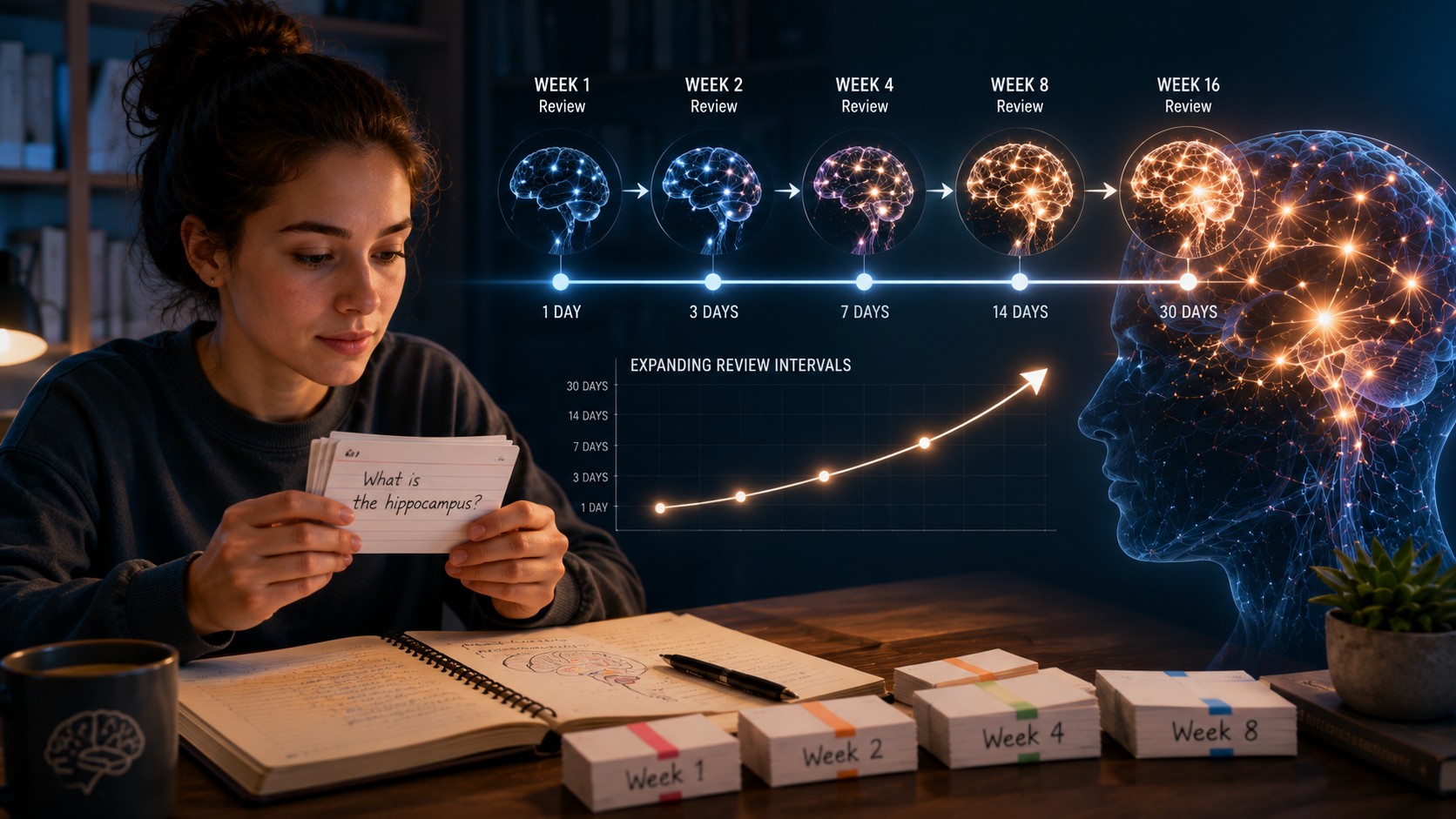
The Complete Guide to Spaced Repetition
How science can help you remember almost everything — the neuroscience, the schedules and the systems that turn study time into lifelong knowledge.
Why Some People Never Forget
Imagine learning a foreign language and still remembering thousands of words years later.
Imagine preparing for a medical exam without endlessly rereading your notes. Imagine remembering names, formulas, programming syntax, historical dates or scientific concepts with surprisingly little effort.
This isn't the result of having a photographic memory. It's the result of using your brain the way it was designed to learn.
One of the most powerful discoveries in cognitive science is that when you review information matters far more than how many times you review it. Instead of cramming repeatedly over a few days, the brain learns best when reviews are carefully spaced over increasing intervals.
This principle is called spaced repetition, and it is one of the most scientifically validated learning techniques ever discovered. Whether you're a student, language learner, physician, engineer, musician, programmer or simply someone who wants to remember more, it can dramatically improve long-term memory while reducing total study time.
In this guide you'll discover:
- Why forgetting is actually useful
- The science behind the forgetting curve
- How spacing strengthens memory
- Why cramming fails
- The best review intervals
- Digital and paper systems
- How to combine spaced repetition with active recall
- Common mistakes
- Practical routines for every learner
By the end, you'll understand how to make information stick for years rather than days.
Why We Forget
Before understanding spaced repetition, we first need to understand forgetting.
Contrary to popular belief, forgetting isn't a flaw. It's an essential feature of an efficient brain.
Imagine remembering every conversation, every advertisement, every street sign, every password you've ever changed and every shopping receipt. Your brain would quickly become overwhelmed.
Instead, the brain constantly decides:
- What's important
- What's temporary
- What deserves long-term storage
Only information that repeatedly proves valuable gets preserved. This is one reason memories fade if we never revisit them. For a deeper look at the mechanisms, see our companion guide Why We Forget and How to Remember More.
The Forgetting Curve
In 1885, German psychologist Hermann Ebbinghaus conducted one of the first scientific studies on human memory. He memorized thousands of meaningless syllables and measured how quickly he forgot them. His findings became famous as the Forgetting Curve.
The results were striking. Most information is forgotten astonishingly quickly. Without review:
- Much is forgotten within hours.
- More disappears after a day.
- After a week only fragments remain.
- After a month very little survives.
The good news? Every successful review dramatically slows future forgetting. Instead of fighting the forgetting curve, spaced repetition works with it.
Why Cramming Doesn't Work
Nearly everyone has experienced this. You study intensely for an exam. You perform well. Two weeks later... most of the information has vanished.
Cramming creates the illusion of learning because information is temporarily active inside working memory. But temporary accessibility isn't the same as long-term storage. The brain needs repeated retrieval over time before memories become stable.
This explains why students often confuse familiarity with mastery. Reading the same page five times feels productive. It rarely is.
Retrieving information from memory — not rereading it — is what actually strengthens learning.
The Brain Loves Productive Difficulty
One surprising discovery from cognitive psychology is that learning feels strongest when it feels hardest.
If recalling information requires a little effort — but is still successful — the brain interprets that information as valuable. Each successful retrieval strengthens neural pathways. This concept is known as desirable difficulty.
Spaced repetition intentionally makes recall slightly harder by increasing the time between reviews. The result is stronger, longer-lasting memories.
The Science Behind Spaced Repetition
Every time you successfully recall a memory, several important things happen inside the brain. Neurons involved in that memory become active together. Their connections strengthen through repeated activation. This process is often explained by the famous neuroscience principle:
"Neurons that fire together wire together."
Each successful review reinforces:
- Synaptic strength
- Neural efficiency
- Retrieval pathways
- Long-term consolidation
Eventually, recalling the information becomes almost automatic. This is why experts appear to possess incredible memories — in reality, they have often strengthened those memories hundreds of times over many years. This same mechanism is at the heart of neuroplasticity.
Spaced Repetition vs Traditional Studying
| Traditional Study | Spaced Repetition |
|---|---|
| Cramming | Distributed learning |
| Re-reading | Active recall |
| Passive recognition | Memory retrieval |
| Short-term performance | Long-term retention |
| High study time | Efficient study time |
| Easy sessions | Productive difficulty |
| Frequent forgetting | Durable memory |
Research consistently shows that spaced repetition produces significantly better long-term retention while often requiring less total study time.
Active Recall + Spaced Repetition: The Perfect Combination
Spaced repetition is powerful. Active recall is powerful. Together they become one of the most effective learning systems ever studied.
Instead of simply reading notes, ask yourself questions:
- What are the four major neurotransmitters?
- What happens during REM sleep?
- What is neuroplasticity?
- Explain dopamine in your own words.
- Draw the structure of a neuron from memory.
Every retrieval strengthens the memory. Every spaced review preserves it. Together they create exceptionally durable knowledge. For a complete deep dive, read The Complete Guide to Memory.
Other free Brain Geek tools to support your learning system:
- Brain Health Score — lifestyle factors that influence memory and learning.
- Cognitive Profile Assessment — your strengths across memory, attention and reasoning.
- Brain Age Calculator — a quick cognitive snapshot.
Continue Learning
If you're interested in mastering memory and learning, don't miss these related guides:
- The Complete Guide to Memory
- Why We Forget and How to Remember More
- The Science of Deliberate Practice
- Neuroplasticity Explained
- The Complete Guide to Focus
- The Complete Guide to Dopamine
The Ideal Review Schedule
Understanding the science is only the first step. The real power of spaced repetition comes from applying it consistently. Fortunately, you don't need to spend hours reviewing every day — in fact, one of the biggest advantages of spaced repetition is that it allows you to study less while remembering more.
The key is reviewing information just before you're about to forget it.
Although no schedule is perfect for everyone, decades of research suggest that expanding intervals produce excellent long-term retention. A typical schedule might look like this:
| Review | Time After Learning |
|---|---|
| First review | Same day |
| Second review | 1 day later |
| Third review | 3 days later |
| Fourth review | 7 days later |
| Fifth review | 14 days later |
| Sixth review | 30 days later |
| Seventh review | 90 days later |
| Eighth review | 6 months later |
| Ninth review | 1 year later |
Notice that each interval becomes longer. As memories become stronger, they require fewer reviews. This is why experts can remember information learned decades earlier with only occasional refreshers.
Why Timing Matters
Reviewing too soon wastes time. Reviewing too late forces you to relearn everything. The ideal review occurs when recalling the information feels slightly difficult but still successful. This "sweet spot" maximizes learning.
Each successful retrieval sends a powerful signal to the brain:
"This information is important. Keep it."
Modern spaced repetition software continuously estimates this optimal moment.
Digital vs Paper Systems
Both methods work. The best choice depends on your learning style.
Paper Flashcards
Advantages: simple, inexpensive, no distractions, excellent for handwriting practice.
Disadvantages: difficult to organize thousands of cards, manual scheduling, limited statistics.
Digital Flashcards
Advantages: automatic scheduling, smart algorithms, thousands of cards, image/audio/video support, progress tracking, cloud sync.
Disadvantages: screen fatigue, potential distractions, learning curve for advanced software.
For most learners studying large amounts of information, digital systems quickly become more efficient.
The Leitner System
Before smartphones existed, one of the most effective paper-based methods was the Leitner Box System.
- Box 1: new cards reviewed every day.
- Box 2: correct answers move here and are reviewed every 3 days.
- Box 3: correct answers move again and are reviewed weekly.
- Box 4: reviewed every two weeks.
- Box 5: reviewed monthly.
Whenever you forget a card, it returns to Box 1. Simple. Effective. Still widely used today.
How Anki Revolutionized Learning
One of the biggest advances in modern education has been the development of intelligent spaced repetition software. Among these, Anki has become the gold standard.
Instead of fixed review intervals, Anki continuously estimates:
- How difficult each card is
- How easily you recalled it
- How often you've succeeded
- The probability you'll forget it
Each answer slightly changes the next review date. Difficult cards appear sooner. Easy cards may not appear again for months — or even years. The result is remarkably efficient studying. Medical students, language learners, lawyers, engineers, pilots and programmers around the world rely on this approach.
Creating Better Flashcards
Many beginners unknowingly create poor flashcards. Large blocks of text rarely work well. Instead, each card should test one idea only. Good examples:
Short questions produce faster recall and more efficient reviews.
The Minimum Information Principle
Learning researchers recommend minimizing the amount of information contained in each flashcard. Instead of asking "What are the four neurotransmitters and all their functions?", create several cards:
- What does dopamine primarily regulate?
- What is serotonin associated with?
- What role does acetylcholine play?
- What is the primary inhibitory neurotransmitter?
Small pieces of information are remembered far more reliably.
Using Images to Improve Memory
The brain processes visual information extremely efficiently. Whenever possible, include:
- Diagrams
- Anatomical illustrations
- Maps and charts
- Scientific figures and molecular structures
- Historical paintings
Images activate additional memory pathways and often make retrieval easier — particularly effective for anatomy, geography, biology, chemistry, engineering and art history.
Learning Languages with Spaced Repetition
Language learners benefit enormously from spaced repetition. Instead of memorizing vocabulary lists repeatedly, each word is reviewed only when necessary.
An effective card pairs a picture of an apple with "Pomme" — even better than the bare word pair "Apple → Pomme". Including pronunciation audio further strengthens learning. Grammar rules, verb conjugations and sentence patterns can all be reviewed using the same principles.
Beyond Flashcards
Many people believe spaced repetition only works with flashcards. It doesn't. It can also be applied to:
- Mathematical formulas
- Musical pieces
- Programming syntax
- Medical diagnoses
- Chess openings
- Historical timelines
- Scientific concepts
- Public speaking, law, engineering, religious texts
Anything that requires long-term retention can benefit.
Common Mistakes That Make Spaced Repetition Less Effective
Spaced repetition is incredibly powerful — but only when used correctly. Many beginners become discouraged because they unknowingly make mistakes that reduce its effectiveness. Fortunately, most are easy to fix.
How Experts Build Lifelong Knowledge
Professionals in many fields rely on spaced repetition throughout their careers. Medical students use it to remember anatomy, physiology and pharmacology. Lawyers review legal principles and precedents. Pilots refresh emergency procedures. Software engineers retain programming languages, algorithms and command-line tools. Language learners maintain thousands of vocabulary words. Musicians revisit scales, chords and repertoire.
The goal isn't simply to pass an exam. It's to build knowledge that remains accessible for years.
The Neuroscience of Expertise
Expert performance is not the result of a single breakthrough. It emerges from thousands of successful retrievals over time.
Each review reinforces neural pathways through processes such as long-term potentiation (LTP). As connections strengthen, recall becomes faster and requires less mental effort. Eventually, knowledge feels intuitive. This is why experts often appear to "just know" the answer — their brains have simply strengthened those pathways through repeated retrieval over months or years. Pair this guide with The Science of Deliberate Practice for a complete view of how expertise is built.
Combining Spaced Repetition with Other Learning Techniques
Spaced repetition becomes even more effective when paired with other evidence-based strategies.
Active Recall
Retrieve information from memory instead of rereading notes. The two techniques complement each other perfectly.
Interleaving
Rather than studying one topic for hours, alternate between related subjects (biology, chemistry, statistics, neuroscience). Switching topics forces the brain to discriminate between concepts, improving flexible thinking.
Deliberate Practice
Use feedback to improve weak areas instead of repeating what you already know — particularly valuable for mathematics, music, programming and chess. Learn more in The Science of Deliberate Practice.
Sleep
Memory consolidation continues while you sleep. Skipping sleep after studying reduces retention. High-quality sleep is one of the simplest ways to make every review session more effective — see The Complete Guide to Sleep, and try the Sleep Calculator and Chronotype Assessment.
Exercise
Regular physical activity supports attention, neuroplasticity and memory formation. Even a short walk before studying can improve learning.
For the cost of multitasking during study and shrinking attention spans, see The Hidden Cost of Multitasking and Why Your Attention Span Is Shrinking.
Frequently Asked Questions
How long should I use spaced repetition?
For as long as the information remains valuable. Some professional knowledge may be reviewed for decades.
Does spaced repetition work for everyone?
Research suggests that nearly everyone benefits, although the optimal review intervals vary from person to person.
Is Anki the only option?
No. Many tools use similar principles, and paper systems such as the Leitner method remain highly effective. The most important factor is consistency — not the software.
Can I use spaced repetition for skills instead of facts?
Yes. You can schedule reviews of musical pieces, programming exercises, mathematical proofs, chess positions, public speaking, drawing techniques, medical procedures and language conversations. Any skill that depends on long-term memory can benefit.
How many flashcards should I review each day?
There is no universal number. The ideal workload is one you can sustain consistently. Regular daily reviews are far more effective than occasional marathon sessions.
A Simple Daily Spaced Repetition Routine
If you're new to the technique, start with a manageable routine.
- Morning (10–15 minutes): review scheduled cards. Add a small number of new cards.
- Afternoon (5–10 minutes): quickly revisit any difficult cards.
- Evening (10 minutes): perform one final review. Identify concepts that need clarification before creating additional cards.
This habit can dramatically improve retention with less than half an hour of study each day.
The Future of Learning
As artificial intelligence becomes more integrated into education, spaced repetition is likely to become even more personalized. Future learning systems may adapt review schedules based on:
- Response accuracy
- Reaction time
- Cognitive load and stress levels
- Sleep quality and wearable device data
- Individual forgetting patterns
Rather than replacing human learning, AI will help learners review the right information at exactly the right time. The underlying principle, however, will remain the same:
Learning is strongest when memories are successfully retrieved just before they fade.
Final Thoughts
Spaced repetition is one of the rare learning techniques that is simultaneously simple, practical and supported by decades of scientific research. It does not require exceptional intelligence. It does not depend on natural talent. Instead, it works by aligning study habits with the way the brain naturally stores and strengthens memories.
Whether your goal is to master a new language, succeed in university, advance your career or simply remember more of what you read, spaced repetition provides a reliable path toward lasting knowledge.
The greatest advantage is not that you'll remember more tomorrow. It's that you'll still remember it years from now.
Brain Geek Recommended Learning Stack
To build an evidence-based learning system, combine this guide with these Brain Geek resources:
Articles
- The Complete Guide to the Human Brain
- The Complete Guide to Memory
- Why We Forget and How to Remember More
- The Science of Deliberate Practice
- Neuroplasticity Explained
- The Complete Guide to Focus
- The Hidden Cost of Multitasking
- Why Your Attention Span Is Shrinking
- The Complete Guide to Sleep
- The Complete Guide to Dopamine
- Cognitive Biases That Influence Your Decisions
- Why Humans Make Irrational Decisions
Brain Geek Tools
- Working Memory Assessment
- Brain Health Score
- Cognitive Profile Assessment
- Brain Age Calculator
- Sleep Calculator
- Chronotype Assessment
Understanding your brain is the first step toward improving it.