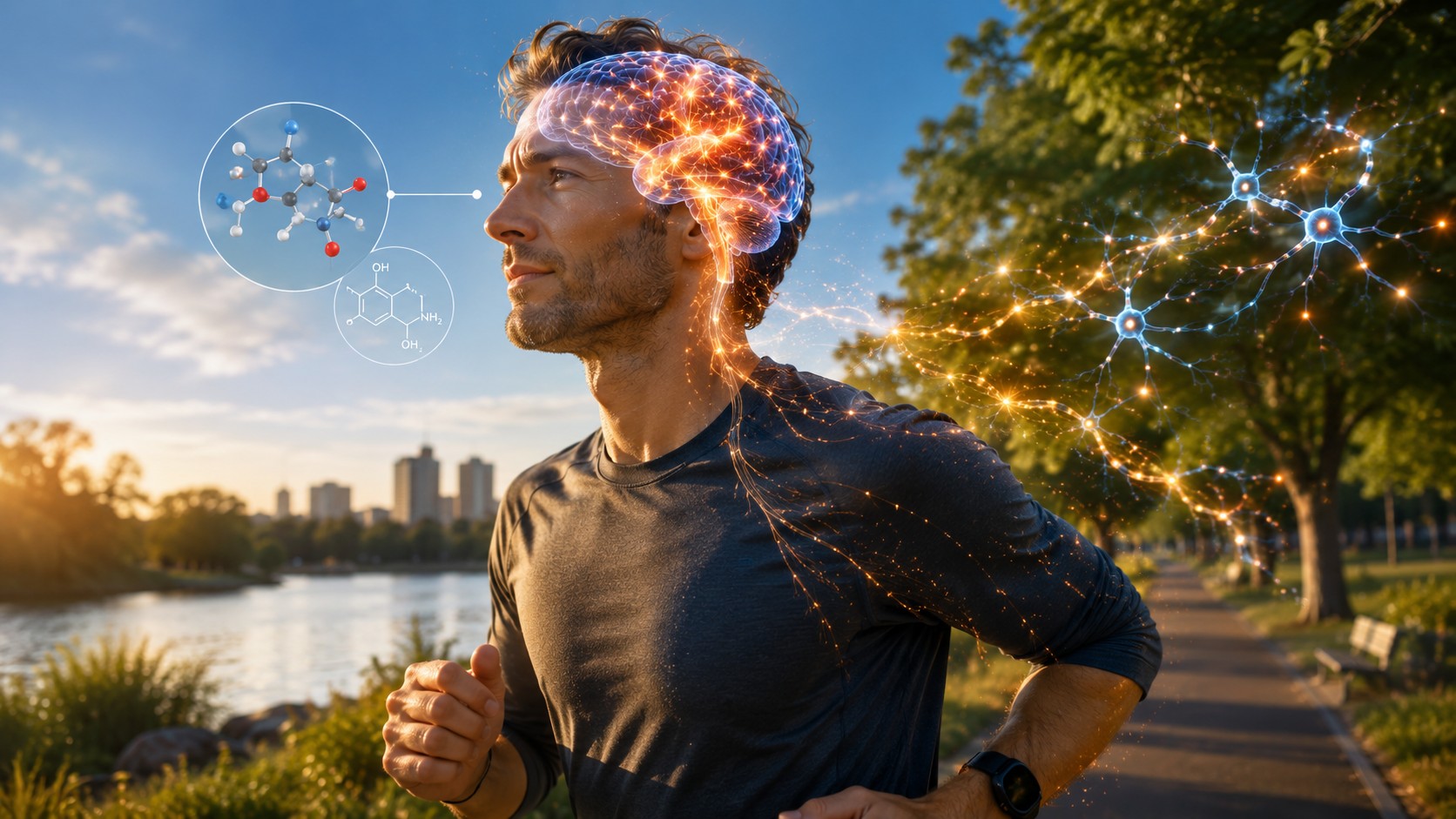
Exercise and Cognitive Performance: How Physical Activity Unlocks Your Brain's Full Potential
The neuroscience of movement — how exercise boosts memory, focus, neuroplasticity, creativity, mood and protects your brain for life.
Why Your Brain Was Built to Move
If someone asked you to name the best way to improve your brain, what would you answer? Reading more books? Learning a new language? Practicing meditation? Taking nootropic supplements?
All of these can support cognitive function.
But according to decades of neuroscience research, one of the most powerful ways to improve your brain doesn't happen while sitting at a desk. It happens when you move.
Whether it's walking, cycling, swimming, lifting weights, dancing or simply taking the stairs, physical activity triggers a remarkable series of biological events that reshape your brain from the inside out.
Exercise increases learning speed. It improves memory. It enhances concentration. It boosts creativity. It regulates emotions.
And perhaps most importantly, it helps protect your brain against cognitive decline for decades to come.
Modern neuroscience now considers exercise one of the most effective and accessible cognitive enhancers available. Unlike expensive supplements or "brain hacks," its benefits have been confirmed by thousands of scientific studies involving children, students, athletes, professionals and older adults.
In this guide, you'll discover:
- Why movement is essential for brain health
- How exercise stimulates neuroplasticity
- The role of BDNF, the brain's growth factor
- Why physically active people learn faster
- Which exercises offer the greatest cognitive benefits
- How movement protects against dementia and Alzheimer's disease
- The optimal exercise routine for peak mental performance
By the end of this article, you'll understand why improving your brain starts by moving your body.
Your Brain Evolved in Motion
For almost all of human history, movement wasn't optional. Our ancestors spent much of every day walking, climbing, hunting, gathering food and exploring unfamiliar environments.
Survival depended on combining physical activity with rapid decision-making.
Finding food. Avoiding predators. Remembering landscapes. Working together. Planning future actions.
The human brain evolved under these conditions. Movement wasn't separate from thinking. Movement helped create better thinking.
Today's world is dramatically different. Many adults spend eight to twelve hours sitting every day. Cars replace walking. Elevators replace stairs. Screens replace outdoor activities.
From an evolutionary perspective, our brains still expect movement. When that movement disappears, cognitive performance often suffers.
Research links prolonged sedentary behavior with:
- Lower attention
- Reduced memory performance
- Poorer executive function
- Increased anxiety
- Higher risk of depression
- Faster cognitive aging
Fortunately, even moderate physical activity can begin reversing many of these effects.
Exercise Changes Your Brain—Literally
One of the greatest discoveries of modern neuroscience is that the adult brain remains remarkably adaptable. Scientists call this ability neuroplasticity.
Every meaningful experience can strengthen, weaken or reorganize neural connections. Exercise is one of the strongest natural stimulators of this process.
Regular physical activity encourages:
- Growth of new neurons
- Formation of stronger synaptic connections
- Increased communication between brain regions
- Development of healthier blood vessels
- Improved cellular energy production
- Reduced chronic inflammation
Rather than simply maintaining your brain, exercise continuously upgrades it.
If you'd like to understand this incredible process in greater depth, don't miss our complete guide: Neuroplasticity Explained.
Meet BDNF: The Brain's Fertilizer
Perhaps no molecule better explains the relationship between exercise and intelligence than Brain-Derived Neurotrophic Factor (BDNF).
Scientists often describe BDNF as fertilizer for the brain. Its role is simple but extraordinary.
BDNF helps neurons:
- Survive
- Grow
- Build stronger connections
- Repair damaged networks
- Form long-term memories
Aerobic exercise is one of the most powerful natural stimulators of BDNF production. Within a relatively short period of sustained activity, BDNF levels begin to rise.
Higher BDNF levels are associated with:
- Faster learning
- Better memory
- Improved creativity
- Greater mental flexibility
- Enhanced neuroplasticity
Without sufficient BDNF, learning becomes significantly more difficult. This explains why physically active people often acquire new knowledge more efficiently than sedentary individuals.
"Exercise is medicine for the brain."
Exercise Helps Grow Your Memory Center
Deep inside the brain lies a small but essential structure called the hippocampus.
This region is responsible for:
- Forming new memories
- Learning new information
- Spatial navigation
- Memory consolidation
Unlike many other parts of the brain, the hippocampus continues producing new neurons throughout adulthood. This process is called adult neurogenesis.
Numerous studies have shown that regular aerobic exercise can increase hippocampal volume. Considering that the hippocampus naturally shrinks with age, this discovery is remarkable.
Exercise doesn't merely slow cognitive aging. It actively helps preserve one of the brain's most important learning centers.
If you're interested in how memories are formed, stored and retrieved, continue with The Complete Guide to Memory and Why We Forget and How to Remember More.
Better Blood Flow Means Better Thinking
Although the brain represents only around 2% of total body weight, it consumes approximately 20% of the body's energy.
To function efficiently, neurons constantly require:
- Oxygen
- Glucose
- Nutrients
- Efficient circulation
Exercise improves each of these.
During physical activity:
- Heart rate increases.
- Blood vessels expand.
- Cerebral circulation improves.
- Oxygen delivery rises.
- Waste products are removed more efficiently.
The result is a brain that works faster and with greater efficiency.
Many people notice this as improved mental clarity immediately after finishing a workout. That feeling isn't imaginary. It's physiology.
Key Takeaways — Part 1
Exercise is far more than a fitness habit. It is one of the most powerful interventions available for improving brain health.
Regular movement:
- Increases neuroplasticity
- Boosts BDNF production
- Improves memory
- Enhances concentration
- Strengthens learning
- Protects against cognitive decline
And this is only the beginning.
Which Type of Exercise Is Best for Your Brain?
One of the most common questions in neuroscience is surprisingly simple:
What type of exercise provides the greatest cognitive benefits?
Should you run? Lift weights? Practice yoga? Do High-Intensity Interval Training (HIIT)? Go for long walks?
The encouraging answer is that almost every form of physical activity benefits the brain.
However, each type of exercise stimulates the brain in slightly different ways. Understanding these differences allows you to build a routine that maximizes both physical fitness and cognitive performance.
Aerobic Exercise: The King of Brain Health
When scientists study exercise and cognition, aerobic exercise consistently produces the strongest evidence.
Activities such as:
- Running
- Cycling
- Swimming
- Brisk walking
- Rowing
- Hiking
increase heart rate for sustained periods.
This improves:
- Cerebral blood flow
- Oxygen delivery
- BDNF production
- Neurogenesis
- Vascular health
Numerous studies have found that regular aerobic exercise improves:
- Memory
- Attention
- Processing speed
- Executive function
- Cognitive flexibility
Even moderate aerobic activity performed several times per week significantly reduces the risk of cognitive decline later in life.
Strength Training Is Good for Your Brain Too
For many years, researchers believed endurance exercise was the primary driver of cognitive improvement.
More recent research tells a different story. Resistance training also produces impressive brain benefits.
Lifting weights stimulates the release of growth factors that support both muscle and brain adaptation.
Studies suggest regular strength training can improve:
- Executive function
- Working memory
- Decision-making
- Attention
- Processing speed
It may also reduce age-related cognitive decline by improving metabolic health and reducing chronic inflammation.
The ideal approach isn't choosing between cardio and strength training. It's combining both.
High-Intensity Interval Training (HIIT): Maximum Benefits in Minimum Time
HIIT alternates short bursts of intense effort with recovery periods.
For example: 30 seconds of sprinting, then 90 seconds of walking. Repeated for 15 to 20 minutes.
Although challenging, HIIT appears particularly effective at increasing:
- BDNF
- Dopamine
- Blood circulation
- Insulin sensitivity
- Mitochondrial efficiency
Many people report feeling mentally sharper for several hours after a HIIT session.
However, because HIIT is demanding, recovery remains essential. Too much high-intensity training without adequate sleep can eventually reduce cognitive performance rather than improve it.
Walking: The Most Underrated Brain Exercise
If there were a pill that improved creativity, reduced stress, enhanced memory and lowered dementia risk, it would likely become one of the world's best-selling medications.
Walking produces many of these same effects.
Research has repeatedly shown that walking:
- Improves divergent thinking
- Enhances creativity
- Reduces stress hormones
- Improves mood
- Supports long-term brain health
Even a 20- to 30-minute walk can significantly improve cognitive performance. Walking outdoors provides additional benefits through exposure to natural environments and sunlight.
For knowledge workers, writers and students, walking may be one of the simplest productivity tools available.
Exercise and Neurotransmitters
Physical activity changes the chemistry of your brain within minutes.
Several neurotransmitters increase during and after exercise.
Dopamine
Exercise increases dopamine availability. This improves:
- Motivation
- Focus
- Goal-directed behavior
- Reward processing
Want to learn more? Read The Complete Guide to Dopamine.
Serotonin
Exercise also increases serotonin activity. Benefits include:
- Improved mood
- Emotional stability
- Better sleep
- Reduced anxiety
This helps explain why physically active people are generally more resilient to chronic stress.
Endorphins
Endorphins are the body's natural painkillers.
They contribute to:
- Reduced pain perception
- Improved mood
- Greater psychological well-being
The famous "runner's high" is now believed to involve both endorphins and endocannabinoids working together.
Norepinephrine
Exercise also increases norepinephrine. This neurotransmitter enhances:
- Alertness
- Attention
- Mental readiness
- Reaction time
Together, these chemical changes create the feeling of mental clarity many people experience after exercise.
When Should You Exercise for Maximum Brain Performance?
The answer depends on your goals.
Before Studying
A moderate workout before learning can improve:
- Attention
- Memory encoding
- Learning speed
Many students retain information more effectively after exercising. See also The Science of Deliberate Practice and The Complete Guide to Spaced Repetition.
Before Creative Work
Walking or light aerobic activity often boosts creativity.
Many famous thinkers—including Charles Darwin, Friedrich Nietzsche and Steve Jobs—used walking as part of their thinking process.
During Long Workdays
Short movement breaks every hour help maintain:
- Concentration
- Energy
- Productivity
Even five minutes of movement can improve cognitive performance. For more on attention and deep work, see The Complete Guide to Focus, The Hidden Cost of Multitasking and Why Your Attention Span Is Shrinking.
Can You Exercise Too Much?
Like most biological systems, the brain responds best to balance.
Overtraining without sufficient recovery can lead to:
- Mental fatigue
- Poor concentration
- Reduced motivation
- Sleep disruption
- Elevated stress hormones
Recovery is where adaptation occurs.
This is why sleep, nutrition and rest remain essential parts of every brain optimization strategy. If you haven't already, read The Complete Guide to Sleep.
Key Takeaways — Part 2
Different forms of exercise benefit the brain in different ways.
- Aerobic exercise enhances memory and neuroplasticity.
- Strength training improves executive function.
- HIIT rapidly stimulates growth factors and neurotransmitters.
- Walking boosts creativity and reduces stress.
The most effective long-term strategy combines all of these while allowing adequate recovery.
Exercise Across Every Stage of Life
One of the most remarkable aspects of exercise is that its cognitive benefits begin before birth and continue throughout life.
Whether you're a child learning to read, a university student preparing for exams, a professional managing complex projects, or a retiree hoping to preserve your independence, physical activity remains one of the most effective ways to support brain health.
The mechanisms may differ with age, but the benefits never disappear.
Exercise During Childhood and Adolescence
The developing brain is exceptionally adaptable.
During childhood, billions of neural connections are created, strengthened and refined.
Regular physical activity helps support this process by improving:
- Attention
- Working memory
- Executive function
- Emotional regulation
- Academic performance
Studies consistently show that physically active children often perform better at school than their sedentary peers.
Importantly, exercise does not reduce academic success by taking time away from studying. Instead, it improves the brain's ability to learn efficiently.
This is why many education experts advocate for more—not less—physical education in schools.
Exercise During Adulthood
Modern working life often demands long hours sitting in front of computers.
Unfortunately, prolonged sedentary behaviour is associated with:
- Reduced concentration
- Mental fatigue
- Lower productivity
- Increased stress
- Poorer metabolic health
Regular exercise acts as a powerful counterbalance.
Adults who remain physically active generally experience:
- Better focus
- Greater creativity
- Faster decision-making
- Improved resilience under pressure
- Better sleep quality
Even brief movement breaks during the workday help restore attention and reduce cognitive fatigue.
Exercise and Healthy Brain Aging
As we age, several natural changes occur inside the brain.
These include:
- Reduced hippocampal volume
- Slower information processing
- Declining blood flow
- Reduced neuroplasticity
Although these changes are normal, they are not fixed.
Exercise significantly slows many aspects of cognitive aging.
Research suggests physically active older adults often maintain:
- Better memory
- Faster reaction times
- Greater independence
- Better balance
- Lower risk of falls
- Improved quality of life
Perhaps most importantly, exercise helps preserve the brain's ability to continue adapting throughout later life.
Can Exercise Help Prevent Alzheimer's Disease?
No single lifestyle habit can completely prevent Alzheimer's disease.
However, exercise is consistently associated with a lower risk of developing dementia.
Scientists believe several mechanisms explain this protective effect. Exercise:
- Improves blood flow to the brain
- Reduces chronic inflammation
- Supports healthy blood vessels
- Stimulates BDNF production
- Improves glucose regulation
- Encourages lifelong neuroplasticity
Together, these adaptations create a healthier environment for brain cells.
Combined with good nutrition, quality sleep, lifelong learning and social engagement, regular exercise forms one of the strongest evidence-based strategies for protecting long-term cognitive health.
Exercise and Mental Health
The relationship between physical activity and mental health is remarkably strong.
Regular exercise has been shown to reduce symptoms associated with:
- Anxiety
- Depression
- Chronic stress
- Burnout
Although exercise is not a replacement for professional medical care when needed, it is now widely recommended as part of a comprehensive treatment strategy for many mental health conditions.
Exercise improves mood by increasing the availability of neurotransmitters such as:
- Dopamine
- Serotonin
- Norepinephrine
It also reduces excessive activation of the body's stress response system.
For many people, movement becomes one of the healthiest ways to manage emotional challenges.
Exercise and ADHD
Growing evidence suggests that physical activity can also benefit individuals with ADHD.
Exercise appears to improve:
- Attention
- Impulse control
- Executive function
- Working memory
- Emotional regulation
Researchers believe these improvements are partly related to increased dopamine and norepinephrine activity within the prefrontal cortex.
For children and adults living with ADHD, regular physical activity may become an important complement to other evidence-based treatments.
Building the Ideal Brain-Boosting Exercise Routine
One of the biggest misconceptions is that improving brain health requires hours of training every day.
In reality, consistency matters far more than perfection.
A balanced weekly routine might include:
Aerobic Exercise — 3 to 5 sessions per week
Examples:
- Brisk walking
- Running
- Cycling
- Swimming
Strength Training — 2 to 3 sessions per week
Focus on compound movements that engage multiple muscle groups.
Mobility and Flexibility
Include stretching or yoga several times each week to improve recovery and reduce injury risk.
Daily Movement
Avoid remaining seated for long periods. Stand up regularly. Take short walks. Use the stairs. Every movement counts.
The Biggest Myths About Exercise and Brain Performance
"Movement is not just fuel for the body. It's fuel for the brain."
Practical Tips You Can Start Today
Improving cognitive performance through exercise doesn't require becoming an elite athlete.
Start with small, sustainable habits. For example:
- Walk for 30 minutes each day.
- Take movement breaks every hour while working.
- Combine aerobic exercise with strength training.
- Exercise outdoors whenever possible.
- Prioritize recovery and quality sleep.
- Stay consistent rather than chasing perfection.
Small improvements, repeated consistently, produce extraordinary long-term results.
Continue Exploring Brain Geek
If you enjoyed this article, continue your journey with:
- The Complete Guide to the Human Brain
- Neuroplasticity Explained
- The Complete Guide to Dopamine
- The Complete Guide to Memory
- The Science of Deliberate Practice
- The Complete Guide to Spaced Repetition
- Why We Forget and How to Remember More
- Why Your Attention Span Is Shrinking
- The Hidden Cost of Multitasking
- The Complete Guide to Focus
- The Complete Guide to Sleep
Explore all our articles at /articles, discover our free cognitive Brain Geek Tools, and visit the Brain Geek Shop.
Frequently Asked Questions
Does exercise improve memory?
Yes. Regular physical activity stimulates neuroplasticity, increases BDNF production and supports the hippocampus, one of the brain's primary memory centers.
Which exercise is best for brain health?
Aerobic exercise has the strongest scientific evidence, but combining cardio, strength training and regular walking appears to provide the greatest overall cognitive benefits.
How much exercise do I need to improve cognition?
Most research suggests that around 150 minutes of moderate physical activity per week, combined with two strength-training sessions, is sufficient to produce significant cognitive benefits.
Can exercise reduce the risk of dementia?
Although no intervention completely prevents dementia, regular physical activity is consistently associated with a lower risk of cognitive decline and Alzheimer's disease.
Final Thoughts
Exercise is far more than a tool for improving physical fitness. It is one of the most powerful ways to strengthen the human brain.
Every workout improves blood flow. Every walk stimulates learning. Every training session strengthens neural connections. Every active day builds resilience against cognitive decline.
You don't need expensive technology or miracle supplements to become mentally sharper.