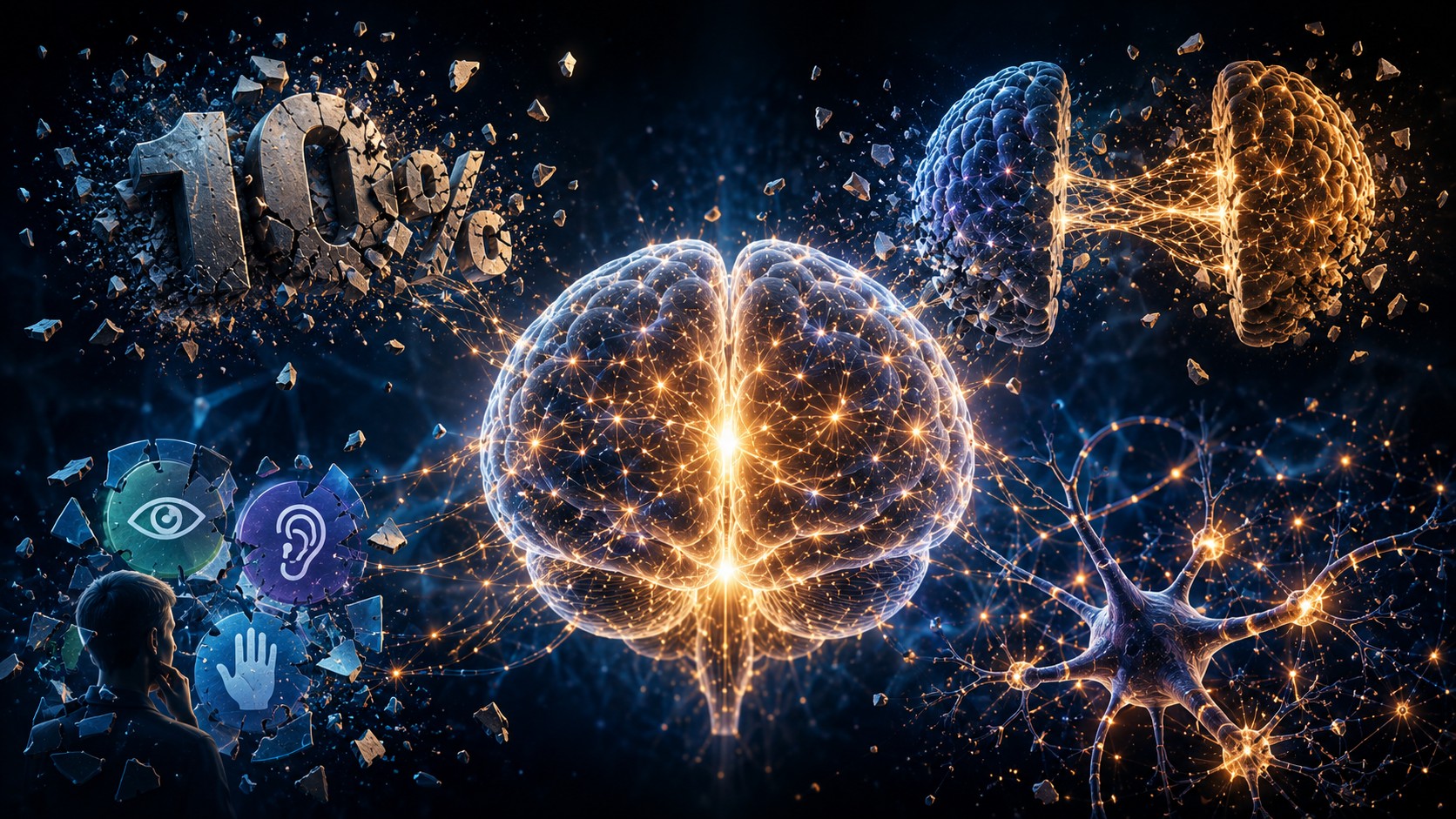
The Biggest Neuroscience Myths: What Science Really Says About Your Brain
You use only 10% of your brain. Creative people are right-brained. Your brain stops changing in adulthood. Dopamine is the pleasure chemical. A neuroscience-backed guide to the myths we all repeat — and what your brain actually does.
You use only 10% of your brain. Creative people are right-brained; logical people are left-brained. Some people are visual learners, while others learn better by listening. Your brain stops changing once you become an adult. Dopamine is the pleasure chemical.
You have probably heard at least one of these claims. Perhaps you have even repeated one.
That would not be surprising. The human brain may be the most complex object we know of, but the stories we tell about it are often remarkably simple. Too simple.
Over the past few decades, neuroscience has transformed our understanding of memory, attention, learning, emotion, motivation, sleep and behavior. Brain-imaging technologies have revealed how neural networks coordinate. Research into neuroplasticity has shown a brain capable of changing throughout life. Studies of memory have shown that remembering is not like replaying a recording. Research on dopamine has dismantled the idea that one neurotransmitter can be reduced to a simple "pleasure chemical."
And yet the myths remain. Some survive because they contain a small piece of truth. Others survive because they are easy to understand. And some survive because they sell books, courses, supplements, apps, educational programs and productivity systems.
This guide examines the biggest neuroscience myths, explains where they came from, and replaces them with a more accurate picture of how your brain actually works. Because the real brain is far more interesting than the myths.
What Is a Neuromyth?
A neuromyth is a misconception about the brain that usually begins with a real scientific finding but becomes distorted through oversimplification, misunderstanding, or repetition.
The pattern often looks like this:
Scientific discovery → simplification → popular interpretation → exaggeration → myth.
Scientists discovered that the two cerebral hemispheres show some degree of functional specialization. That is true. Language processing tends to be more strongly lateralized toward the left hemisphere in many people. Certain aspects of spatial processing often involve stronger contributions from the right hemisphere.
But popular culture transformed this complex reality into something much simpler: "Logical people use the left side of their brain, while creative people use the right side." That conclusion does not follow from the science.
Research on neuromyths has repeatedly found that misconceptions such as the 10% myth, left-brain/right-brain personality types and fixed learning styles remain widespread — even among educators. The problem is not simply that people know too little about neuroscience. Exposure to neuroscience vocabulary without sufficient scientific literacy may still leave people vulnerable to attractive but incorrect explanations.
Neuromyths satisfy several psychological needs. They give us simple explanations for complex behavior. They create identities. They promise hidden potential. They offer quick solutions. And they often use scientific-sounding vocabulary — dopamine, neuroplasticity, hemisphere, neural pathway, brain waves — which can make a weak claim sound authoritative. But scientific vocabulary is not the same thing as scientific evidence.
Myth #1: You Only Use 10% of Your Brain
Your brain is not a computer with 90% of its hardware permanently switched off. Different tasks recruit different combinations of brain regions and networks. Reading this sentence involves visual processing, language systems, attention, working memory and semantic knowledge. Walking through a crowded street requires sensory processing, spatial navigation, motor control, prediction, balance and decision-making.
Even when you appear to be doing nothing, your brain is not inactive. Resting-state research has identified organized patterns of spontaneous brain activity, including networks associated with internally directed thought, autobiographical memory, future simulation and self-referential processing. The brain is always doing something.
Why the 10% Myth Makes No Biological Sense
The human brain is extraordinarily expensive tissue. Although it represents only a small fraction of body mass, it consumes a disproportionately large share of the body's resting energy budget. Maintaining a large organ composed of mostly useless tissue would be evolutionarily absurd.
Brain injuries make this even clearer. Relatively small lesions in specific areas can produce significant changes in language, movement, memory, attention or personality. If 90% of the brain were genuinely unused, damage to most areas should have little effect. That is not what neurology shows.
The Better Question
The important question is not "How much of my brain am I using?". It is: "Which networks are active, how are they interacting, and how efficiently are they performing the current task?"
Cognitive performance can genuinely improve — through learning, deliberate practice, sleep, exercise, attention training, effective memory strategies, stress management, appropriate nutrition and spaced repetition. These interventions do not activate dormant continents of tissue. They improve how existing neural systems function, adapt, coordinate and retrieve information.
Explore this in depth: The Complete Guide to the Human Brain, Neuroplasticity Explained and The Complete Guide to Memory.
Myth #2: People Are Either Left-Brained or Right-Brained
The myth contains a fragment of genuine neuroscience. Some cognitive processes show lateralization: one hemisphere may contribute more strongly to certain aspects of a task. Language is the classic example — for many people, important components of language processing are more strongly associated with left-hemisphere networks. Some spatial and attentional processes show stronger right-hemisphere involvement.
Research on split-brain patients (whose corpus callosum was surgically severed) revealed fascinating differences in how information could be processed by each hemisphere. But popular culture made a huge leap: hemispheric specialization became hemispheric personality. That leap is not supported by evidence.
Creativity Is Not Located in the Right Hemisphere
Consider writing a novel. You might imagine this as a classic "right-brain" activity. But writing requires language, semantic memory, working memory, attention, planning, emotional processing, inhibition, error monitoring, mental simulation and motor control — distributed across multiple brain systems.
The same applies to music. A musician performing a complex piece must process rhythm, timing, auditory information, movement, memory, prediction, emotion and attention. Creativity is not a button located in the right hemisphere. And logic is not stored in a left-brain compartment.
Why This Myth Is Harmful
Labels influence behavior. Someone who believes "I am right-brained, so I am bad at mathematics" may avoid mathematical practice. Someone who believes "I am a logical left-brain person, so I am not creative" may stop exploring artistic activities. These labels become self-imposed limitations.
A better approach is to ask: What have I practiced? Which strategies am I using? Where are my current weaknesses? Which skills can improve with deliberate training? What environmental conditions help me perform well?
Myth #3: Everyone Has a Fixed Learning Style
People clearly have preferences. Some enjoy diagrams. Others like lectures. Some prefer reading. Others enjoy practical experience. But preference is not the same as performance. You may prefer watching videos — that doesn't mean video is always the best way for you to learn.
The most effective format often depends on the material. Learning geography? Maps and spatial representations help. Learning pronunciation? Listening becomes essential. Learning surgery? Observation and physical practice matter. Learning historical arguments? Reading and writing may be particularly important.
The best method should be matched primarily to the content, the objective, the task and the learner's existing knowledge — not to a permanent identity label.
What Actually Improves Learning
Instead of asking "What is my learning style?", ask "Which strategies have strong evidence behind them?"
- Active retrieval. Trying to recall information strengthens memory more effectively than repeatedly re-exposing yourself to the same material.
- Spaced repetition. Distributing learning sessions across time dramatically improves long-term retention. See The Complete Guide to Spaced Repetition.
- Interleaving. Mixing related problem types improves discrimination and flexible application.
- Elaboration. Ask: Why is this true? How does this connect to what I already know? Can I explain it in my own words?
- Deliberate practice. Clear goals, focused attention, feedback, correction. See The Science of Deliberate Practice.
- Sleep. Memory consolidation continues after you close the book. See The Complete Guide to Sleep.
The Pattern Behind the First Three Myths
The first three myths share something important: they take a complex system and replace it with a simple label. The 10% myth says you have hidden capacity waiting to be unlocked. Left-brain/right-brain says your personality is determined by a dominant hemisphere. Learning styles say your brain belongs to one fixed category.
All three are attractive because they reduce uncertainty. But neuroscience rarely gives us such simple categories. The human brain is dynamic, adaptive, context-dependent, network-based and shaped by both biology and experience. Understanding that complexity doesn't make neuroscience less useful. It makes it more useful — because once we abandon simplistic labels, we can focus on the factors that actually matter: practice, sleep, attention, exercise, memory strategies, environment, nutrition, stress, experience and time.
Myth #4: The Adult Brain Cannot Change
Modern neuroscience has dramatically changed this picture. The adult brain is not static. It is plastic. But neuroplasticity is also one of the most misunderstood concepts in modern neuroscience. The truth lies between two extremes — your brain is neither permanently fixed nor infinitely malleable.
Neuroplasticity refers broadly to the nervous system's ability to change its structure, function and patterns of connectivity in response to internal and external influences. Individual synapses can strengthen or weaken. Neural circuits can reorganize. Cortical representations can change with experience. New skills alter patterns of neural activity. After certain injuries, surviving networks may adapt to support functional recovery.
Neuroplasticity does not mean that anything is possible.
Biology matters. Age matters. Genetics matter. Health matters. The nature of the skill matters. The amount and quality of practice matter. Plasticity operates within biological constraints. It makes the brain adaptable, not magical.
Plasticity Does Not Always Mean Improvement
The brain adapts to repeated experience — and repeated experience is not always positive. Chronic stress can influence neural systems. Persistent pain can involve maladaptive changes. Addictive behaviors reshape motivation and reward-related systems. Avoidance becomes automatic. Poor movement patterns become habitual.
The important question is not "Is my brain changing?" — of course it is. It is "What is my brain adapting to?"
Your brain is always learning something. The question is whether your repeated behaviors are building the abilities and habits you actually want.
Adults can learn languages, instruments, academic subjects, technical skills, sports, artistic disciplines and new professional abilities. Children benefit from developmental periods during which certain neural systems are especially sensitive to input. Adults possess different advantages: larger knowledge networks, stronger metacognitive abilities, deliberate goal-setting and explicit learning strategies. The adult brain is different. Different does not mean incapable.
Read more: Neuroplasticity Explained, The Science of Deliberate Practice and How to Build Cognitive Reserve.
Myth #5: You Are Born With All the Brain Cells You Will Ever Have
Most changes involved in learning do not require the brain to replace large numbers of neurons. Much of neuroplasticity involves changes in synaptic strength, connectivity, dendritic structure, network organization, myelination and patterns of neural activity.
Scientific discussion of adult human neurogenesis has focused on the hippocampus, a structure strongly involved in memory and learning. Research remains complex, and scientists have debated the extent and functional importance of adult neurogenesis in humans. The safest conclusion is neither "adults can produce no new neurons" nor "you can grow an entirely new brain by doing crossword puzzles." The real picture is more nuanced. And nuance matters.
Myth #6: Memory Works Like a Video Recording
When you remember an event, your brain reconstructs aspects of the past using information distributed across sensory details, emotional associations, semantic knowledge, expectations, contextual information and later experiences. The process can be remarkably effective. It also creates opportunities for distortion.
Details may disappear. Elements may be combined. Later information may influence recollection. Confidence may increase even when accuracy does not. Repeated retelling may subtly change the story. This does not mean every memory is false. It means subjective certainty and objective accuracy are not the same thing.
Why Memory Distortion Happens
Memory was not designed to preserve a perfect documentary archive. It helps us preserve useful information, recognize patterns, predict future events, maintain relationships, guide decisions, learn from experience and build a coherent sense of identity. This system prioritizes meaning and usefulness over perfect reproduction.
Two people can experience the same argument and later remember different details — both genuinely convinced their version is correct. Memory is not a neutral witness. It is a biological process.
Explore more: The Complete Guide to Memory, The Complete Guide to Spaced Repetition, and Why We Forget and How to Remember More.
Myth #7: Brain Damage Always Means Permanent Loss
Recovery depends on many factors: type, location and extent of injury; age; timing of intervention; rehabilitation; general health; individual differences; and the functions involved. Recovery is not guaranteed. But temporarily impaired tissue may recover function, swelling may decrease, existing pathways may become more efficient, surviving networks may reorganize, and patients may develop compensatory strategies.
Rehabilitation provides structured practice — movement, language, attention, memory strategies, sensory feedback, repetition, task-specific practice. Neuroplasticity provides part of the biological foundation. But plasticity is not magic. The brain cannot always recreate destroyed tissue or restore every lost function. The scientifically accurate position is neither hopelessness nor miracle thinking. It is evidence-based rehabilitation combined with realistic expectations.
Compensation Is Also a Form of Success
Someone with a memory impairment who learns to use structured routines, external calendars, environmental cues and digital reminders may still carry the original impairment — but daily function can improve substantially. Human adaptation is broader than biological restoration: the brain, body, technology, environment and behavior all work together.
Myth #8: Brain-Training Games Make You Smarter
Practice makes you better at what you practice. If you repeatedly play a specific memory game, you will often improve at that game. The important question is: Does the improvement transfer? Does becoming better at remembering symbol sequences also make you better at learning a language, managing projects, solving unfamiliar problems, understanding difficult books, or making better decisions?
Specific training can be valuable when the target ability is clearly defined, the training is appropriately designed, expectations are realistic and the practiced task is relevant to the desired outcome. The problem begins when narrow results are marketed as universal brain enhancement.
If your goal is to become better at chess, study and play chess. If your goal is to speak Spanish, practice Spanish. If your goal is to solve mathematical problems, solve meaningful mathematical problems. Specificity matters.
What Has Stronger Evidence for General Brain Health
- Physical exercise. Cardiovascular health, and multiple mechanisms relevant to cognitive function. See Exercise and Cognitive Performance.
- Sleep. Attention, emotional regulation, learning, memory consolidation. See The Complete Guide to Sleep.
- Learning challenging skills. Engaging multiple cognitive systems in a stimulating lifestyle.
- Social engagement. Language, memory, emotion, prediction, perspective-taking.
- Nutrition. Cardiovascular and metabolic health support long-term brain health. See Brain Nutrition for Peak Performance.
- Managing cardiovascular risk factors. The brain depends on continuous blood supply.
- Building cognitive reserve. See How to Build Cognitive Reserve.
Myth #9: Intelligence Is Completely Fixed
Cognitive abilities are influenced by complex interactions among genetics, prenatal development, childhood environment, education, nutrition, health, sleep, stress, exposure to toxins, learning opportunities, motivation, practice and socioeconomic conditions. Genes matter. Environment matters. And they interact.
The Danger of the "Unlimited Potential" Myth
Telling people "you can achieve anything if you work hard enough" may seem motivational, but it is not scientifically accurate. People differ. Biological constraints exist. Opportunities are unequal. Talent varies. The useful lesson from neuroplasticity is not that everyone has identical potential. It is that current performance is not always a perfect measure of future performance.
The Danger of the "Nothing Can Change" Myth
The opposite belief can be equally damaging. If someone believes intelligence is fixed, difficulty becomes evidence of permanent inability. A difficult math problem becomes "I am not a math person." A language mistake becomes "I am bad at languages." A failed attempt becomes "my brain cannot do this." These conclusions ignore the effects of practice, instruction, strategy, feedback and accumulated knowledge.
The productive question is: What can be improved, through which method, over what period of time?
Your brain has limits. But you probably do not know exactly where they are. Scientific thinking requires us to reject both fatalism and magical thinking.
Myth #10: Dopamine Is the Pleasure Chemical
Dopamine is involved in reward-related learning, motivation, movement, prediction, salience, reinforcement and goal-directed behavior. Pleasure can be part of the picture, but dopamine is not simply a pleasure chemical. It is more accurate to think of dopamine as deeply involved in wanting, learning, seeking, prediction and motivation.
Dopamine and Prediction
When something is better than expected, dopamine activity may help the brain update its expectations. When a predicted reward fails to appear, dopamine-related activity may shift in the opposite direction. This helps the brain learn what is worth pursuing — with implications for food, social behavior, habits, addiction, learning and motivation. Dopamine contributes to computations about what matters, what to approach, what to repeat, what predicts reward and what deserves effort. That is much richer than the phrase "pleasure chemical."
Why the Dopamine Myth Matters
The myth shapes how people talk about motivation and self-control: "I have no dopamine." "My dopamine is broken." "I need a dopamine detox." These statements often oversimplify the underlying biology. Motivation, attention, addiction and productivity are not controlled by one molecule. Brain chemistry works through systems, circuits, receptors, timing, context, learning history, behavior and environment.
Read more: The Complete Guide to Dopamine.
Myth #11: A Dopamine Detox Resets Your Brain
You cannot detox dopamine out of your brain. And you would not want to — dopamine is essential for movement, motivation, learning, attention and many other processes. The useful part of a so-called "dopamine detox" is not chemical detoxification. It is behavioral reset.
Instead of thinking "I need less dopamine," think "I need fewer compulsive triggers and better behavioral design." Practical changes include:
- Turning off non-essential notifications
- Creating phone-free work blocks
- Removing addictive apps from the home screen
- Using website blockers during deep work
- Setting clear start and stop rules for entertainment
- Replacing passive scrolling with active rest
- Protecting sleep
- Using friction to make bad habits harder — and cues to make good habits easier
This is not a dopamine detox. It is habit architecture.
See also: The Complete Guide to Focus and Why Your Attention Span Is Shrinking.
Myth #12: Serotonin Is Simply the Happiness Chemical
Serotonin is involved in many biological and psychological processes: mood regulation, sleep, appetite, cognition, pain, gastrointestinal function and behavioral flexibility. It is not a simple happiness switch.
The myth can make mental health sound mechanically simple — "depression is just low serotonin." In reality, mood is influenced by genetics, development, stress, sleep, trauma, inflammation, social context, cognition, behavior, hormones, lifestyle and many other biological systems. Serotonin is part of a wider network. Simple chemical slogans rarely capture the complexity of mental health.
Neurotransmitters are not personality types. Dopamine is not ambition. Serotonin is not happiness. Oxytocin is not love. Cortisol is not evil. They are biological signaling systems working in context.
Myth #13: Oxytocin Is the Love Hormone
Oxytocin's effects depend heavily on context. In some circumstances it may support bonding and trust. In others, it may intensify in-group preference, social sensitivity or defensive behavior. Human social behavior cannot be reduced to one hormone. Love involves memory, attachment, culture, perception, safety, personality, learning, body state and relationship history. Oxytocin is part of the biology of social connection. It is not love itself.
Myth #14: Cortisol Is Always Bad
Cortisol is essential. It helps regulate energy, metabolism, immune function, circadian rhythms and stress responses. A healthy cortisol rhythm helps the body respond to demands. The problem is not cortisol itself. The problem is chronic dysregulation.
Acute Stress vs. Chronic Stress
Short-term stress can improve performance. Before an exam, presentation or competition, physiological arousal may sharpen attention and mobilize energy. But chronic, uncontrollable, poorly managed stress can harm sleep, mood, immune function, attention and long-term health.
The key distinction is not stress = bad. It is: What kind of stress, for how long, under what conditions, with what recovery? Your brain and body need challenge. They also need recovery.
Myth #15: Multitasking Makes You More Productive
When you move from one task to another, your brain must reconfigure attention, goals, working memory, rules and context. This takes time and mental energy. Even brief interruptions can leave attention residue — part of your mind remains attached to the previous task while you try to start the next one. That is why constant switching often creates the feeling of being busy without producing deep progress.
Multitasking is especially damaging when tasks require working memory, language, decision-making, planning, creativity, problem-solving or emotional regulation. You may be able to walk and talk. But writing a strategic report while checking Slack, email and social media is a different problem.
Read more: The Hidden Cost of Multitasking and Why Your Attention Span Is Shrinking.
A Practical Framework for Spotting Neuromyths
Neuromyths will keep appearing — in headlines, social media, self-help books, wellness products, corporate training and educational programs. You do not need a neuroscience degree to think more clearly about them. A few questions catch most of them.
- Does the claim reduce the whole brain to one number, molecule or half? Real neuroscience almost always involves systems and interactions.
- Does it promise dramatic transformation with minimal effort? "Rewire your brain in seven days" is a marketing claim, not a scientific one.
- Does it use scientific vocabulary as decoration? Words like dopamine, neuroplasticity, gamma waves can dress up weak claims.
- Does it collapse individual differences into a fixed identity? "You are a visual learner." "You are a right-brained person." Identities are attractive; the brain is more flexible than that.
- Does it ignore context? Cortisol, dopamine, serotonin, oxytocin — the same molecule can have very different effects depending on situation, timing and person.
- Does it treat correlation as causation? "People who do X have healthier brains" ≠ "doing X will make your brain healthier."
- Is there a product attached? An app, supplement or course that solves the problem is a red flag, not a green one.
What Actually Works (Boring, Evidence-Based, Effective)
If the myths sold to you don't work, what does? The honest answer is that the interventions with the best evidence for brain health are unglamorous — but genuinely powerful, especially in combination:
- Sleep — consistently, most nights, in a dark, cool room. See The Complete Guide to Sleep.
- Aerobic and strength exercise — the single most powerful non-pharmacological brain intervention.
- A Mediterranean-style diet rich in vegetables, fish, olive oil and whole grains. See Nutrition and Cognitive Performance.
- Continuous learning of hard things — languages, instruments, complex crafts.
- Deep, sustained work instead of chronic multitasking.
- Meaningful social connection.
- Managing cardiovascular risk factors — blood pressure, blood sugar, cholesterol.
- Purpose and identity that stretch beyond a single role.
The Real Brain Is More Interesting Than the Myths
Your brain is not a machine with a hidden 90% waiting to be activated. It is not divided into a creative half and a logical half. It is not locked permanently into a learning style. It is not frozen when you reach adulthood. It is not powered by a single "pleasure chemical." It is not a video recorder. It is not a fixed intelligence score.
It is a living, adaptive, network-based biological system, quietly reorganizing every day around what you repeatedly ask of it. That is a much bigger idea than any myth. And it is a much more useful one — because it means the levers that matter most are already in your hands: sleep, movement, attention, learning, relationships, meaning, and time.
The good news of modern neuroscience is not that you have a hidden superhero brain waiting to be unlocked. It is that the brain you already have is more capable, more adaptable and more interesting than any myth ever suggested.
Frequently Asked Questions
Do we really only use 10% of our brain?
No. Different tasks recruit different combinations of brain regions and networks. Even during sleep, distributed neural systems remain active. The whole brain is used across the day — but not all regions fire at maximum intensity at the same time.
Are people really left-brained or right-brained?
No. The two hemispheres show some functional specialization, but complex tasks (creativity, logic, language, reasoning) recruit distributed networks across both. Personality cannot be classified by hemisphere dominance.
Do learning styles improve learning?
Preference is not the same as performance. There is no strong evidence that matching instruction to a supposed 'learning style' improves outcomes. Retrieval practice, spaced repetition, elaboration, interleaving, sleep and deliberate practice are supported by much stronger evidence.
Can the adult brain change?
Yes. Neuroplasticity is real. But it operates within biological constraints and does not mean unlimited potential. What matters is what your brain is repeatedly adapting to.
Is memory a video recording of the past?
No. Memory is reconstructive. Subjective certainty and objective accuracy are not the same thing.
Do dopamine detoxes work?
You cannot detox dopamine — it is essential to normal brain function. What does work is behavioral reset: removing compulsive triggers and rebuilding healthier habits.
Does brain training make you smarter?
It usually makes you better at the trained task. Broad transfer to unrelated skills is limited. For general brain health, exercise, sleep, learning challenging skills, social engagement and cardiovascular health have stronger evidence.
Continue Exploring on Brain Geek
The Complete Guide to the Human Brain — the cornerstone overview of brain architecture and chemistry.
Neuroplasticity Explained — how your brain rewires itself for learning and growth.
The Complete Guide to Memory — how memory really works and how to improve it.
The Complete Guide to Focus — training deep concentration in an age of distraction.
The Complete Guide to Sleep — the most underrated cognitive tool you already own.
The Complete Guide to Dopamine — beyond the "pleasure molecule" cliché.
The Complete Guide to Spaced Repetition — remember more, forget less.
The Science of Deliberate Practice — why most people never reach their potential.
Nutrition and Cognitive Performance — how food shapes your brain.
Exercise and Cognitive Performance — movement as the single most powerful brain intervention.
How to Build Cognitive Reserve — the science of a more resilient brain.
Cognitive Biases That Influence Your Decisions — the mental shortcuts behind every choice.