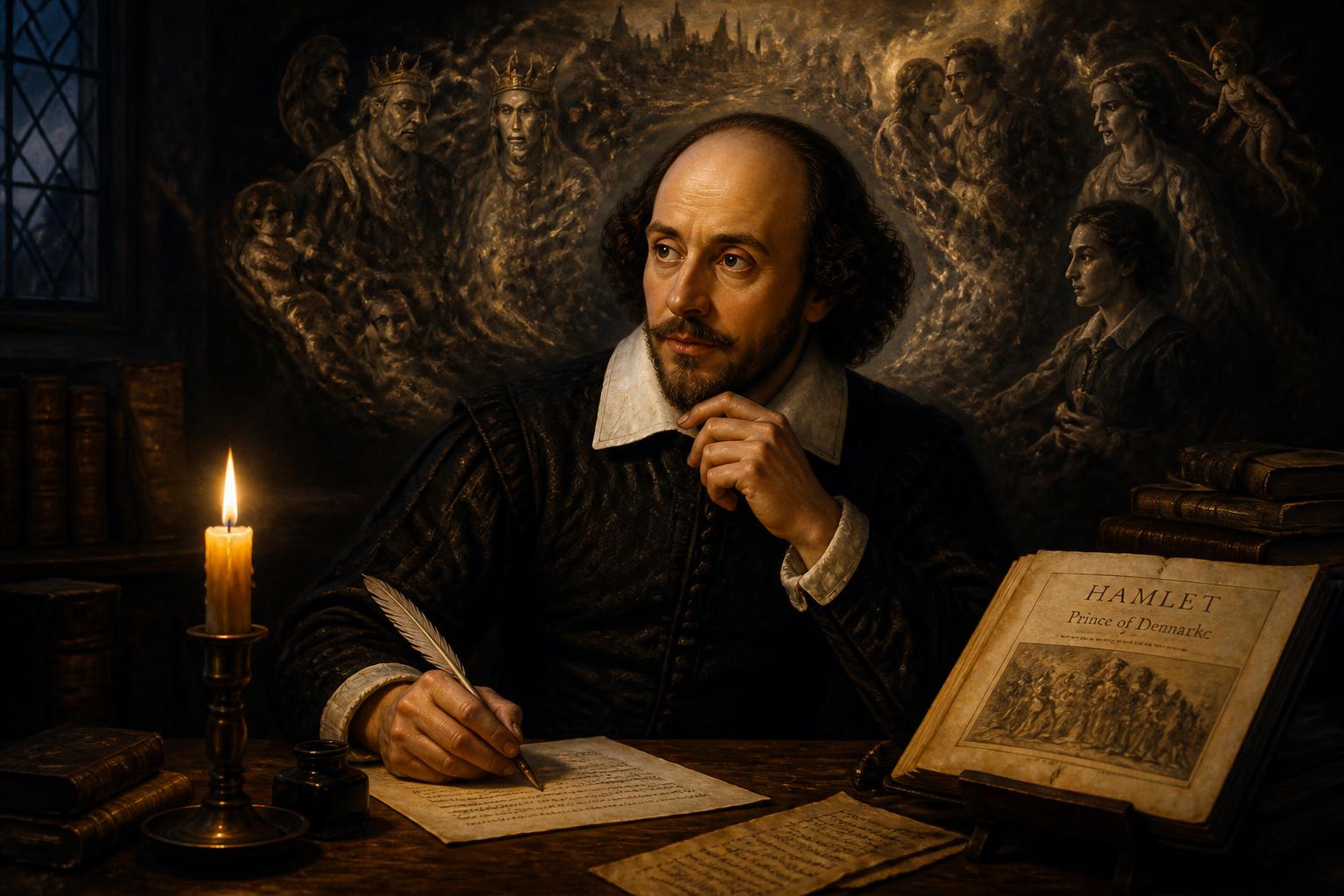
William Shakespeare: The Mind That Gave English Its Soul
From a glove-maker's son in Stratford to the playwright who reshaped the English language and mapped the human mind on stage — and why neuroscience still listens to him today.
Few minds in history have shaped how human beings think, feel and speak as profoundly as William Shakespeare. Four centuries after his death, his plays are still performed every single night somewhere on Earth; phrases he wrote in candlelight have become ordinary English; and modern neuroscientists, psychologists and linguists keep finding reasons to come back to him.
This profile, the latest in our Great Brains series, follows Shakespeare from a small market town in Warwickshire to the world stage — and asks what his extraordinary mind can still teach us about language, creativity, empathy, memory, decision-making and emotional intelligence.
Early Life in Stratford-upon-Avon
William Shakespeare was born in April 1564 in Stratford-upon-Avon, a busy market town in the English Midlands. His exact birthday is unknown, but the parish register records his baptism on April 26. By tradition his birthday is celebrated three days earlier — on St George's Day, April 23 — the same date he would later die.
His father, John Shakespeare, was a glove-maker, dealer and ambitious local official who eventually became bailiff (the rough equivalent of a mayor) of Stratford. His mother, Mary Arden, came from a prosperous farming family. The household was middle-class by Tudor standards: literate, religious, and embedded in the trades and politics of a small English town.
Young William almost certainly attended the King's New School in Stratford, a grammar school where boys spent long days drilling Latin grammar, rhetoric, and the works of Roman authors such as Ovid, Plautus, Cicero and Seneca. He never went to university — a fact rivals would later use against him — but the curriculum he absorbed at school gave him a working library of mythology, history and language he would draw on for the rest of his life.
In 1582, at the age of 18, he married Anne Hathaway, eight years his senior. The couple had three children: Susanna in 1583, and the twins Hamnet and Judith in 1585. Hamnet's death at age 11 is widely believed to echo through plays such as Hamlet, King John and Twelfth Night.
London, the Globe and a Working Playwright
By 1592, Shakespeare was working in London — and he was already successful enough to be attacked in print. The playwright Robert Greene sneered at him as an "upstart crow, beautified with our feathers." That insult, intended as gatekeeping, is also the first surviving evidence of just how good Shakespeare had become.
In 1594 he joined the Lord Chamberlain's Men, the leading theatre company in England, as one of its founding shareholders. Unlike most writers of his time, Shakespeare was not a freelancer hawking scripts to whichever company would buy them. He was an owner, a working actor, and a resident playwright. Every play he wrote, he wrote for a stage he knew personally — for actors whose strengths he understood and a public whose appetite he could feel.
In 1599, the company built its own playhouse on the south bank of the Thames: the Globe Theatre. Round, open to the sky, capable of holding around 3,000 spectators, it was a noisy, democratic space where aristocrats in galleries sat above standing groundlings who had paid a penny to be there. It is hard to overstate how unusual that was. The Globe was effectively a mass cognitive laboratory — a place where ideas about kingship, jealousy, love and madness were tested night after night against the responses of a real, mixed audience.
When King James I came to the throne in 1603, the company became The King's Men — the royal theatre of England. By the time Shakespeare retired to Stratford around 1613, he had written or co-written some 39 plays and 154 sonnets, in addition to longer narrative poems. He died on April 23, 1616, at the age of 52, a wealthy and respected gentleman.
Seven years later, in 1623, two of his fellow actors gathered his scripts together and published the First Folio: 36 plays in one volume. Without that book, roughly half of Shakespeare's work — including Macbeth, The Tempest, Julius Caesar and Twelfth Night — would simply not exist today.
"He was not of an age, but for all time."— Ben Jonson, on Shakespeare, 1623
Literary Innovations
Calling Shakespeare a "great writer" undersells what he actually did. He didn't just produce excellent plays inside an existing tradition — he rewired the tradition itself. A few of the innovations that still shape storytelling today:
Blank verse and the music of thought
Earlier playwrights wrote in rhymed couplets that locked actors into a sing-song rhythm. Shakespeare perfected the use of iambic pentameter — a ten-syllable line that mirrors the cadence of natural English speech. Layered with carefully placed deviations, it gave his characters a way to sound as if they were thinking out loud in real time. It is one reason Hamlet's soliloquies feel less like speeches and more like a mind happening on stage.
The soliloquy as a window into the brain
Shakespeare turned the soliloquy from a plot device — "let me explain what happens next" — into an X-ray of consciousness. When Hamlet asks "To be, or not to be," or Macbeth describes his hallucination of a floating dagger, the audience is not being told about a character. They are being granted direct access to a working mind in conflict: weighing options, second-guessing, rationalising, regretting.
Mixing tragedy and comedy
Classical theory said tragedy and comedy must never mix. Shakespeare ignored this. His tragedies have drunken porters and gravediggers; his comedies have moments of genuine pain. This blending is one reason his plays feel emotionally accurate — real human lives also refuse to keep their genres straight.
Characters that change
Before Shakespeare, most stage characters were essentially fixed types: the jealous husband, the loyal servant, the wise king. Shakespeare's great characters transform over the course of the play. Macbeth becomes a different man scene by scene. Prince Hal grows into King Henry. Even Iago, a portrait of pure malice, reveals new shades of cunning as he goes. This idea — that human beings change, and that change is itself the story — is now so basic to novels, film and television that it is difficult to imagine drama before it.
His Influence on the English Language
If you have ever felt that something was a "foregone conclusion", asked a friend to "break the ice", described a problem as "too much of a good thing", or accused someone of being on a "wild-goose chase", you have quoted Shakespeare without knowing it. So have generations of politicians, advertisers and screenwriters.
The Oxford English Dictionary credits Shakespeare with the earliest recorded use of roughly 1,700 English words. Some he likely coined; others he simply lifted out of the streets and immortalised on stage. Either way, a surprising amount of everyday English flows through him:
- Words: eyeball, bedroom, lonely, addiction, fashionable, swagger, gossip, manager, generous, lacklustre.
- Phrases: "heart of gold", "in a pickle", "wear my heart upon my sleeve", "the green-eyed monster", "method in his madness", "the world is my oyster".
- Idioms of feeling: "love is blind", "for goodness' sake", "what's done is done".
Linguists have a special name for one of his most distinctive tricks: functional shift, the practice of using a word as a different part of speech than expected — for example, turning the noun "god" into a verb in "he godded me". Neuroscientists led by Philip Davis at the University of Liverpool used EEG to study readers encountering these shifts in real time, and found a measurable spike of neural activity at the exact moment the brain has to reinterpret the word. In other words, Shakespeare's grammar is not just beautiful — it is literally good exercise for the brain.
To go deeper into how language shapes thinking, see our long-form guide on 👉Why We Forget and How to Remember More and our pillar essay on 👉Neuroplasticity Explained — both pair beautifully with reading the plays out loud.
The Psychological Depth of His Characters
Long before psychology existed as a science, Shakespeare was already its master practitioner. The American literary critic Harold Bloom went so far as to argue that "Shakespeare invented the human" — meaning not that no one had inner lives before him, but that no one had portrayed those inner lives with such accuracy that audiences started recognising themselves on stage.
Hamlet — the overthinking brain
Hamlet is the original portrait of analysis paralysis. Faced with a clear task — avenge his father — he turns it over, qualifies it, doubts the evidence, doubts himself, and acts only when forced to. Modern cognitive science would recognise the pattern instantly: high working memory, high openness, low impulsivity, and a tendency toward ruminative thought.
Macbeth and Lady Macbeth — guilt, rumination and sleep
The Macbeths are case studies in what happens when guilt meets a high-stakes decision. Macbeth's hallucinated dagger and "Sleep no more" speech read almost like a textbook on intrusive thoughts and stress-induced insomnia; Lady Macbeth's sleepwalking and compulsive hand-washing are a 17th-century portrait of what we might now describe as PTSD with obsessive features. For the underlying science, see 👉The Complete Guide to the Human Brain.
Othello — the architecture of jealousy
Othello is what happens when a single cognitive bias — confirmation bias, fed by Iago — is allowed to run unchecked in an otherwise capable mind. Shakespeare anatomises, step by step, how a confident, decent man can be turned into a murderer by being shown only the evidence that supports his worst fears. Anyone who has spent time with our guide to 👉Why Humans Make Irrational Decisions will recognise the pattern immediately.
Lear — ageing, identity and the failing brain
King Lear is a study of an ageing mind under catastrophic stress. Memory wavers, identity fractures, attention is hijacked by grief. Several neurologists have read Lear as one of the earliest realistic portrayals of dementia and its emotional impact, both on the patient and on the family.
"What a piece of work is a man! How noble in reason, how infinite in faculty… in apprehension, how like a god!"— Hamlet, Act II, Scene 2
Shakespeare and Modern Neuroscience
Shakespeare obviously knew nothing about neurons, fMRI scanners or dopamine pathways. And yet his plays keep showing up in modern brain research. Here is a quick map of the territory where he and contemporary neuroscience meet.
Creativity
Shakespeare's working method — heavy borrowing from older sources, ruthless combination, constant revision in front of live audiences — looks remarkably like what cognitive scientists describe today as the "combinatorial" model of creativity: novelty emerges from connecting two familiar things in an unfamiliar way. Each of his plays is a remix; the genius is in the remixing.
Empathy
Reading or watching Shakespeare is one of the most efficient empathy workouts we have. Studies on "reading the mind in the eyes" and on literary fiction (notably the work of David Kidd and Emanuele Castano) consistently find that engaging with complex, morally ambiguous characters improves performance on theory-of-mind tasks. Shakespeare's plays are practically designed for this: we are constantly inside one character's view, then suddenly inside another's, learning to hold incompatible perspectives in our heads at the same time.
Memory
Elizabethan actors routinely memorised tens of thousands of lines, often learning a new play every week or two. Their methods — chunking, rhythmic verse, emotional anchoring, spaced repetition through performance — line up neatly with modern memory science. The plays themselves are also masterclasses in how memory works under stress: who forgets what, who remembers too much, and what cost both extremes carry. Our deep dive on 👉Why We Forget and How to Remember More draws directly on the same principles.
Decision-making
From Hamlet's paralysis to Macbeth's impulsive ambition, Shakespeare's tragedies are essentially a gallery of decision-making failures. Each character makes their fatal choice for reasons modern behavioural science would recognise — bias, framing effects, sunk cost, motivated reasoning. For the underlying mechanics, the article on 👉Why Humans Make Irrational Decisions is a useful companion.
Attention and emotional intelligence
The plays demand sustained attention — long arguments, dense metaphor, plots spread across hours. They also demand emotional fluency from the audience. Modern research on emotional intelligence identifies four core skills: perceiving emotions, using them, understanding them and managing them. Every Shakespearean play exercises all four. To strengthen the underlying brain machinery, our pillar guides on 👉Why Your Attention Span Is Shrinking and 👉The Hidden Cost of Multitasking are natural next reads.
A Life in Milestones
The major moments that shaped Shakespeare's life and work:
- 1564Born in Stratford-upon-Avon, baptized on April 26; the son of John Shakespeare, a glove-maker and town official.
- 1582At 18, marries Anne Hathaway. The couple will have three children: Susanna and the twins Hamnet and Judith.
- 1592Already established as a working playwright and actor in London — attacked in print by a rival, proof of his rising reputation.
- 1594Becomes a founding member and shareholder of the Lord Chamberlain's Men, the leading theatre company in England.
- 1599The Globe Theatre opens on the south bank of the Thames; Shakespeare is part-owner and resident playwright.
- 1600 – 1606Writes Hamlet, Othello, King Lear and Macbeth — the great tragedies that map the human mind under pressure.
- 1603Under King James I, the company is renamed The King's Men, becoming the royal theatre of England.
- 1611Writes The Tempest, often regarded as his farewell to the stage.
- 1613Returns to Stratford-upon-Avon to live as a wealthy gentleman and landowner.
- 1616Dies on April 23 in Stratford, at the age of 52.
- 1623His friends publish the First Folio — 36 plays in one volume — saving 18 plays, including Macbeth and The Tempest, from being lost forever.
Cultural and Intellectual Legacy
Four hundred years on, Shakespeare is the most-quoted, most-translated and most-performed writer in human history. His plays have been staged in every major language. Hollywood has built entire studios on adaptations of them. He is the only writer most people can quote — often unknowingly — in everyday speech.
But the deeper legacy is harder to measure. Shakespeare didn't just leave us 39 plays. He left a vocabulary for the inner life: a way of describing jealousy, ambition, love, regret, doubt and joy that is now embedded in how English-speakers think about themselves. Every modern novel, every prestige television series, every therapy session conducted in English borrows something from him.
"We are such stuff as dreams are made on, and our little life is rounded with a sleep."— Prospero, The Tempest
Why Shakespeare Still Inspires
For writers, students, teachers and lifelong learners, Shakespeare offers a posture worth borrowing:
- Borrow boldly. Shakespeare reused other people's plots almost every time — and made them his own through depth of character.
- Write for a real audience. Every play was tested nightly in front of 3,000 noisy people. The feedback loop made the work sharper.
- Pay attention to language. The right word, in the right rhythm, can change a brain — and an audience.
- Take psychology seriously. A character is only as interesting as their inner contradictions.
- Keep showing up. Shakespeare wrote roughly two plays a year for two decades. Genius, again, is the byproduct of stubborn, daily work.
Explore Your Own Mind
Shakespeare turned his stage into a laboratory of the human mind. These free Brain Geek tools let you do something similar with your own:
Frequently Asked Questions
Why is Shakespeare still considered one of the greatest minds in history?
Shakespeare's genius spans language, psychology and storytelling. He invented or popularized thousands of English words and phrases, mapped human emotions with unmatched depth, and created characters — Hamlet, Macbeth, Lady Macbeth, Iago, Juliet — that still shape how we think about the mind, ambition, love and self-doubt today.
How many words did Shakespeare invent?
Modern scholarship credits Shakespeare with introducing or first recording around 1,700 words into English, including 'eyeball', 'lonely', 'bedroom', 'addiction', 'fashionable', 'gossip' and 'swagger'. Many more common phrases — 'break the ice', 'heart of gold', 'wild-goose chase' — also originate in his plays.
What can neuroscience teach us about Shakespeare's characters?
Neuroscience and cognitive psychology recognise Shakespeare's characters as remarkably accurate portraits of working brains under stress. Hamlet illustrates the cost of overthinking on decision-making; Macbeth shows how rumination and intrusive thoughts erode sleep and mental health; Othello dramatises the destructive power of cognitive bias and jealousy.
Did Shakespeare really write all his plays?
The overwhelming scholarly consensus is yes. Stylometric analysis, contemporary references and the First Folio published by his colleagues all support his authorship, though he collaborated with other playwrights such as John Fletcher and Thomas Middleton on several late plays — a normal practice in Elizabethan theatre.
Why does reading Shakespeare improve cognitive skills?
Shakespeare's compressed metaphors and unusual word order force the brain to construct meaning actively, which engages working memory, attention and language networks. Imaging studies suggest that his 'functional shifts' — using a noun as a verb, for example — trigger a measurable spike of neural activity as the brain reinterprets a word in real time.
What's the best way to start reading Shakespeare today?
Start with one accessible play — A Midsummer Night's Dream, Macbeth or Romeo and Juliet — using a good annotated edition. Read a scene aloud, then watch a high-quality performance of the same scene. Hearing the rhythm of the verse helps the meaning click in a way pure silent reading often can't.
Continue Exploring Brain Geek
👉Albert Einstein: The Genius Who Changed Our Understanding of the Universe — The first profile in our Great Brains series.
👉Leonhard Euler: The Most Prolific Mathematician in History — The second Great Brains profile.
👉Discover more Great Brains — Upcoming profiles on Newton, Ramanujan, Turing, Curie, Tesla and many more.
👉The Complete Guide to the Human Brain — The cornerstone overview of brain architecture and chemistry.
👉The Complete Guide to Memory — How great thinkers built and used extraordinary memory.
👉Neuroplasticity Explained — Why reading challenging language literally rewires your brain.
👉Dopamine Explained — The neurochemistry of curiosity, motivation and creative work.
👉Why Humans Make Irrational Decisions — The cognitive biases that animate Othello, Macbeth and Lear.
👉Why Your Attention Span Is Shrinking — How to rebuild the kind of attention Shakespeare's plays demand.
Why Shakespeare Still Matters
William Shakespeare remains one of history's greatest intellectual figures not because he wrote in beautiful English, but because he wrote with uncanny accuracy about the human mind. His characters anticipate modern psychology. His language has shaped the way English-speakers describe their own thoughts. His plays still measurably exercise attention, empathy and working memory.
In an age of shortening attention spans, algorithmic feeds and disposable content, Shakespeare quietly insists on the opposite: long thoughts, ambiguous characters, careful language, hard questions about how to live. That is exactly the cognitive diet a modern brain needs. Four centuries on, "the upstart crow" from Stratford is still teaching us how to think — and how to feel.