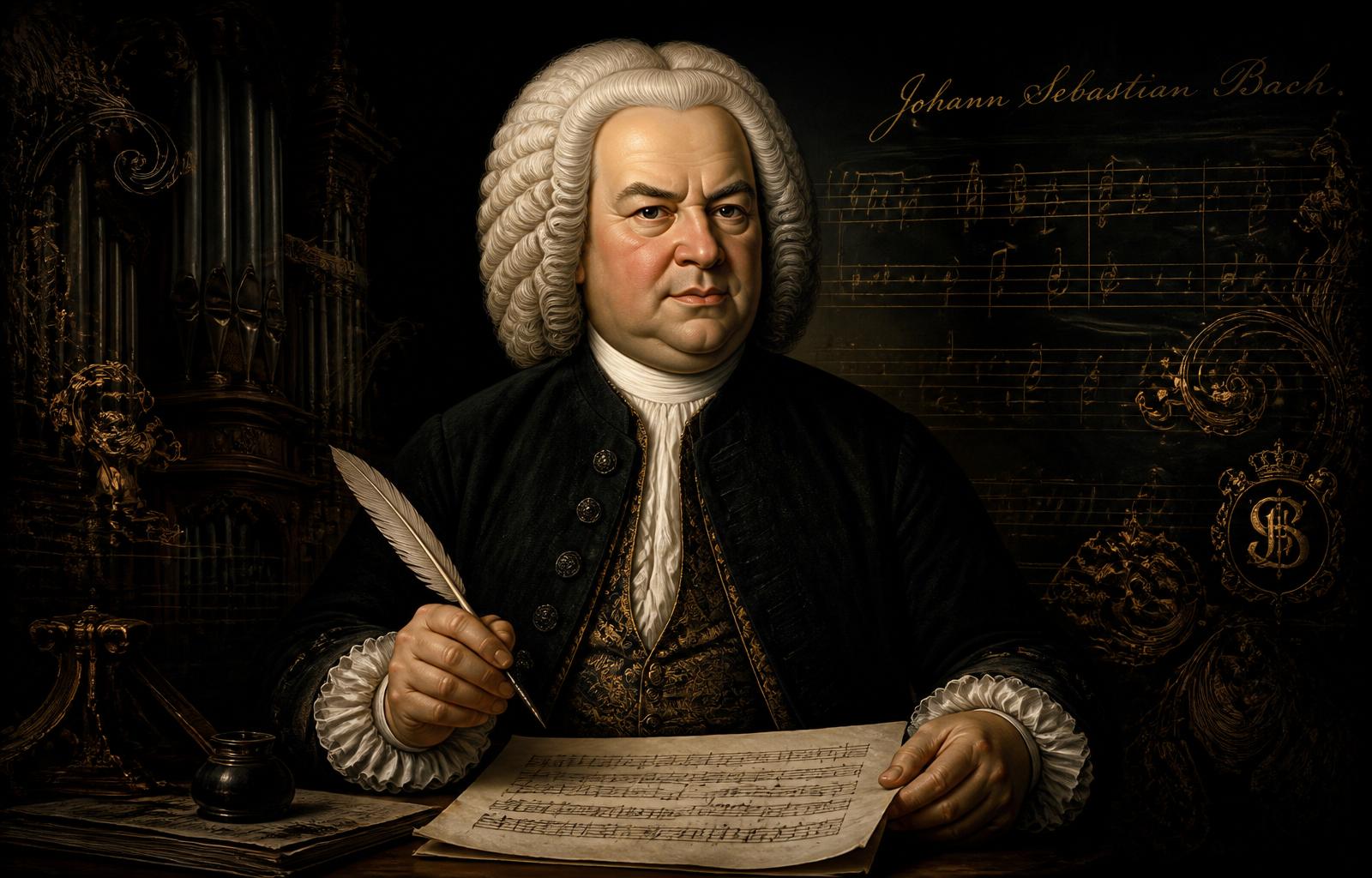
Johann Sebastian Bach: The Mathematician of Music
From a small German town to the summit of Western music — how Bach's mind united mathematics, faith and feeling, and why neuroscientists still listen to him to understand the brain.
Few minds in history have combined intellectual rigor and emotional depth as completely as Johann Sebastian Bach. Two and a half centuries after his death, his music is still studied by composers, performed every night somewhere on Earth, taught in conservatories on six continents — and quietly used in neuroscience laboratories to investigate how the brain handles complexity, memory, emotion and meaning.
This profile, the latest in our Great Brains series, follows Bach from a small Thuringian town to the summit of Western music — and asks what his extraordinary mind can still teach us about creativity, deliberate practice, memory, pattern recognition, attention and emotion.
Childhood and Musical Education
Johann Sebastian Bach was born on March 21, 1685, in Eisenach, a small town tucked into the forested hills of Thuringia, central Germany. He was the youngest of eight children of Johann Ambrosius Bach, the town's director of music, and Maria Elisabeth Lämmerhirt. From his first breath, music was the family business.
His father taught him the violin and the basics of music theory. An uncle gave him organ lessons. By the time he was nine, Bach had lost both parents — his mother in 1694, his father a few months later — and was sent to live with his older brother, Johann Christoph Bach, an organist in nearby Ohrdruf. There, the ten-year-old boy was put through one of the most rigorous musical educations in Europe: daily lessons on the harpsichord and organ, choir singing at the Lyceum, and patient drill in figured bass and counterpoint.
A famous legend captures Bach's hunger to learn. His brother kept a precious manuscript book of organ music locked in a cabinet. Young Sebastian, denied access, supposedly crept down at night to copy the entire book by moonlight over six months, ruining his eyes in the process. The story may be exaggerated — Bach's first biographer, his son Carl Philipp Emanuel, told it after Bach's death — but it captures a real personality trait: a deep, almost obsessive willingness to do whatever the work required.
The Bach Family of Musicians
Understanding Bach means understanding the family he was born into. The Bachs were not aristocrats and not wealthy, but in their corner of Germany they were everywhere: the organist of one town, the town-musician of another, the violinist at a small ducal court. They gathered every year for enormous family reunions where, by tradition, they sang elaborate improvised quodlibets — humorous polyphonic mash-ups of popular tunes.
Bach grew up inside this living workshop. Counterpoint, the art of weaving independent melodic lines together, was something he heard at the dinner table before he could read. By the time he was a teenager, he was already a working musician, and by 18 he held his first paid position — as church organist in Arnstadt.
His own household, in turn, was an extension of the same tradition. Of the twenty children he had with his two wives, four sons — Wilhelm Friedemann, Carl Philipp Emanuel, Johann Christoph Friedrich and Johann Christian — became important composers in their own right. C. P. E. Bach in particular bridged the baroque and classical eras and directly influenced the young Haydn and Mozart.
From Arnstadt to Leipzig: A Working Composer's Life
Bach was never a free-floating artist supported by patrons of his choice. He was a working professional, hired and fired, negotiating contracts, fighting with town councils, raising a large family and constantly looking for the next better job. His career falls into four main chapters.
Arnstadt (1703 – 1707)
At 18, Bach became the organist of the New Church in Arnstadt. His employers got a young man of astonishing skill — and a young man with no patience for mediocrity. He scandalised them by introducing "strange variations" into the hymns and feuding with his choir of bored teenagers. In 1705 he asked for a four-week leave to hear the great organist Dietrich Buxtehude in Lübeck. He stayed four months, walking roughly 400 km in each direction. The trip changed his music.
Weimar (1708 – 1717)
As court organist and later concertmaster at the ducal court of Weimar, Bach entered the most concentrated decade of organ composition in Western history. The great preludes, fugues, toccatas and chorale settings — including the famous Toccata and Fugue in D minor — date from this period. He also began to absorb the Italian concerto style, transcribing works by Vivaldi and Marcello for solo keyboard. The "Bach sound" was beginning to crystallise: dense polyphony fused with the clear, dramatic shapes of Italian music.
Köthen (1717 – 1723)
At Köthen, Bach worked for Prince Leopold, a Calvinist who needed no elaborate church music. Freed from the weekly demands of the cantata cycle, Bach turned to instrumental composition. The result is one of the most extraordinary catalogues in Western music: the Brandenburg Concertos, the Sonatas and Partitas for solo violin, the Six Suites for solo cello, the French Suites, the English Suites, the Inventions and Sinfonias and the first book of the Well-Tempered Clavier.
Leipzig (1723 – 1750)
For the final 27 years of his life, Bach was Thomaskantor in Leipzig — director of music for four churches, music tutor at the Thomasschule, and effectively the city's chief musical official. The job was punishing. Every Sunday and feast day, the choirs of the Thomaskirche and the Nikolaikirche needed new or freshly arranged sacred music. In his first five years alone, Bach composed something like three complete annual cycles of cantatas — more than 200 in all, of which around 200 survive. From the Leipzig years also come the St Matthew Passion, the St John Passion, the Christmas Oratorio, the Mass in B Minor, the Goldberg Variations, the second book of the Well-Tempered Clavier, the Musical Offering and the unfinished Art of Fugue.
"I was obliged to work hard. Whoever is equally industrious will succeed equally well."— Johann Sebastian Bach
That self-description — terse, modest, factual — is closer to the truth than the romantic image of a divinely inspired genius. Bach's output is the product of extraordinary, daily, lifelong effort. For the science of how that kind of mastery is built, see our pillar guide on 👉The Science of Deliberate Practice.
The Great Masterworks
A handful of Bach's works are so central to Western culture that they deserve their own section. They span almost every form he worked in.
The Well-Tempered Clavier (1722 / 1742)
Two books of 24 preludes and fugues each, one in every major and minor key. The work was partly pedagogical — a workout for keyboard students — but it is also one of the most complete demonstrations in music history of how a small number of techniques (subject, answer, inversion, stretto) can be combined into an infinite variety of moods. Beethoven called it "the musician's Old Testament."
The Brandenburg Concertos (1721)
Six concertos for unusual combinations of instruments, written for (and ignored by) the Margrave of Brandenburg. Each one is a small encyclopedia of baroque instrumental writing: the dazzling solo harpsichord of No. 5, the dialogue of violin and recorders in No. 4, the bright trumpet of No. 2.
The Goldberg Variations (1741)
Thirty variations on a single sarabande theme, framed by a haunting aria. The famous story — that Bach wrote them for an insomniac Russian count, Hermann Carl von Keyserlingk, who needed something to fill the long nights — may be apocryphal, but the work itself is real, and one of the deepest meditations on theme and variation ever written. Every third variation is a canon, and each canon climbs by one interval, like an ascending mathematical staircase.
The Mass in B Minor (completed 1749)
Bach was a devout Lutheran writing a Latin Catholic mass, drawing on music he had composed across his entire career. It is in effect his musical last will and testament: a synthesis of every technique he commanded, set to the most universal sacred text he could find. He never heard it performed in full.
The St Matthew Passion (1727)
A two-part setting of the Passion narrative in Matthew's Gospel, scored for two choirs, two orchestras, soloists and a chorale tune that recurs throughout. After Bach's death it was forgotten for nearly a century. In 1829 the 20-year-old Felix Mendelssohn conducted a partial revival in Berlin — the first performance in 79 years — and ignited the Bach revival that has continued ever since.
Counterpoint, Fugue and Mathematical Structure
To understand why scientists and mathematicians keep coming back to Bach, you have to understand counterpoint — the art of combining two or more independent melodic lines so that each one makes sense on its own and they make sense together.
A fugue is the strictest, most virtuosic form of counterpoint. A single theme — the "subject" — is announced in one voice, then imitated in turn by the others, and from then on the entire piece develops by playing that one theme against itself: inverted, mirrored, sped up, slowed down, layered against new countersubjects. Done well, the result feels like a conversation between independent minds; done badly, it feels like algebra. Bach makes it feel like both at once.
The transformations Bach used on his fugue subjects are essentially mathematical operations: identity, inversion (flipping up–down intervals), retrograde (reversing in time), augmentation (doubling the note values), diminution (halving them), transposition. In The Art of Fugue, his final unfinished masterpiece, he uses a single subject and pushes these operations to their limit — fourteen fugues and four canons that systematically explore what one short tune can be made to do.
This is why Douglas Hofstadter's Pulitzer-winning book Gödel, Escher, Bach sits Bach beside Gödel's incompleteness theorems and Escher's recursive drawings: all three are exploring how rich, self-referential structures can emerge from a handful of simple rules. The deep pleasure of listening to Bach is often the pleasure of pattern recognition — your brain noticing, half-consciously, that "this melodic line is the first one upside down."
Creativity, Deliberate Practice and the Composer's Brain
Bach's career is one of the cleanest historical case studies for what cognitive scientists today call deliberate practice: the slow, focused, feedback-rich accumulation of skill over decades. He began technical training before age 10. He took a four-month walk to hear a master organist. He copied out, by hand, the scores of dozens of other composers. He wrote a new cantata almost every week for years. He revised his own works obsessively. He taught his children and students through written exercises he composed for the purpose.
What looks from the outside like effortless invention was, on the inside, an extraordinary daily habit. For the underlying science of how skill of this magnitude is built — and why most people never come close — see our deep-dive guide on 👉The Science of Deliberate Practice.
Bach's working method also illustrates the modern combinatorial view of creativity: he reused, reworked and recombined material constantly. The Mass in B Minor draws on cantatas. Concertos are transformed into harpsichord concertos. Fugue subjects from one work reappear in another. None of this diminishes him. It tells us, instead, that even the most original of all minds was built on relentless recombination of patterns he had mastered.
Musical Memory and the Composer's Mind
Bach's musical memory was, by all accounts, prodigious. Contemporary reports describe him sitting down to improvise a six-part fugue on a theme played to him moments earlier — a feat almost no living musician would attempt. In 1747 King Frederick the Great of Prussia handed him a long, intentionally awkward theme and asked for a three-part fugue. Bach delivered it on the spot. The king then asked for six parts. Bach declined to improvise that one, but went home and worked it out on paper — and the result became The Musical Offering.
From a cognitive standpoint, what Bach was doing involved several systems at once:
- Working memory — holding the subject and three or four counter-voices "active" while inventing the next bar.
- Long-term schema knowledge — a lifetime of internalised harmonic and contrapuntal patterns.
- Auditory imagery — actually hearing, in the mind's ear, what the voices will sound like together before they exist.
- Motor planning — at the keyboard, the fingers' own memory of patterns the hands had played thousands of times.
Modern memory research suggests that this kind of feat is not magic — it is what happens when extreme working-memory capacity is fed by an enormous, well-organised long-term memory. To understand why this matters for everyday learning, see 👉Why We Forget and How to Remember More and 👉The Complete Guide to Spaced Repetition.
Music, Neuroplasticity and the Brain
Music is one of the most widely studied stimuli in modern neuroscience, and for good reason: almost every major brain network responds to it. Listening to a Bach fugue, for example, engages:
- Auditory cortex — decoding pitch, timbre and the relationships between simultaneous voices.
- Motor cortex and cerebellum — entraining to rhythm even when you sit perfectly still.
- Hippocampus — binding melody, harmony and context into memory traces.
- Frontal cortex — predicting where the music is going, then comparing predictions to what actually happens.
- Limbic and reward circuits — releasing dopamine at moments of harmonic resolution and surprise.
Learning an instrument goes further. fMRI and structural-MRI studies consistently find that long-term musical training produces measurable changes in the brain — denser white matter in the corpus callosum, larger auditory and motor regions, stronger functional connections between hemispheres. Music is one of the clearest demonstrations of neuroplasticity in action. For the underlying biology, see our pillar guide on 👉Neuroplasticity Explained.
There is also growing evidence that musical engagement helps build cognitive reserve — the brain's ability to maintain function in the face of aging or damage. Older adults who play an instrument tend to show better executive function, attention and memory than non-musicians of the same age. For an overview of the daily habits that protect long-term cognition, see 👉The Complete Guide to the Human Brain and 👉The Complete Guide to Sleep.
Music, Attention, Learning and Emotion
One of Bach's quiet superpowers is what his music does to attention. Counterpoint forces you to track several lines at once. A fugue invites you to hold a subject in mind for ten or twelve minutes while it migrates from voice to voice. Listening properly is itself an exercise in sustained, undistracted thought.
This is one reason students, programmers, mathematicians and writers so often work to Bach. The music has structure rich enough to engage the brain's pattern-recognition systems without lyrics or sudden surprises that hijack attention. For the modern crisis of fractured focus and what to do about it, see our pillar guide on 👉Why Your Attention Span Is Shrinking and our deep dive on 👉The Hidden Cost of Multitasking.
Bach also reaches the emotional brain in unusually direct ways. The St Matthew Passion has reduced atheist musicologists to tears for a reason: the slow, gentle 12/8 of "Erbarme dich, mein Gott" places the listener inside a moment of profound regret, and the brain — particularly the limbic system — responds as it would to a real emotional event. To understand the chemistry behind moments like these, see our pillar essay on 👉The Complete Guide to Dopamine.
"Bach is a colossus. Beside him, all other composers are dwarfs."— Pablo Casals, cellist
A Life in Milestones
The major moments that shaped Bach's life and work:
- 1685Born March 21 in Eisenach, Germany, into a family of professional musicians stretching back five generations.
- 1695Orphaned at 10, he moves in with his older brother Johann Christoph, an organist who teaches him keyboard and counterpoint.
- 1703At 18, takes his first professional post as organist at the New Church in Arnstadt.
- 1705 – 1706Walks roughly 400 km to Lübeck to hear the great organist Dietrich Buxtehude — a 4-month leave that becomes legendary.
- 1707Marries his cousin Maria Barbara Bach. The couple will have seven children, four of whom survive infancy.
- 1708 – 1717Court organist and concertmaster at Weimar, where he writes much of his greatest organ music.
- 1717 – 1723Kapellmeister at the court of Prince Leopold in Köthen — a Calvinist court with no need for church music. Bach turns to instrumental works: the Brandenburg Concertos, suites, sonatas and Book I of the Well-Tempered Clavier.
- 1720Maria Barbara dies suddenly while Bach is away with the prince. He returns to find her already buried.
- 1721Marries Anna Magdalena Wilcken, a gifted soprano who becomes his closest musical collaborator. They will have 13 children together.
- 1723Appointed Kantor of the Thomasschule in Leipzig — a post he will hold for the next 27 years.
- 1727Premiere of the St Matthew Passion at the Thomaskirche on Good Friday.
- 1741Publishes the Goldberg Variations, originally written, according to legend, to soothe an insomniac Russian count.
- 1747Visits Frederick the Great in Potsdam. The king gives him a theme; Bach improvises a fugue on the spot and later expands it into The Musical Offering.
- 1749Completes the Mass in B Minor — a sacred work synthesising every technique of his career.
- 1750Dies on July 28 in Leipzig at age 65, leaving the unfinished Art of Fugue and a body of work that will shape Western music for ever.
Bach's Influence: Mozart, Beethoven, Mendelssohn — and Modern Music
When Bach died in 1750, the musical world was already moving on. The dense, contrapuntal "learned style" he embodied was being replaced by the lighter, more melodic galant manner favoured by his own sons. For a generation, Johann Sebastian was remembered mainly as an old-fashioned organist with extraordinarily clever fingers.
And yet his shadow stretches across everything that follows.
- Mozart studied Bach intensively in the 1780s after the Baron van Swieten introduced him to the Well-Tempered Clavier. Mozart's late fugues — and the dazzling counterpoint in the finale of the Jupiter symphony — are direct descendants.
- Beethoven learned the Well-Tempered Clavier as a child. He famously called Bach not a stream (Bach in German) but an ocean. The great fugues of his late period — in the Hammerklavier Sonata, the Grosse Fuge, the late string quartets — are unimaginable without Bach.
- Mendelssohn rediscovered Bach for the wider public with his 1829 revival of the St Matthew Passion. From that moment, performance and scholarship of Bach has only grown.
- Chopin warmed up by playing the Well-Tempered Clavier and made his own pupils do the same.
- Brahms, Schumann, Liszt and Wagner studied Bach scores obsessively. So did Schoenberg, Webern, Stravinsky, Shostakovich and Hindemith in the twentieth century.
- In jazz, players from Jacques Loussier to Keith Jarrett have improvised on Bach's music. Bill Evans called Bach "the most important composer for any pianist."
- In modern film, his music underscores films from Solaris to Hannibal to The Tree of Life.
There is no comfortable distance from which to admire Bach. Almost every Western musician alive has either studied his music directly or learned from a teacher who did. His fingerprints are on the harmonic textbooks, the conservatory curricula, the practice routines of children learning piano this morning.
Why Bach Still Inspires
For students, learners, musicians and curious minds, Bach offers a posture worth borrowing:
- Show up every day. Bach wrote a new cantata almost every week for years. Genius, again, is the byproduct of stubborn, daily work.
- Master the rules before you transcend them. Bach knew every contrapuntal technique of his era cold. That mastery was what let him bend them into something nobody had heard before.
- Combine the structural and the emotional. Math and feeling are not enemies. Bach proves they can be the same act of imagination.
- Reuse and remix. Even the greatest composer of all time recycled and reworked his own material. Originality is recombination plus depth.
- Teach what you know. The Inventions, the Sinfonias and the Well-Tempered Clavier were teaching pieces. Trying to explain something to a student is one of the most powerful ways to deepen your own understanding.
Explore Your Own Mind
Bach turned a Lutheran choir loft into a laboratory of musical and mathematical thought. These free Brain Geek tools let you do something similar with your own brain:
Frequently Asked Questions
Why is Johann Sebastian Bach considered the greatest composer of all time?
Bach mastered every genre and technique available in his era — organ works, cantatas, concertos, keyboard suites, passions, masses — and pushed each one further than anyone before or after him. His ability to unite mathematical structure with deep emotion, and his quiet influence on Mozart, Beethoven, Mendelssohn and almost every later Western composer, is why musicians and neuroscientists alike still place him at the summit.
What are Bach's most important works?
The Well-Tempered Clavier, the Brandenburg Concertos, the Goldberg Variations, the Mass in B Minor, the St Matthew Passion, the Cello Suites, the Sonatas and Partitas for solo violin, the Art of Fugue and the great organ works (including the Toccata and Fugue in D minor) are widely regarded as the pillars of his output.
How does Bach's music affect the brain?
Listening to Bach activates a remarkable spread of brain regions: auditory cortex for pitch and timbre, motor regions for rhythm, the hippocampus for memory, and frontal areas for predicting harmonic resolution. fMRI and EEG studies suggest that polyphonic music like Bach's gives the brain unusually rich pattern-recognition work, which is why many listeners report improved focus and a sense of mental clarity.
Is it true that Bach was forgotten after his death?
Partially. His sons remained famous, but Johann Sebastian himself was known mainly as a learned 'old style' composer. The full rediscovery began in 1829, when the 20-year-old Felix Mendelssohn conducted the St Matthew Passion in Berlin — the first performance in nearly a century. From that moment, Bach's reputation as the foundation of Western music has only grown.
Why do mathematicians and scientists love Bach?
Bach's counterpoint, canons and fugues are built on transformations — inversion, retrograde, augmentation — that are essentially mathematical operations. His Goldberg Variations and Art of Fugue read almost like symmetric proofs in sound. Douglas Hofstadter's Pulitzer-winning book Gödel, Escher, Bach made this connection famous.
Can listening to or learning Bach improve learning and memory?
There is no magic 'Bach effect' that raises IQ, but the underlying activities — actively listening to complex music, learning an instrument, sight-reading, practicing — robustly strengthen working memory, attention, auditory processing and neuroplasticity throughout life. Music study is one of the most evidence-backed forms of cognitive cross-training we have.
Continue Exploring Brain Geek
👉Albert Einstein: The Genius Who Changed Our Understanding of the Universe — The first profile in our Great Brains series.
👉Leonhard Euler: The Most Prolific Mathematician in History — A mathematical counterpart to Bach's musical genius.
👉William Shakespeare: The Mind That Gave English Its Soul — Bach's literary contemporary at the summit of Western creativity.
👉Discover more Great Brains — Upcoming profiles on Newton, Ramanujan, Turing, Curie, Tesla and many more.
👉The Complete Guide to the Human Brain — The cornerstone overview of brain architecture and chemistry.
👉Neuroplasticity Explained — Why learning an instrument literally rewires the brain.
👉The Science of Deliberate Practice — How Bach-level mastery is actually built.
👉Why We Forget and How to Remember More — The science of musical memory and beyond.
👉The Complete Guide to Spaced Repetition — The most evidence-based way to make new knowledge stick.
👉The Complete Guide to Dopamine — The chemistry of musical pleasure and creative drive.
👉Why Your Attention Span Is Shrinking — How to rebuild the kind of focus a fugue demands.
👉The Hidden Cost of Multitasking — Why deep music (and deep work) require single-tasking.
👉The Complete Guide to Sleep — How sleep consolidates the skills musicians build by day.
Why Bach Still Matters
Johann Sebastian Bach remains one of history's greatest creative minds not because his music is beautiful — though it is — but because he showed, more clearly than almost anyone before or since, that structure and emotion are not opposites. A six-voice fugue can be a piece of pure mathematics and a piece of pure feeling at the same time. A cantata can teach a congregation theology and rewire the listeners' attention. The Well-Tempered Clavier can be both a textbook and a private universe.
In an age of shortening attention spans, algorithmic feeds and disposable content, Bach quietly insists on the opposite: long thoughts, complex patterns, sustained attention, deep emotion built on craft. That is exactly the cognitive diet a modern brain needs. Three centuries on, the boy who copied music by moonlight in Ohrdruf is still teaching us how to think — and how to feel.