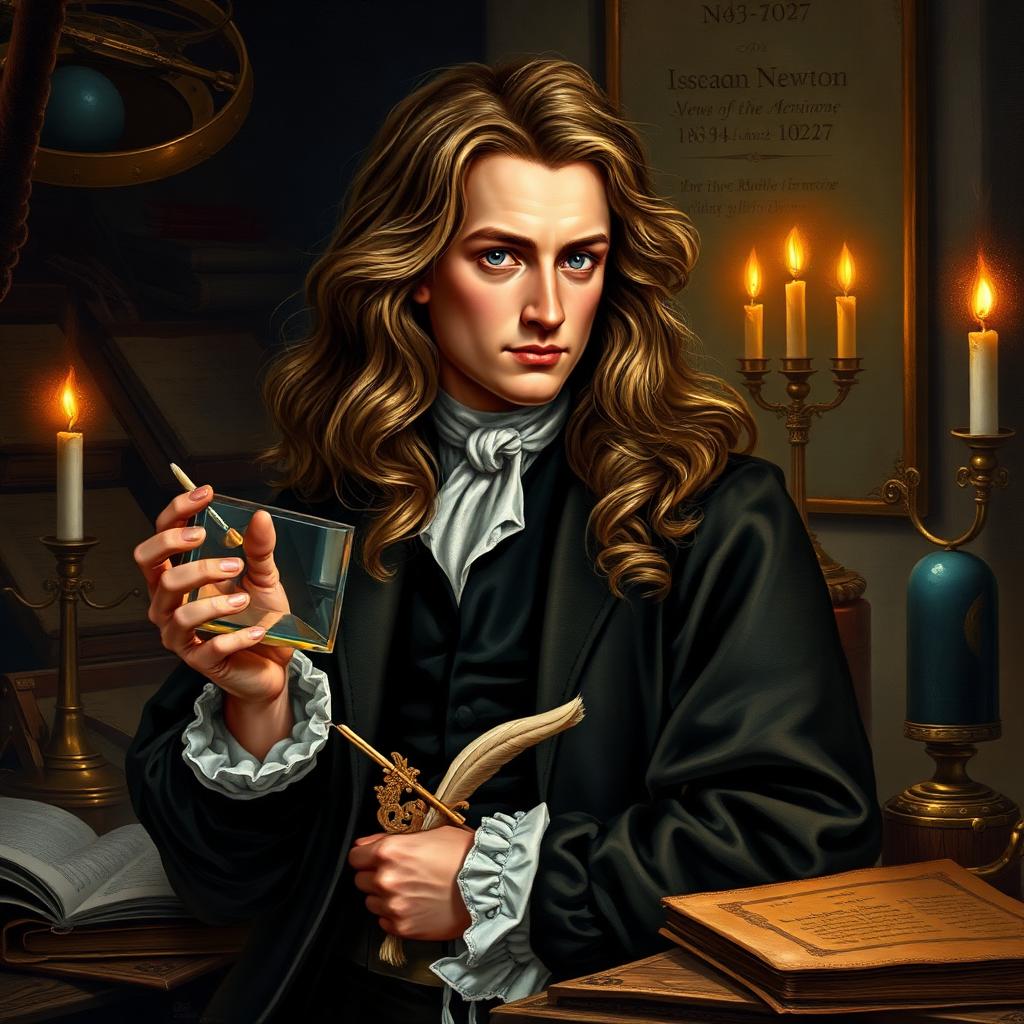
Isaac Newton: The Father of Classical Mechanics
From a lonely Lincolnshire farm and a plague-year miracle to the Principia, gravity, calculus and the colors of light — how Newton's relentless focus rebuilt our picture of the universe and still shapes how we think today.
Few minds in history have rearranged the world as completely as Sir Isaac Newton. In a single lifetime he co-invented calculus, formulated the laws of motion, discovered universal gravitation, demonstrated that white light is a spectrum of colors, designed the first practical reflecting telescope, and wrote what is still arguably the most influential book in the history of science: the Philosophiæ Naturalis Principia Mathematica.
This profile, the latest in our Great Brains series, follows Newton from a small Lincolnshire farm to Westminster Abbey — and asks what his extraordinary mind can still teach us about deep focus, deliberate practice, working memory, creativity, pattern recognition and scientific thinking.
Childhood and Early Education
Isaac Newton was born on January 4, 1643 (Gregorian calendar) at Woolsthorpe Manor, a modest stone farmhouse in Lincolnshire, England. His father, also named Isaac, had died three months earlier. The baby was so small and weak that, in his mother's later words, he "could have been put into a quart pot." Almost no one expected him to survive the year.
He did survive — but childhood was hard. When Isaac was three, his mother Hannah remarried the Reverend Barnabas Smith, a wealthy older clergyman in a neighboring village, and left Isaac behind at Woolsthorpe with his grandparents. The boy spent the next seven years separated from his mother, and the wound never fully healed. In a notebook he kept as a teenager, he listed his own sins. One of them: "Threatening my father and mother Smith to burn them and the house over them."
From this lonely childhood emerged an unusually self-contained, observant boy. At school in Grantham he built water clocks, sundials and a working windmill driven by a mouse. He was not, at first, a brilliant student. A famous schoolyard fight with a stronger classmate (which young Isaac won, partly by intelligence and partly by stubbornness) reportedly fueled his decision to beat the same boy academically — which he then did, methodically, until he was top of the school.
Cambridge: Trinity College and the Lucasian Chair
In 1661, at 18, Newton was admitted to Trinity College, Cambridge, as a subsizar — a student who paid reduced fees by waiting on wealthier undergraduates. He was older than most of his classmates, intensely private and almost friendless. He recorded his expenses in a thrifty notebook, including small amounts spent on "loss at cards" — one of the few hints we have of any youthful indulgence.
The Cambridge curriculum at the time still revolved around Aristotle. Newton dutifully read the prescribed texts, then, in a notebook he later titled Quæstiones quædam Philosophicæ ("Certain Philosophical Questions"), began to record his own questions — about light, color, motion, atoms, time, the soul — together with the experiments he might do to answer them. He wrote at the top of the page, in Latin: "Amicus Plato amicus Aristoteles magis amica veritas" — "Plato is my friend, Aristotle is my friend, but my best friend is truth."
By his last year as a student, Newton was reading Descartes, Galileo, Kepler and the radical English mathematician Isaac Barrow, the first Lucasian Professor of Mathematics, who quickly recognized that this awkward Lincolnshire student was the most original mathematical mind in Cambridge.
The Plague Years and the Annus Mirabilis (1665 – 1666)
In 1665, the Great Plague swept through England. Cambridge closed. Newton, now 22 years old and freshly armed with a bachelor's degree, returned home to Woolsthorpe. For roughly eighteen months he had no lectures, no examinations, no committees, no social distractions — just a quiet country house, a small library, and his own notebook.
What followed has no parallel in the history of science. Working alone, the young Newton:
- Invented the method of fluxions — the version of calculus that would let him model anything that changes continuously.
- Developed the basic ideas of the binomial theorem for fractional and negative exponents.
- Worked out the law of universal gravitation, including the inverse-square dependence on distance, and convinced himself that the same force that pulls an apple down also keeps the Moon in orbit.
- Performed his first prism experiments on the nature of light and color, beginning the work that would become the Opticks forty years later.
The famous apple, by Newton's own account in old age, really did fall. He told the story several times, most reliably to the antiquarian William Stukeley in 1726: walking in the garden at Woolsthorpe, he saw an apple drop straight down and asked himself why it always fell perpendicular to the earth — and from that simple question began to wonder whether the same force that pulled the apple also held the Moon. It did. The apple did not strike his head, but the question very much struck his mind.
"In those days I was in the prime of my age for invention, and minded mathematics and philosophy more than at any time since."— Isaac Newton, on the Annus Mirabilis
From a cognitive standpoint, the plague years are one of the cleanest historical examples of what neuroscientists today call deep work — long, undistracted blocks of focused, generative thought. For the modern science of how that kind of attention is built and protected, see our pillar guides on 👉The Complete Guide to Focus, 👉Why Your Attention Span Is Shrinking and 👉The Hidden Cost of Multitasking.
The Invention of Calculus
Calculus is the mathematics of change. Before it existed, science could describe states — where a planet is right now — but it had no general way to describe how those states change with time. Newton's method of fluxions gave him a tool for handling continuously varying quantities: velocities, accelerations, areas under curves, instantaneous rates.
Newton developed his calculus around 1665–1666 but, characteristically, did not publish. He shared the method privately with a few mathematicians, including Isaac Barrow. Meanwhile, in Germany, Gottfried Wilhelm Leibniz independently arrived at his own version of calculus in the 1670s, with the elegant notation — dx, dy, ∫ — that we still use today, and published first.
A bitter priority dispute followed, dragging on for the rest of Newton's life. Modern historians agree that the discovery was independent on both sides. Newton got there first; Leibniz published first; the world uses Leibniz's notation and Newton's physics. The episode is a sobering case study in how the same problem, given the same intellectual climate, can be solved by two minds at once — and a useful reminder, when we think about creativity and originality, that great ideas almost always have multiple parents.
The Three Laws of Motion
In the 1680s, prompted by a visit from the astronomer Edmond Halley, Newton finally agreed to systematize his physics into a single book. The result, published in 1687, was the Philosophiæ Naturalis Principia Mathematica — the Mathematical Principles of Natural Philosophy. At its heart sit three deceptively simple statements:
- First Law (Inertia). An object at rest stays at rest and an object in motion stays in motion, in a straight line, unless acted on by an external force.
- Second Law. The force on an object equals its mass times its acceleration: F = ma.
- Third Law. For every action there is an equal and opposite reaction.
These three laws describe the motion of almost everything you experience: a falling ball, a rolling car, a rocket leaving the launch pad, your foot pressing the floor. For more than two centuries they were the basis of all of physics. Einstein later extended them at very high speeds and very strong gravitational fields, but in everyday life Newton's mechanics still rules. The engineers who build your bridges, your aircraft and the satellites that power your phone all use Newton's equations.
Universal Gravitation
The deeper insight of the Principia was the law of universal gravitation. Newton proposed that every two objects in the universe attract each other with a force proportional to the product of their masses and inversely proportional to the square of the distance between them. The same force that pulls an apple from a tree pulls the Moon toward the Earth — and curves its straight-line motion into an orbit.
The conceptual leap is hard to overstate. Until Newton, the heavens and the earth had been treated as fundamentally different realms — celestial bodies followed one set of rules, terrestrial bodies another. Newton showed that a single mathematical law governs both. The universe became, for the first time, one thing.
The Principia also gave the world the first complete mathematical derivation of Kepler's laws of planetary motion, predicted the shape of the Earth (slightly flattened at the poles), and explained the tides as a joint effect of the Moon's and Sun's gravitational pull. Halley, who paid for the book out of his own pocket because the Royal Society had spent its budget on a book about fish, called it "a divine treatise."
"Nature and Nature's laws lay hid in night: God said, Let Newton be! and all was light."— Alexander Pope, 1730
Optics and the Nature of Light
Parallel to the gravity work, Newton spent decades on optics — the study of light. In a darkened room, he let a thin beam of sunlight pass through a glass prism and watched it split into a band of colors. He then used a second prism to recombine the colors back into white light. The experiment was simple. The conclusion was revolutionary: white light is not pure, but a mixture of all the colors of the rainbow, each of which the prism bends by a slightly different amount.
Newton published these results in 1672 in a paper that drew immediate fire from the established natural philosopher Robert Hooke. Their rivalry — Hooke insisted Newton had stolen ideas from his own earlier work on light — would last for decades and color the Royal Society for a generation. Newton, never gracious about criticism, eventually withdrew almost entirely from publication on optics. The full account, the Opticks, did not appear until 1704, the year after Hooke's death.
The Reflecting Telescope
Newton's optical theory had a practical consequence. Existing refracting telescopes — like Galileo's — used glass lenses to bend light, and they suffered from chromatic aberration: different colors bent by different amounts and produced blurred, color-fringed images. Newton's prism experiments showed why, and suggested a solution. If you used a curved mirror instead of a lens to gather light, every color would reflect in the same way, and the aberration would vanish.
In 1668, with his own hands, Newton ground the mirror, built the tube, and assembled the world's first practical reflecting telescope. The little instrument was no longer than a foot and used a one-inch primary mirror, yet it could magnify roughly forty times — outperforming much longer refractors of the day. When the Royal Society saw it in 1671, they elected him a Fellow the next year.
Today every large research telescope on Earth and in orbit — from the Hubble to the James Webb to the Extremely Large Telescope — is a descendant of that one little reflector. The basic optical design that Newton invented in his thirties still defines how we look at the universe.
The Principia Mathematica
The Principia, published in 1687 in three Latin volumes, is one of those rare books that genuinely changed the world. Newton wrote it deliberately in difficult, classical geometric style — partly to model the rigor of Euclid, partly, he later admitted, "to avoid being baited by little smatterers in mathematics." It demanded an extraordinary reader.
And yet it became the foundation of physics. Within a generation, the European Enlightenment had absorbed it. Within a century, every working scientist had built on it. Within two centuries, it had reshaped engineering, astronomy, navigation, ballistics and the philosophy of nature. When Albert Einstein finally generalized Newton's mechanics in 1915 with general relativity, he was careful to say that Newton's laws still hold to extraordinary precision in the regime where almost all of us live — and that he, Einstein, was standing "on the shoulders of giants" exactly as Newton had said two centuries before.
For more on Einstein's debt to Newton — and the rest of the long lineage of modern physics — see our profile 👉Albert Einstein: The Genius Who Changed Our Understanding of the Universe.
"If I have seen further it is by standing on the shoulders of Giants."— Isaac Newton, letter to Robert Hooke, 1675
The Royal Mint and the Hunt for Counterfeiters
In 1696, in his early fifties and tired of Cambridge politics, Newton accepted a government post in London as Warden of the Royal Mint. Three years later he was promoted to Master of the Mint, a position he held for the rest of his life. What was supposed to be a comfortable sinecure for an aging professor became, in Newton's hands, a serious second career.
He oversaw the Great Recoinage of 1696, replacing the hammered silver currency with milled coins that were far harder to clip and counterfeit. And he personally pursued counterfeiters through London's criminal underworld with the same single-mindedness he had once applied to the orbit of the Moon. He interrogated suspects in person, ran a network of informers, and in at least one case sent a notorious forger to the gallows. The man who united heaven and earth in mathematics was also an unusually effective seventeenth-century detective.
Alchemy, Theology and the "Other" Newton
The Newton who appears in physics textbooks — the cool, rational, mechanical-universe Newton — is only half the man. He spent decades on alchemy, the prescientific predecessor of chemistry, searching for the philosopher's stone and a deeper, occult order behind matter. He kept it largely secret because alchemy was illegal in England, and because he genuinely believed he was glimpsing ancient knowledge entrusted only to the worthy.
He also spent more time on theology and biblical chronology than on physics. He wrote roughly a million words on the Book of Daniel and the Book of Revelation, attempting to decode prophecy and reconstruct the architecture of Solomon's Temple. He was, in private, an anti-Trinitarian — a heresy serious enough that, had it become public, he would have lost his fellowship.
When the economist John Maynard Keynes bought a trunk of Newton's unpublished manuscripts at auction in 1936, he famously concluded: "Newton was not the first of the age of reason. He was the last of the magicians." The line is unfair to Newton's science, but it captures something real. His curiosity ran across every category his age recognized — and several it did not.
The Rivalry with Leibniz
Newton's relationships with other scientists are one of the saddest themes in his story. The most damaging was the long quarrel with Gottfried Wilhelm Leibniz over the invention of calculus. Both men had arrived at it independently. Newton first, around 1665–1666; Leibniz a decade later, in the 1670s. But Leibniz published first, in 1684, and his elegant notation spread quickly across continental Europe.
From the early 1700s, a tribal war broke out between English and continental mathematicians, with Newton orchestrating the campaign from the presidency of the Royal Society. In 1712, the Society set up a "neutral" committee to investigate the priority dispute. Newton secretly wrote both the committee's report and the anonymous review of the report. Leibniz, who died in 1716, never recovered his reputation in his lifetime. English mathematics, locked into Newton's clumsier notation, fell behind continental work for almost a century.
The dispute is a reminder that scientific genius does not come bundled with grace. It also illustrates a deep cognitive bias: the asymmetric way in which we remember evidence that supports our position and forget evidence that does not — a pattern modern psychology calls motivated reasoning. For more on how the brain systematically misleads even brilliant thinkers, see our pillar essay on 👉Why Humans Make Irrational Decisions.
Newton's Personality and Extraordinary Concentration
Almost every contemporary description of Newton mentions the same thing: the intensity of his concentration. He could lose himself in a problem for hours, sometimes days. His secretary, Humphrey Newton (no relation), recalled that when his master sat down to think, he would often sit motionless until food sent from the kitchen sat untouched on the table beside him. Asked how he had discovered the law of universal gravitation, Newton reportedly answered: "By thinking on it continually."
From the perspective of cognitive science, what Newton was doing involved several systems at extreme settings:
- Sustained attention — the ability to hold a problem in the mind for hours without distraction.
- Working memory — juggling many intermediate quantities and relations simultaneously.
- Executive function — planning, inhibiting irrelevant thoughts, monitoring progress, switching strategies.
- Long-term memory — a vast, well-organized internal library of mathematical and physical results to draw on.
- Pattern recognition and fluid intelligence — seeing, beneath the surface, that two apparently different phenomena are instances of the same underlying rule.
Newton's life is also a striking case study in deliberate practice — the slow, focused, feedback-rich accumulation of skill over decades. He read everything mathematical he could get his hands on, copied results into his notebooks, redid the derivations himself, and pushed each one a little further. For the modern science of how that kind of mastery is built, see 👉The Science of Deliberate Practice.
He was, by all accounts, also moody, suspicious, prickly and difficult. He never married. He had no close friends until quite late in life. He may well have suffered from depression and, after a period of intense alchemical experimentation in the early 1690s, a serious nervous breakdown — possibly exacerbated by mercury poisoning from his alchemical work. Genius does not protect a brain from biology.
Memory, Creativity and Scientific Thinking
One striking feature of Newton's mind was the way he combined immense long-term memory with a willingness to rederive things from scratch. He did not just memorize results; he internalized the methods that produced them. This is what cognitive scientists today call schema-based memory: a flexible, well-organized network of concepts that you can recombine to generate new ideas. For the underlying science of how memory is built and rebuilt, see our pillar guides on 👉The Complete Guide to Memory, 👉Why We Forget and How to Remember More and 👉The Complete Guide to Spaced Repetition.
Newton's creative breakthroughs were rarely sudden flashes. They were the result of combinatorial recombination — taking pieces of Galileo, Kepler, Descartes, Wallis and Barrow and fitting them together with his own new mathematics. Originality, in his case, was old material rearranged at a deeper level. This is exactly the view modern neuroscience has of creativity: the brain combining stored representations in new ways, with the default-mode network and the executive network alternating between free generation and disciplined critique.
And like every great scientific mind, Newton lived on curiosity. The Quæstiones notebooks, kept at age 20, ask question after question with no apparent embarrassment about not knowing the answer. Three centuries of neuroscience later, we know that this attitude — staying curious, asking why, sitting with uncertainty — is also one of the strongest predictors of lifelong cognitive reserve and healthy aging of the brain. To explore the everyday habits behind that reserve, see 👉The Complete Guide to the Human Brain and 👉Neuroplasticity Explained.
A Life in Milestones
The major moments that shaped Newton's life and work:
- 1643Born January 4 (Gregorian) at Woolsthorpe Manor, Lincolnshire — a small, premature baby whose father had died three months earlier.
- 1646His mother, Hannah, remarries and leaves three-year-old Isaac with his grandmother — a separation that will mark him for life.
- 1655 – 1659Attends the King's School in Grantham, where a school fight reportedly motivates him to become the top student in the class.
- 1661Enters Trinity College, Cambridge, as a subsizar — a student who paid his way by serving wealthier classmates.
- 1665 – 1666The plague closes Cambridge. Newton retreats to Woolsthorpe for 18 months — the Annus Mirabilis — and lays the foundations of calculus, gravitation and optics.
- 1667Returns to Trinity; elected a minor Fellow of the College.
- 1669At 26, succeeds Isaac Barrow as Lucasian Professor of Mathematics at Cambridge.
- 1672Elected Fellow of the Royal Society after presenting his reflecting telescope and the New Theory About Light and Colours.
- 1684 – 1687Edmond Halley's famous visit prompts Newton to write the Philosophiæ Naturalis Principia Mathematica — published in 1687 with Halley's financial help.
- 1689Elected to Parliament as MP for Cambridge University.
- 1693Suffers a severe mental and physical breakdown, possibly worsened by mercury exposure from his alchemical experiments.
- 1696Appointed Warden, and later Master, of the Royal Mint in London — a role he takes very seriously, pursuing counterfeiters relentlessly.
- 1703Elected President of the Royal Society, a position he holds for the rest of his life.
- 1704Publishes Opticks, his second great book, summarising decades of work on the nature of light and color.
- 1705Knighted by Queen Anne at Trinity College — the first scientist ever to be knighted for scientific work (though, formally, also for political services).
- 1727Dies on March 31 in London at age 84. Buried with state honours in Westminster Abbey.
Newton's Influence on Modern Science
When Newton died in 1727, he was already an icon. He lay in state for a week. His coffin was carried to Westminster Abbey by two dukes, three earls and the Lord Chancellor. The French philosopher Voltaire, who attended the funeral, wrote home in astonishment that England buried its scientists like its kings.
And his shadow stretches across almost everything that follows.
- Classical mechanics — the entire framework that engineers, architects, automotive designers and aerospace teams still use today is Newton's.
- Astronomy — every prediction of planetary motion, every orbit-insertion burn for a spacecraft, every satellite trajectory is computed with Newton's gravity (with relativistic corrections only when needed).
- Calculus — the language of every quantitative science, from epidemiology to economics, descends from Newton and Leibniz.
- Optics and instrumentation — every reflecting telescope, every spectrometer, every prism-based color analysis traces back to his prism experiments.
- Scientific method — Newton's "Hypotheses non fingo" ("I do not feign hypotheses") helped establish the modern norm of testing claims against experiment.
- Modern physics — Maxwell, Einstein, Bohr, Feynman and Hawking all built on Newton's framework, either by extending it (Einstein) or by replacing it where it broke down (quantum mechanics).
For another genealogy of the same revolution, see our profile 👉Leonhard Euler: The Most Prolific Mathematician in History, who extended Newton's calculus into the modern language of analysis, and 👉Johann Sebastian Bach: The Mathematician of Music, a contemporary whose mind united mathematics and feeling in a very different domain.
Why Newton Is Considered One of History's Greatest Thinkers
Voted by Royal Society fellows in 2005 — ahead of Einstein — as the most influential scientist of all time, Newton is a strong candidate for the single greatest mind in the history of physical science. The case rests on four points:
- Range. He made foundational contributions to mathematics (calculus), mechanics (the three laws), gravitation (the inverse-square law), optics (the spectrum, the reflecting telescope) and observational astronomy.
- Unification. He showed that heaven and earth obey the same laws — arguably the most important single conceptual move in the history of science.
- Method. He fused mathematical rigor and experimental evidence into a recognizably modern style of scientific work.
- Durability. Two and a half centuries later, his mechanics still governs almost everything we build. Even quantum mechanics and relativity are framed as departures from his picture.
Why Newton Still Inspires
For students, scientists, engineers and curious minds, Newton offers a posture worth borrowing:
- Sit with a hard question. Newton said his secret was "thinking on it continually." Hard problems do not yield to bursts. They yield to time.
- Protect deep focus. The Annus Mirabilis was 18 months without committees or notifications. Modern brains rarely get even 18 minutes.
- Build from first principles. Newton rederived results he could have looked up. The point was to own them.
- Combine theory and experiment. The prism in one hand, the mathematics in the other.
- Stay curious about everything. Physics, alchemy, theology, coinage — every category Newton entered, he tried to push.
Explore Your Own Mind
Newton turned a quiet Lincolnshire farm into a laboratory of physics and mathematics. These free Brain Geek tools let you do something similar with your own brain:
Frequently Asked Questions
Why is Isaac Newton considered one of the greatest scientists in history?
Newton single-handedly built the foundations of classical mechanics, formulated the law of universal gravitation, co-invented calculus, and revolutionized optics. His Principia Mathematica unified terrestrial and celestial physics for the first time, and his framework remained the basis of physics for more than two centuries until Einstein extended it.
What did Newton discover during the Annus Mirabilis?
While Cambridge was closed during the 1665–1666 plague, the 23-year-old Newton retreated to his family farm at Woolsthorpe and laid the groundwork for calculus (his method of fluxions), the theory of universal gravitation, and the experimental analysis of light and color with prisms — arguably the most productive 18 months in the history of science.
Did an apple really fall on Newton's head?
Not on his head. Newton himself told the story of watching an apple fall in the garden at Woolsthorpe and wondering why it fell straight down — the question that led him to ask whether the same force pulling the apple also held the Moon in orbit. The story is real; the embellishments are not.
What are Newton's three laws of motion?
1) An object at rest stays at rest and an object in motion stays in motion unless acted on by an external force (inertia). 2) Force equals mass times acceleration, F = ma. 3) For every action there is an equal and opposite reaction. Together these three statements describe the motion of almost everything we experience daily.
Who really invented calculus, Newton or Leibniz?
Modern historians agree that Newton and Leibniz developed calculus independently. Newton arrived at his method of fluxions first (around 1665–1666) but published late; Leibniz developed his version in the 1670s and published first, with the notation (dx, dy, ∫) we still use today. Their bitter priority dispute poisoned mathematics for a generation, but credit is now shared.
What does neuroscience say about Newton's mind?
Newton is a historical case study in extreme deep focus, working memory and pattern recognition. Contemporaries described him forgetting to eat for days, dropping into hours of motionless thought, and re-deriving entire branches of mathematics from first principles. Modern cognitive science calls this kind of skill building 'deliberate practice' — and Newton's career is one of its purest examples.
Continue Exploring Brain Geek
👉Albert Einstein: The Genius Who Changed Our Understanding of the Universe — The scientist who finally extended Newton's mechanics in 1915.
👉Leonhard Euler: The Most Prolific Mathematician in History — Newton's great mathematical heir.
👉William Shakespeare: The Mind That Gave English Its Soul — A different kind of genius in a different century.
👉Johann Sebastian Bach: The Mathematician of Music — Newton's contemporary at the summit of Western creativity.
👉Discover more Great Brains — Upcoming profiles on Curie, Da Vinci, Turing, Tesla, Ramanujan and many more.
👉The Complete Guide to the Human Brain — The cornerstone overview of brain architecture and chemistry.
👉The Complete Guide to Memory — How working and long-term memory power deep thinking.
👉Neuroplasticity Explained — Why learning genuinely rewires the brain.
👉The Complete Guide to Focus — The attention skills behind Newton-style deep work.
👉The Science of Deliberate Practice — How Newton-level mastery is actually built.
👉The Hidden Cost of Multitasking — Why breakthroughs need single-tasking.
👉Why Humans Make Irrational Decisions — The cognitive biases that misled even Newton in the calculus dispute.
👉Why We Forget and How to Remember More — The science of building a Newton-style internal library.
👉The Complete Guide to Spaced Repetition — The most evidence-based way to make knowledge stick.
👉The Complete Guide to Dopamine — The chemistry of curiosity and discovery.
👉Why Your Attention Span Is Shrinking — How to rebuild Annus-Mirabilis-grade focus today.
Why Newton Still Matters
Three and a half centuries after the apple fell at Woolsthorpe, Sir Isaac Newton remains one of the great test cases for what a single human mind can accomplish. He took the universe his generation inherited — a strange, half-mystical place of crystal spheres and unrelated celestial laws — and handed back a world governed by a handful of equations, the same on earth and in the sky.
He did it not with a flash of inspiration but with decades of focused, recombinative thinking: long quiet hours at a desk, prism in hand, notebook open, the question held steady in working memory until it gave way. That is also, in the end, the most useful lesson he leaves modern readers. In an age of fractured attention and instant feeds, Newton quietly insists on the opposite: long thoughts, hard problems, patient mathematics, sustained focus. That is exactly the cognitive diet a modern brain needs. The small premature baby born at Woolsthorpe in the winter of 1643 is still, three centuries on, teaching us how to think.